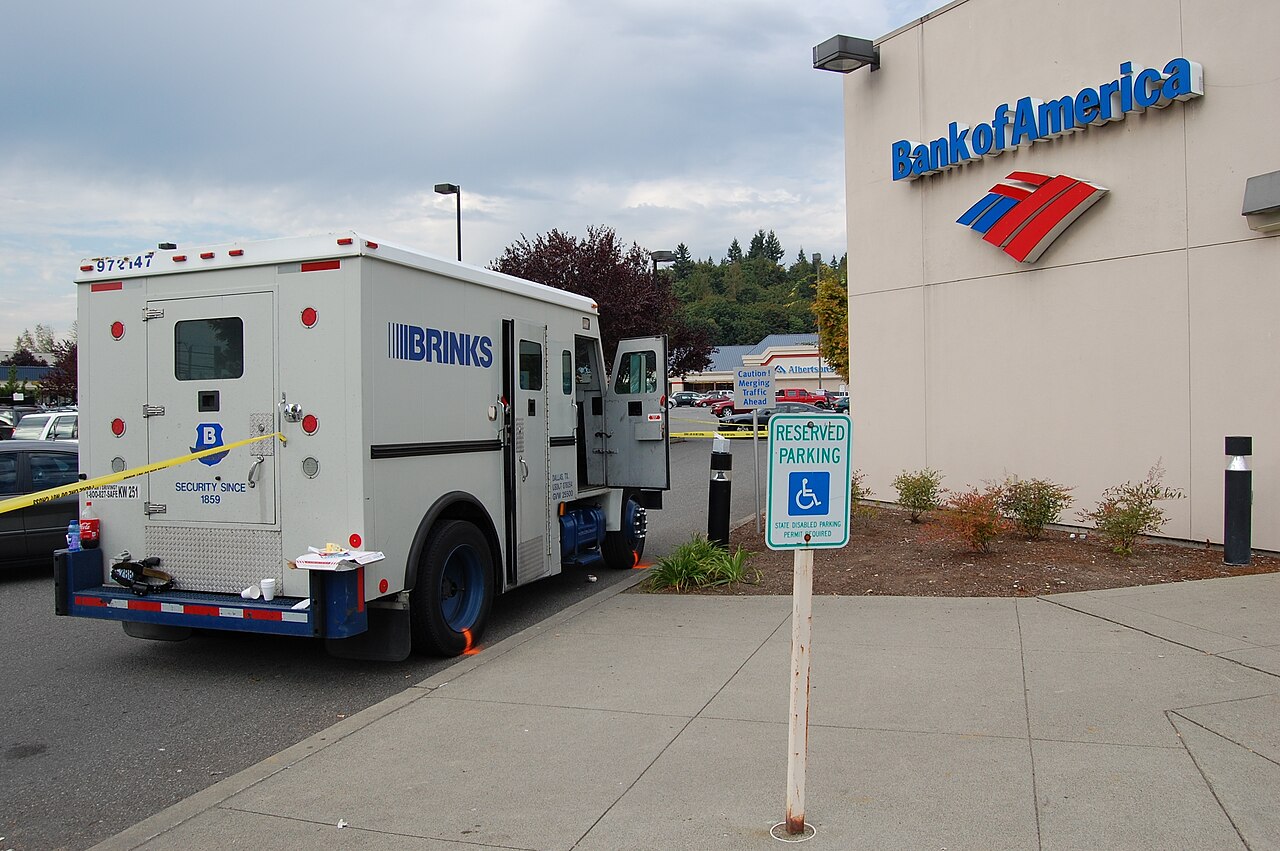
Brink's is priced like a company trying to escape the slow-decline story attached to cash. The new question after its NCR Atleos deal is narrower: can a route-based cash logistics network become a higher-recurring ATM and retail cash infrastructure platform before added debt and integration drag absorb the upside?[2][3]
That is the right frame for the stock and for the theme. Cash is not growing like cards or phones, but it has not disappeared into a straight-line decline either. The Federal Reserve's 2025 Diary of Consumer Payment Choice found that cash was still 14% of U.S. consumer payments by number in 2024, that consumers averaged seven cash payments per month, and that more than 90% of consumers intended to use cash in the future either as a payment method or store of value.[1] The investable point is not that cash wins. It is that enough cash remains to make density, outsourcing, and uptime matter.
Brink's is trying to turn that floor into a platform. In February 2026, the company agreed to acquire NCR Atleos in a cash-and-stock transaction valued at about $6.6 billion, including 13.3 million Brink's shares, $2.2 billion in cash, and assumption of about $2.6 billion of NCR Atleos debt.[3] The headline sounds like a cash logistics company buying an ATM company. The better read is a bet that banks and retailers will keep outsourcing pieces of the physical money stack: cash-in-transit, cash vaulting, ATM replenishment, ATM software, transaction processing, and retail cash automation.
The Mechanism
The old Brink's model is route density. A truck route, branch stop, vault, technician, and security process become more profitable when more customer volume rides on the same fixed operating skeleton. That is why the 2025 result matters. Brink's reported $5.261 billion of 2025 revenue, $977 million of adjusted EBITDA, $436 million of free cash flow, and net leverage of 2.7x adjusted EBITDA. Management also said fourth-quarter AMS/DRS organic growth reached 22%, while the 2026 framework called for mid-single-digit organic revenue growth and mid-to-high-teens AMS/DRS growth.[2]
NCR Atleos adds the other half of the mechanism: ATM estate management. Its first-quarter 2026 revenue rose 7% year over year to $1.04 billion, with 72% from recurring revenue streams. Self-Service Banking revenue grew about 12%, led by roughly 30% growth in ATM as a Service and 23% hardware growth. That is a different quality of revenue than moving a bag from point A to point B, even if the bag still has to be moved.[4]
The merger case depends on joining those two clocks. A bank that wants fewer owned branches may still need cash access. A retailer that wants less back-office cash handling may still need tills, safes, deposits, and cash availability. If Brink's can sell a bundled service that replaces fragmented vendors, the customer pitch becomes operational simplification rather than pure cash handling.
Scenario 1: The Base Case
The base case is that cash use keeps shrinking as a share of transactions but not enough to make the network uneconomic. The Fed data supports that middle outcome: cards and mobile payments keep gaining, remote purchases are more common, but cash has been stable at seven monthly payments since 2020 and remains a backup instrument for consumers who prefer other methods.[1]
In this branch, banks continue reducing branch infrastructure while preserving access obligations and customer convenience. Retailers keep accepting cash because excluding it can lose sales and create social or regulatory friction. Brink's uses NCR Atleos to increase managed ATM exposure, attach software and processing revenue to routes, and move the mix toward recurring services.
The proof is margin quality. Brink's already showed adjusted EBITDA margin of 18.6% in 2025, up 40 basis points, and guided to another 30-50 basis points of adjusted EBITDA margin expansion in 2026 before strategic transactions.[2] If the combined company can add NCR Atleos without breaking service levels, the operating model should look less like a volume-sensitive armored-car business and more like a financial infrastructure outsourcer with route economics under it.
Scenario 2: The Upside Case
The upside case is that ATM outsourcing becomes the growth product while cash logistics supplies the moat. NCR Atleos said its ATMaaS business grew around 30% in Q1 2026, with expansion in Europe and Latin America, and that network managed units were 77.7 thousand.[4] Brink's, meanwhile, says its operations serve customers in 51 countries and more than 100 countries through its network.[5] If those footprints can be cross-sold cleanly, the transaction can create a larger addressable market than either company had alone.
Loomis is the useful peer check. Its 2025 annual report says revenue exceeded SEK 30 billion, currency-adjusted growth was 6%, and EBITA margin reached a record 12.7%.[7] That does not make Loomis a perfect comparison, but it shows that cash logistics is not only a melting ice cube. Operators with density, automation, acquisitions, and specialized security services can still grow and improve margins.
Under this branch, Brink's captures the announced deal logic: more recurring revenue, broader service bundles, and meaningful cost synergies. The company said the transaction was expected to produce at least $200 million of annual run-rate cost synergies and at least 35% EPS accretion.[3] Those are aggressive enough to matter. They are also aggressive enough to be tested quarterly.
Scenario 3: The Downside Case
The downside case is not that cash vanishes overnight. It is that the company pays platform multiples for a network whose customer priorities fragment. Banks may outsource ATMs but push hard on price. Retailers may automate cash handling but negotiate away route savings. Regulators may slow the deal in countries where ATM access, cash handling, or financial-services infrastructure are sensitive.
That regulatory risk is already visible. The U.K. Competition and Markets Authority opened a Brink's / NCR Atleos merger inquiry page on May 20, 2026, with the case state listed as open and the invitation-to-comment window running from May 20 to June 4, 2026.[6] A review is not a rejection, but it means timing and remedies belong in the model.
The balance sheet is the second risk. Brink's amended and extended its credit facility in preparation for the transaction, increasing it from $2.225 billion to $3.85 billion, including a $1.025 billion delayed-draw term loan and a $600 million larger revolver. The facility matures on March 31, 2031, and the release explicitly notes closing remains subject to regulatory and shareholder approvals.[5] Debt is manageable if synergy and cash flow arrive on time. It becomes the equity problem if integration consumes management attention while cash volumes and ATM economics disappoint.
The Falsifier
The bullish reading is wrong if the combined company cannot keep leverage moving down while integrating NCR Atleos. The clean falsifier is this: by late 2027, adjusted EBITDA, free cash flow, and recurring revenue mix should be visibly higher, while net leverage should be moving back toward the stated target zone rather than staying elevated because synergies, customer retention, or regulatory approvals lag.[3][5][6]
The bearish reading is wrong if the company closes the deal without harsh remedies, protects service quality, keeps ATMaaS growth near the recent high-teens to 30% band, and shows that banks and retailers prefer one vendor for cash logistics, ATM operations, and retail cash automation. In that outcome, cash decline is not the key variable. Vendor consolidation is.
Watchlist
- Regulatory milestones: CMA and other approvals matter because timing, divestitures, or conduct remedies can change the synergy math.[6]
- ATMaaS growth: NCR Atleos' roughly 30% Q1 2026 ATMaaS growth is the high-quality revenue signal to track after closing.[4]
- Leverage path: the larger credit facility makes debt paydown a core scorecard, not a secondary finance detail.[5]
- AMS/DRS mix: Brink's mid-to-high-teens 2026 growth framework for AMS/DRS is the bridge between route density and platform economics.[2]
- Cash behavior floor: the Fed's cash-use data should keep showing a durable backup and store-of-value role; if that floor cracks, density assumptions weaken.[1]
The practical conclusion is that Brink's-NCR Atleos is not a simple pro-cash bet. It is a wager that the physical money system will become more outsourced as it becomes less central to everyday payments. That can be a good business if route density, software, and managed ATMs reinforce each other. It can also be a leveraged integration trap if customers treat the bundle as a procurement event rather than a platform.
Sources
- Federal Reserve Financial Services, "2025 Diary of Consumer Payment Choice" - U.S. cash-use shares, cash payment frequency, mobile-payment growth, and future cash-use intent.
- The Brink's Company SEC exhibit, "Brink's Announces Fourth-Quarter and Full-Year 2025 Results" (February 26, 2026) - 2025 revenue, adjusted EBITDA, free cash flow, leverage, AMS/DRS growth, and 2026 framework.
- The Brink's Company SEC exhibit, "Brink's to Acquire NCR Atleos for $6.6 Billion" (February 26, 2026) - transaction value, cash/stock mix, assumed debt, ATMaaS rationale, synergy targets, and EPS accretion claim.
- NCR Atleos, "NCR Atleos Corporation Reports Strong First Quarter 2026 Results with 7% Revenue Growth" - Q1 2026 revenue, recurring revenue share, Self-Service Banking growth, ATMaaS growth, network metrics, and tariff/vault cash margin comments.
- NCR Atleos SEC filing, "Brink's Announces Amendment and Extension of its Credit Agreement in Preparation for NCR Atleos Acquisition" (April 7, 2026) - facility size, delayed-draw term loan, revolver increase, maturity, pricing note, and closing conditions.
- Competition and Markets Authority, "The Brink's Company / NCR Atleos Corporation merger inquiry" - U.K. merger-review status, dates, and invitation-to-comment timetable.
- Loomis, "Annual Report 2025" - peer revenue growth, currency-adjusted growth, and EBITA margin benchmark.
- Wikimedia Commons, "File:18 Brinks truck.jpg" - FBI/Monroe Police Department photograph of a Brink's armored car in Monroe, Washington on September 30, 2008, used as the article image source.