Access-control suppliers are still often priced and discussed as if they were refined door-hardware companies. That is the floor, not the whole trade. The newer question is whether locks, readers, door operators, visitor systems, and credential software can turn an installed base of ordinary openings into a recurring upgrade cycle.
The mechanism is easy to miss because the product still sits on a wall or door. A building can keep the same doorway while changing the economic layer around it: mechanical key to card, card to mobile credential, standalone panel to cloud-managed access, access log to identity-governance feed, and door event to video or occupancy workflow. If that sequence keeps moving, the sector deserves more than a construction-cycle multiple. If it stalls, the stocks are still good industrials, but the electronics story has been overcapitalized.
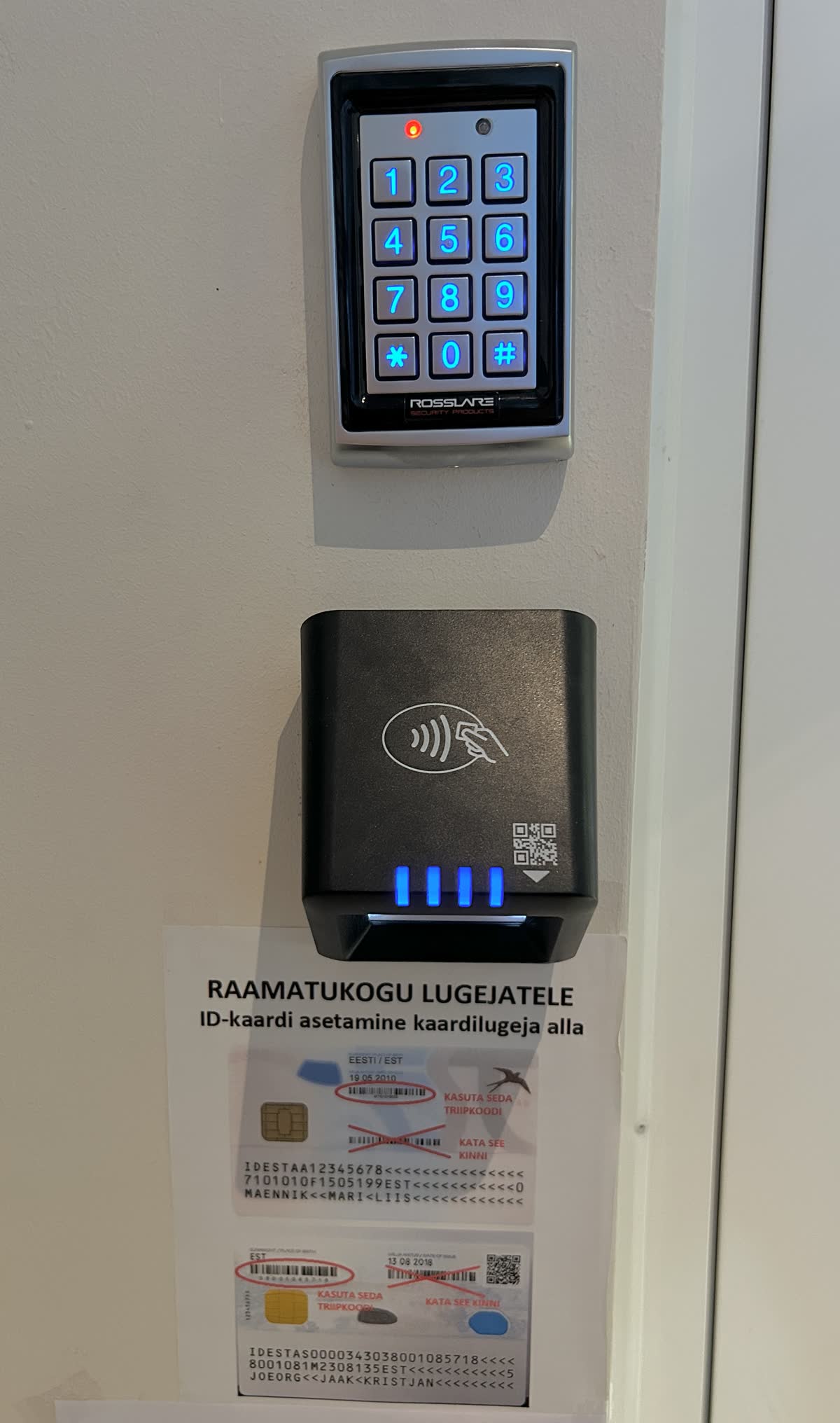
The priced layer
The priced view is that this is a resilient access-solutions market with good brands, code-driven replacement demand, and enough aftermarket to cushion weak construction. Allegion's Q1 2026 result showed $1.034 billion of revenue, up 9.7% reported and 2.6% organically, while management said growth was led by Americas non-residential and electronics businesses.[1] ASSA ABLOY's Q1 report tells the same defensive story at larger scale: net sales were SEK 35.751 billion, organic growth was 2%, and operating cash flow rose 30% year over year despite a large currency headwind.[2]
That is why the sector is not a simple housing call. Residential weakness matters, but schools, hospitals, offices, apartments, hotels, airports, logistics sites, labs, government facilities, and data centers all keep replacing and modernizing access systems on different clocks. ASSA ABLOY said its Americas organic growth reached 4%, driven by North America non-residential and Latin America, while North America residential declined under high rates and a challenging housing market.[2] The split is the point. The premium case depends on non-residential and aftermarket activity staying firm enough to offset softer new-home demand.
What is new
The new layer is credential modernization. HID's 2026 security and identity report says 73% of respondents identified identity management as a top priority, 84% of end users using mobile credentials still maintain physical credentials inside mobile deployments, and 75% of organizations have either deployed or are evaluating unified identity solutions.[4] Those numbers describe a transition that is real but incomplete. The market is not simply ripping out every card reader. It is running hybrid systems while trying to make physical access, digital identity, visitor management, and compliance speak to one another.
That hybrid period can be attractive for suppliers. It creates upgrade work without requiring a clean-slate building cycle. A university can add mobile credentials while keeping plastic cards for some users. A hospital can add biometric or real-time location layers while preserving badge workflows. A multifamily owner can move from mechanical keys toward a perimeter-to-unit mobile path one property at a time. Each step can pull hardware, software, integration, credential issuance, service, and support.
Dormakaba's half-year 2025/26 report shows the same pattern from another angle. Its Access Solutions segment generated CHF 1.161 billion of sales, 2.6% organic growth, and a 16.0% adjusted EBITDA margin. The company cited airports, healthcare, marine, data centers, UK border e-gates, hotel chains, and access-control modernization as active demand pockets.[3] That is not one end market. It is a portfolio of openings where security, labor, compliance, guest flow, and building operations are being reworked.
The mechanism
The attractive economics come from three connected loops.
First is the installed-base loop. Once a supplier's hardware, readers, panels, software, credentials, and service channel are embedded, replacement tends to be evolutionary rather than purely competitive. Door hardware has to satisfy safety codes, fire rules, durability expectations, accessibility requirements, and local installer familiarity. Electronic access adds cybersecurity, credential compatibility, administrator training, audit trails, and integration with video or building-management systems.
Second is the identity loop. A badge is no longer just a plastic token. It increasingly carries rules about who can enter, when they can enter, whether they need a second factor, how guests are sponsored, how contractors expire, and how events are logged. HID's report explicitly frames the market around converged physical and digital identity, with mobile credentials, biometrics, unified identity, and RFID all becoming part of the same decision surface.[4] That raises the switching cost, but it also raises implementation risk.
Third is the service loop. ASSA ABLOY says roughly two-thirds of sales are generated in the aftermarket, a structural cushion across cycles.[2] That matters because access control is not useful when it is merely installed. It has to keep working after tenant turnover, employee churn, phone upgrades, expired permissions, building renovations, emergency drills, and audit requests. The supplier that owns the service relationship can earn on maintenance, replacement, software modules, credential refresh, and adjacent doors.
Counterweight
The strongest counterweight is that "electronics" can sound cleaner than it is. Access control is still installed in physical buildings by people with schedules, budgets, local codes, and procurement constraints. A cloud dashboard does not remove the door closer, strike, reader wiring, fire inspection, battery, latch alignment, or union labor. It adds another layer on top.
That is why margin proof matters. Allegion's Q1 adjusted operating margin fell to 21.2%, down 150 basis points, even while revenue grew.[1] That does not break the thesis, but it is a useful warning. Mix, acquisitions, input costs, tariff exposure, project timing, and investment can absorb the apparent quality of the electronics story if suppliers do not price and execute well.
Johnson Controls' 2026 access-control launch language also points to the other risk: customers want open, scalable, integrated access and video systems, faster implementation, and stronger connectivity across security functions.[5] That is the right product direction, but it is also a competitive invitation. Software-led integration can pull value toward platforms, integrators, cloud providers, and security-management vendors rather than letting every dollar stay with the lock and reader manufacturer.
Falsifier
The thesis breaks if credential modernization fails to convert into profitable pull-through. A clean falsifier would be this pattern: electronics and mobile-access language keeps expanding in investor decks, but organic growth stays around low-single digits, margins compress, aftermarket attachment weakens, and customers delay projects because integration is too expensive or too complex.
In that branch, access-control companies would still own durable hardware franchises. They would not deserve a bigger multiple for a software upgrade cycle that mostly benefits someone else.
Watchlist
- Allegion Americas electronics: the Q1 2026 lead from Americas non-residential and electronics needs to repeat without further margin leakage.[1]
- ASSA ABLOY aftermarket mix: the two-thirds aftermarket claim is the stabilizer; watch whether it continues to offset residential and currency pressure.[2]
- Dormakaba vertical wins: airports, healthcare, data centers, hospitality, and border-control projects are useful only if they keep Access Solutions margins near or above the current 16.0% level.[3]
- Hybrid credential and integrator capture: HID's 84% physical-plus-mobile credential finding is the reality check; migration is gradual, integrated access/video work is rising, and suppliers still need to prove enough economics stay with the manufacturer rather than the installer.[4][5]
The practical conclusion is narrow. Access control deserves to be read as more than door hardware, but less than frictionless software. The best suppliers are turning doors into managed identity endpoints while still respecting the physical world that makes the business hard to displace. The next leg is not "more buildings." It is more credentials, more integrations, more aftermarket, and more proof that the upgrade cycle improves margins rather than merely modernizing the brochure.
Sources
- Allegion, "Results Center: Results for First-Quarter 2026" - Q1 revenue growth, organic growth, regional growth, margin, EPS, 2026 outlook, and management commentary on Americas non-residential and electronics.
- ASSA ABLOY, "Quarterly Report Q1 2026" (April 28, 2026) - net sales, organic growth, division commentary, operating cash flow, Americas/non-residential strength, Global Technologies/HID growth, and aftermarket resilience.
- dormakaba, "Half-year Report 2025/26: Access Solutions" - segment sales, organic growth, adjusted EBITDA margin, vertical demand, access-control modernization, e-gates, data centers, and acquisitions.
- WIOT Group, "HID's 2026 Security & Identity Report on Trust & Protection" (2026) - accessible summary of HID's 2026 survey figures on identity-management priorities, mobile credentials, biometrics, RTLS, unified identity, and RFID.
- Johnson Controls, "Johnson Controls introduces next-generation enterprise & commercial access control & video solutions at ISC West 2026" (March 24, 2026) - product direction for integrated access control, video, open platforms, implementation speed, and commercial security ecosystems.
- Kärdla Linnaraamatukogu, "Kärdla raamatukogu läheb üle kahekordsele autentimisele" (homepage notice, 2026) - source page for the photographed keypad and contactless reader used as the article image.