Hong Kong’s dollar peg anchors the exchange rate, but treating local funding as a simple copy of US dollar funding misses the adjustment happening inside the banks. The liquidity round trip of 2025 shows why a stable currency can accompany a substantial repricing of short-term money.[1][3]
The distinction matters whenever a falling Hong Kong interbank rate is read as an independent easing decision, or a rising one as evidence that the peg is failing. Under the Linked Exchange Rate System, changing the price of local money helps keep the exchange-rate promise. My reading is that intervention and rate volatility must be assessed together before either becomes a verdict on credibility.
Mechanism and sources checked October 12, 2026. The numerical episode below concerns May–August 2025; it is not a report of current intervention.
The exchange transaction changes the clearing balance
The Hong Kong Monetary Authority provides banks with convertibility undertakings at HK$7.75 and HK$7.85 per US dollar. At the strong side, it supplies Hong Kong dollars against US dollars. At the weak side, it buys Hong Kong dollars and supplies US dollars. The monetary base is backed by US dollar assets, with changes matched under the currency-board rules.[1]
The immediate transmission runs through the Aggregate Balance: the sum of banks’ clearing-account balances held with the HKMA. This is the settlement money banks keep at the authority. It is one component of the monetary base, alongside the backing for bank-issued notes, government currency, and Exchange Fund Bills and Notes.[2]
A bank deposit held by a household belongs to a different layer of the system. So does the Exchange Fund’s portfolio of reserve assets. A decline in the Aggregate Balance cannot, on its own, establish that household deposits have disappeared or that the authority is running out of foreign reserves. The definition tells us which balance sheet entry is moving; it also tells us which conclusions that entry cannot support.[2]
When a strong-side transaction settles, banks receive additional Hong Kong dollar clearing balances. Easier availability tends to lower interbank borrowing rates. Weak-side transactions remove those balances and tend to lift rates. The resulting change in the relative attraction of holding Hong Kong dollars helps counter the original currency pressure.[1]
The 2025 round trip
The HKMA’s September 2025 stability report records a particularly clear sequence. Equity-related demand and appreciation elsewhere in Asian currencies helped push the Hong Kong dollar to the strong side in early May. The authority sold HK$129.4 billion, adding local liquidity. The Aggregate Balance reached HK$174.1 billion on May 8.[3]
Hong Kong Interbank Offered Rates, or HIBORs, then softened. Wider negative interest-rate spreads against the US dollar encouraged carry trades: selling the lower-yielding currency to hold the higher-yielding one. Those flows helped move the Hong Kong dollar toward the weak side.[3]
Between late June and mid-August, the authority bought HK$119.9 billion under the weak-side undertaking. By the end of August, the Aggregate Balance had fallen to HK$54.1 billion. Short-term HIBORs picked up as settlement liquidity contracted.[3]
That chronology changes the interpretation of the intervention headline. The authority’s purchases and sales formed opposite legs of an adjustment process. Reading only the later drain would omit the earlier addition of liquidity and the incentives it created.
Linked rates can still differ
A narrow exchange-rate band leaves room for expectations about movement within it. HKMA researchers’ 2018 study explains why the interest-rate differential interacts with that expected movement: an investor weighs both the interest earned and the exchange rate at which the position may eventually be converted. The study examines a target zone, rather than assuming an exchange rate that never moves at all.[4]
Consequently, a lower Hong Kong dollar interest rate does not by itself establish a costless trade. A position exposed to currency movement has a different payoff from one with its future conversion rate hedged. Funding tenor matters as well. Comparing an overnight rate with a term rate can manufacture an apparent discrepancy before any currency analysis begins. These are implications of the framework, not a claim that every observed spread is explained by the peg alone.[4]
Local payment demands supply another part of the explanation. In its July 2, 2026 meeting record, the Currency Board Sub-Committee described occasional overnight HIBOR increases associated with month-end and capital-market funding needs. The convertibility undertakings had not been triggered during the April 23–June 22 review period. Rates could move while the Aggregate Balance remained broadly stable.[5]
That observation is an important counterweight to a mechanical reading of the 2025 episode. Aggregate supply matters, but demand for settlement money changes too. A particular balance does not dictate a unique interest rate.
Stability has a domestic price
The strongest objection to celebrating this mechanism is that successful exchange-rate defence can still impose uncomfortable financing conditions. The HKMA’s own explanation acknowledges that the system leaves little room for an autonomous interest-rate policy and shifts more economic adjustment into domestic prices and costs.[6]
That is a real tradeoff. A functioning peg can coexist with expensive money, weak demand, or pressure on borrowers. Conversely, abundant local liquidity can depress short-term rates without signalling that policymakers have chosen a separate growth target. Neither observation should be stretched into a claim about the health of every bank or borrower.
The interpretation here has a clear falsifier: a documented failure to honour the standing convertibility undertaking for an eligible bank transaction would invalidate the claim that the episode was simply adjustment within the existing rules. A rate spike or a currency trading at the edge of its band would not meet that test by itself.[1]
What to watch at the next turn
- When the next convertibility transaction settles: match its direction and value date to the published Aggregate Balance change. The daily monetary statistics provide the place to distinguish settlement effects from a headline about trading activity.[7]
- At the next month-end funding period: compare HIBOR movements across matching tenors and check whether convertibility operations occurred. A temporary rise without an operation would make local funding demand an essential part of the explanation.[5]
- At the next Currency Board Sub-Committee release: read the account of market functioning alongside the funding numbers. Evidence about actual access to conversion is more decisive for the exchange-rate promise than the size of an interest-rate move alone.[5][6]
Sources
- Hong Kong Monetary Authority, “How Does the LERS Work?” — convertibility undertakings, reserve backing, and interest-rate adjustment; revised October 22, 2025.
- Hong Kong Monetary Authority, “Components of the Monetary Base” — definition of the Aggregate Balance and the other monetary-base components.
- Hong Kong Monetary Authority, Half-Yearly Monetary and Financial Stability Report, September 2025, pages 20–22 — May liquidity expansion, subsequent weak-side operations, and interbank-rate adjustment.
- HKMA Research Department, “Linked Exchange Rate System Operations — Mechanism and Theory,” Research Memorandum 11/2018 — target-zone expectations and interest-rate differentials.
- Hong Kong Monetary Authority, Currency Board Sub-Committee meeting record for July 2, 2026, released August 7 — local funding demand and operations during April 23–June 22.
- Hong Kong Monetary Authority, FAQs, Linked Exchange Rate System questions B2–B6 — currency-board discipline, operations within the band, and limits on independent monetary policy.
- Hong Kong Monetary Authority, “Daily Monetary Statistics” — ongoing publication of interbank liquidity and monetary-base data.
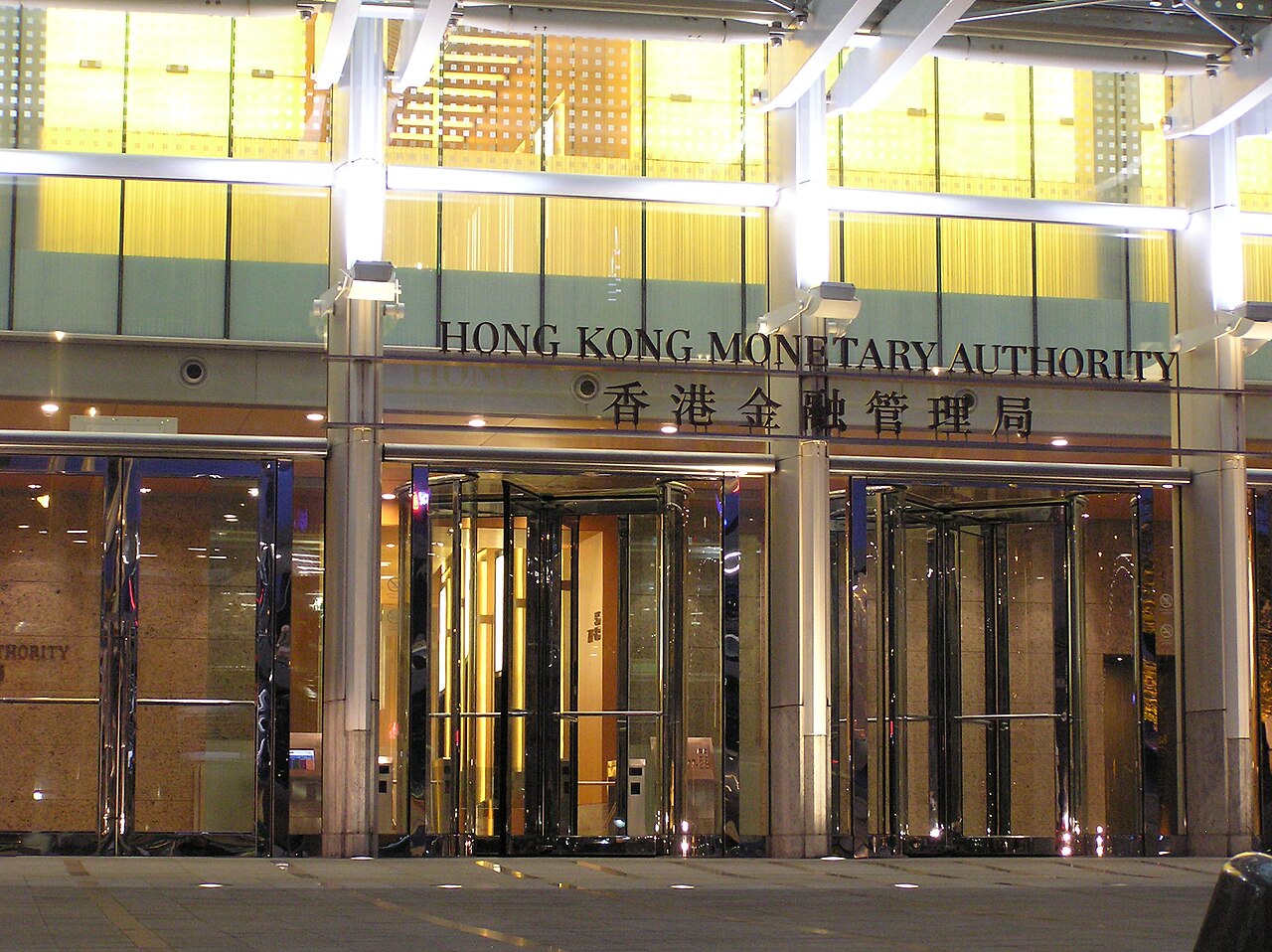
- Alan Mak, “Hong Kong Monetary Authority,” May 2009, Wikimedia Commons — photograph of the headquarters; CC BY-SA 3.0, with license and attribution details.