The priced story in U.S. housing finance is the mortgage lock-in: many owners still carry low fixed first-lien debt and do not want to refinance the whole house at current rates. The new wrinkle is that home equity lines of credit are becoming the cleaner way to extract cash from that frozen balance sheet, but the trade is a variable-rate collateral valve, not a cheap-debt reset.
That distinction matters because HELOC growth can look benign from a distance. The loan is secured by a house, balances are still small beside mortgage debt, and homeowners generally have more collateral protection than unsecured borrowers. But the mechanism is different from a 2020-era cash-out refi. A HELOC lets the owner keep the old first mortgage while adding a second, usually floating-rate claim on the property. The household avoids repricing the entire mortgage stack, while the bank gets collateral, a credit line, and rate exposure that can adjust faster than a fixed mortgage.
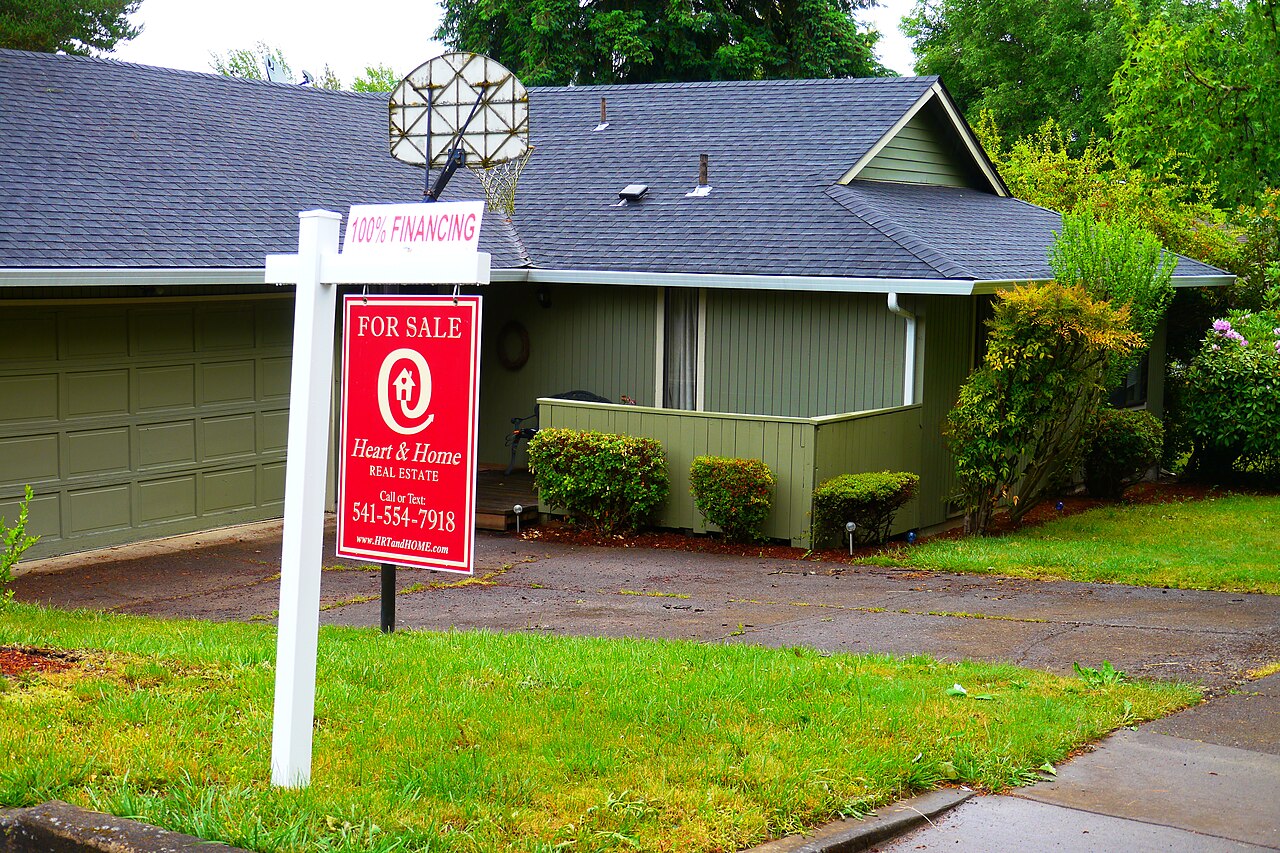
Cover image context: the photograph shows a house-for-sale sign and a "100% financing" banner in Eugene, Oregon. It is not a HELOC advertisement, but it is the right visual register for this post: household leverage is sold at the curb, while the real risk sits in the contract attached to the property.[7]
The mechanism
The clean HELOC case starts with a homeowner who has equity, a stable income, and a specific use for borrowed funds. The homeowner does not want to disturb a low-rate first mortgage, so a line of credit against equity becomes the marginal debt instrument. If the funds are used for home improvement, the tax treatment may also be cleaner: IRS Publication 936 says home-equity loan and line-of-credit interest is deductible only when the borrowed funds are used to buy, build, or substantially improve the home securing the loan, subject to the broader mortgage-interest rules.[6]
The weak case is different. The homeowner uses the house to refinance ordinary consumption, tuition, medical bills, business cash burn, or credit-card balances. That may still be rational if it prevents a worse liquidity event, but it is no longer cheap money simply because the collateral is a house. It is a variable-rate second lien whose payment can rise, whose draw period can create false comfort, and whose collateral can become less forgiving if local home prices soften.
The New York Fed's first-quarter household-debt report shows why the channel is worth watching now. HELOC balances rose by $12 billion in Q1 2026 to $446 billion, marking the 16th consecutive quarterly increase. HELOC limits also rose by $14 billion, or 1.4%, continuing an expansion that began in 2022.[1][2] That is not a crisis number. It is a flow number. The banking system is reopening an equity-tapping channel while the first-lien mortgage market remains rate-constrained.
Numbers that constrain the view
The first anchor is the balance: $446 billion of HELOC debt is meaningful, but it is still small next to the mortgage stock. That keeps the immediate systemic reading modest. The better market read is behavioral: after years of elevated home prices and locked-in mortgages, owners are using second-lien credit as the pressure-release valve.[1]
The second anchor is the rate. FRED's Bankrate Monitor series put the national average HELOC rate at 7.45% for the week of May 27, 2026.[3] That is lower than many credit-card rates, but it is not low in household cash-flow terms. At that level, a borrower using a HELOC for discretionary consumption is not harvesting free equity. They are swapping unsecured spread risk for secured collateral risk.
The third anchor is the prime-rate base. FRED's weekly bank prime loan rate stood at 6.75% on May 27, 2026.[4] Many HELOCs price off prime plus or minus a margin, so the instrument can reprice with short-rate conditions faster than a fixed mortgage. That helps lenders protect net interest margin, but it means borrowers do not own the same payment certainty they get from a fixed first lien.
The fourth anchor is the first-lien alternative. Freddie Mac's PMMS archive put the 30-year fixed mortgage average at 6.53% on May 28, 2026.[5] A homeowner with a much lower existing mortgage rate has little reason to refinance the whole balance just to access cash. The HELOC wins because it leaves the old mortgage untouched, not because the new borrowing is especially cheap.
The fifth anchor is collateral depth. The Fed's Z.1 household balance sheet shows household real estate values remained very large through 2025, even after quarterly softness.[8] That equity cushion is the reason HELOC credit can expand without immediately resembling unsecured consumer stress. It is also the reason investors should avoid reading HELOC growth as pure demand strength. Strong collateral can invite borrowing before cash-flow stress is visible.
Strongest counterweight
The bullish counterargument is simple: HELOCs are a healthier way to borrow than credit cards. The line is secured, underwriting can see income and property value, and the borrower may be funding repairs that preserve or improve the house. If the owner has a low first-lien mortgage, then adding a smaller second lien can be more efficient than detonating the entire capital structure with a cash-out refi.
There is also a macro-stabilizer argument. In a high-rate housing market, households cannot easily move, refinance, or monetize equity through sale without resetting shelter costs. A HELOC can keep the household from selling into a bad personal timing window. For banks, secured consumer credit may also look more attractive than unsecured card growth or marginal auto lending when delinquencies are uneven across products.
That counterweight is real. It is why rising HELOC balances are not automatically a household-credit alarm. The problem is that the same structure can hide stress. A draw can cover a cash-flow gap for several quarters. A variable rate can keep the lender whole while the borrower absorbs the payment squeeze. A collateral cushion can make credit available precisely when a household should be shrinking risk.
Falsifier
The HELOC-risk thesis is wrong if balances keep rising while utilization remains modest, serious-delinquency flows stay contained, home-price weakness remains local rather than broad, and borrowers mainly use proceeds for value-preserving home improvements. Under that path, the HELOC revival is just a sensible workaround for mortgage lock-in: households preserve old first-lien rates and banks extend secured credit against real equity.[1][2][6]
The thesis starts to break the other way if HELOC draws accelerate while credit-card and auto stress also worsens, or if house-price declines move from a few overheated metros into the national collateral base. The key is sequencing. HELOCs are dangerous late in the cycle when they become a bridge from unsecured stress into secured household leverage. They are less dangerous when they fund repairs, remodels, or liquidity buffers for borrowers with conservative loan-to-value ratios.
Watchlist
Watch the next two New York Fed household-debt releases for the split between HELOC balances, limits, and serious-delinquency flow. Limit growth alone says lenders are offering capacity; balance growth says borrowers are using it; delinquency flow says whether the line is becoming strain rather than flexibility.[1][2]
Watch prime and HELOC rates together. If prime stays sticky while HELOC averages rise further, the household carry cost deteriorates even without a new shock to home prices.[3][4]
Watch Freddie Mac's 30-year mortgage rate. A sustained move lower would reopen the cash-out-refi comparison and reduce the relative appeal of second-lien borrowing. A stuck mortgage rate keeps the HELOC channel alive because it protects the old first mortgage from repricing.[5]
Watch tax use and purpose. Borrowers using HELOC proceeds for home improvement may have a better economic and tax case than borrowers using the house to term out everyday consumption. The IRS boundary is not the investment thesis, but it is a useful discipline: if the proceeds do not improve the collateral or the household balance sheet, the line deserves a higher hurdle.[6]
Takeaway
HELOC growth is not the return of easy housing credit. It is the market's answer to a locked first-lien mortgage system: keep the old fixed mortgage, borrow at the margin, and let collateral do the work. That can be rational for disciplined homeowners, but investors should treat the signal as a cash-flow and underwriting test. The question is not whether Americans still have home equity. It is whether the new second-lien borrowing is improving the house, bridging temporary liquidity, or quietly moving unsecured stress onto the roof.
Sources
- Federal Reserve Bank of New York, "Household Debt Balances Rise Slightly as Delinquency Transition Rates Hold Steady" (May 12, 2026) - Q1 2026 household-debt press release and category table.
- Federal Reserve Bank of New York, Quarterly Report on Household Debt and Credit: 2026 Q1 - full report on HELOC balances, limits, originations, and delinquency flows.
- Federal Reserve Bank of St. Louis FRED, "Bankrate Monitor (BRM): Home Equity Line of Credit (HELOC) Rate" - weekly national HELOC-rate series.
- Federal Reserve Bank of St. Louis FRED, "Bank Prime Loan Rate" - weekly prime-rate series from the Federal Reserve Board H.15 release.
- Freddie Mac, "Mortgage Market Survey Archive" - weekly 2026 PMMS 30-year and 15-year fixed mortgage rates.
- Internal Revenue Service, Publication 936 (2025), Home Mortgage Interest Deduction - home-equity interest deductibility boundary.
- Wikimedia Commons, "File:Heart & Home Real Estate For Sale Sign.jpg" - source page for Rick Obst's photograph of a real-estate sign in Eugene, Oregon.
- Federal Reserve Board, Financial Accounts of the United States - Z.1, table B.1 (2025:Q4 release) - household real-estate asset and net-wealth context.