Equipment rental is already priced as a resilient way to own construction activity without owning a contractor's backlog. The new spread is narrower: whether the big rental fleets can keep specialty mix, utilization, and resale discipline strong while industry growth slows from the post-pandemic rebuild into a more normal construction cycle.
That distinction matters because the macro backdrop is not weak enough to make the bear case easy. Census estimated March 2026 U.S. construction spending at a seasonally adjusted annual rate of $2.185 trillion, up 0.6% from February and 1.6% from March 2025; private construction alone ran at $1.659 trillion.[4] There is still work to serve. But the rental industry's own forecast no longer looks like a broad acceleration story: the American Rental Association's August 2025 forecast put 2025 U.S. construction and general tool rental revenue growth at 3.9% to $80.9 billion, followed by 2.9% growth in 2026.[2]
The Mechanism
The equipment-rental model converts construction and industrial activity into a fleet-yield problem. A rental company buys aerial work platforms, earthmoving machines, pumps, power units, trench-safety gear, temporary climate equipment, and smaller tools. It then tries to earn enough through rental rates, time utilization, delivery fees, specialty services, and resale value to cover depreciation, maintenance, labor, branch density, interest, and fleet replacement.
That makes rental different from owning a contractor. The contractor takes project execution risk. The rental company takes fleet-allocation risk. If demand is broad, a machine can move from one job to another and keep earning. If demand narrows, the fleet owner has to choose between cutting price, moving equipment farther, selling used fleet, or accepting lower utilization.
United Rentals' first quarter shows why the model still deserves a premium. The company reported $3.985 billion of total revenue and $3.419 billion of rental revenue in Q1 2026, with rental revenue up 8.7% year over year.[1] Average original equipment at cost rose 5.7%, while fleet productivity rose 2.3%.[1] That is the clean version of the thesis: more fleet, better productivity, and enough demand to absorb both.
But the detail is less one-note. General rentals revenue rose 6.2% and gross margin improved to 33.8%, while specialty rentals revenue rose a stronger 13.8% to $1.190 billion but specialty gross margin fell 170 basis points to 41.4% because of higher depreciation, delivery costs, and mix.[1] Specialty is the growth engine, but it is not a free margin upgrade if the incremental dollar comes with more complex logistics or lower-margin ancillary revenue.
What Is Actually New
The market already understands the "rent instead of own" argument. Contractors and industrial customers rent because it preserves capital, shifts maintenance burden, improves access to specialized gear, and avoids owning machines that may sit idle after a project ends. The new question is whether rental companies can keep expanding fleet without turning every growth dollar into a depreciation bill.
United Rentals raised its 2026 outlook after Q1 to $16.9 billion to $17.4 billion of revenue and $7.625 billion to $7.875 billion of adjusted EBITDA.[1] It also expects net rental capital expenditures of $2.95 billion to $3.35 billion after gross purchases of $4.4 billion to $4.8 billion.[1] Those numbers are not small. This is a capital-cycle business with high EBITDA margins, but cash conversion depends on how much fleet has to be bought before the next rental dollar arrives.
Herc's Q1 points in the same direction, with a different balance-sheet tone. Herc reported $981 million of equipment rental revenue, up 33%, but its 10-Q says the increase reflected a larger average fleet after the H&E acquisition; on a pro forma basis that includes standalone pre-acquisition H&E results, equipment rental revenue decreased 3% year over year in part because of moderation in some local markets.[3] Sales of rental equipment rose 31%, while the margin on those sales fell to 21% from 28% because of the fair-value markup on acquired fleet that was sold.[3] The industry is still growing, but it is doing so by deploying capital into fleet, integrating acquisitions, and managing residual values, not by riding a frictionless demand surge.
This is why specialty mix matters. Specialty categories can deepen customer relationships and make a rental branch more than a yard full of commoditized lifts. Power, HVAC, trench safety, fluid solutions, and tool services often require technical knowledge, faster response, and better job-site planning. That can support pricing and account stickiness. The offset is that specialty can bring more delivery complexity, safety requirements, parts needs, and depreciation if the fleet is expanding ahead of demand.
The Numbers That Constrain The View
The first anchor is the construction base: $2.185 trillion of annualized U.S. construction spending in March 2026.[4] That says the demand pool is still large.
The second anchor is the industry forecast: ARA's latest cited projection of 2.9% rental-revenue growth in 2026 after 3.9% in 2025.[2] That says the broad market is not accelerating fast enough to rescue sloppy fleet deployment.
The third anchor is United Rentals' Q1 fleet math: 5.7% average OEC growth and 2.3% fleet productivity growth.[1] That says better returns require more than simply buying more machines.
The fourth anchor is United Rentals' specialty mix: 13.8% specialty rental-revenue growth, paired with a 170-basis-point specialty gross-margin decline.[1] That is the whole debate in miniature.
The fifth anchor is the used-equipment channel. United Rentals generated $350 million of used-equipment sale proceeds in Q1 at a 45.7% GAAP gross margin and 47.4% adjusted gross margin.[1] Residual values are not a footnote. They are the release valve when a rental company needs to refresh the fleet or right-size categories.
The Counterweight
The strongest bearish counterweight is that rental growth can look healthy right before utilization weakens. A fleet owner sees customer demand, buys machines, opens or consolidates branches, and then discovers that the next phase of construction is less equipment-intensive, more delayed, or more price-sensitive than expected. Because depreciation and interest do not wait for the job site to speed up, a small utilization miss can turn into a margin story.
There is also a rate-cycle risk. If financing costs stay elevated, customers have more reason to rent rather than own, which helps demand. But the rental company also pays to finance a large fleet and must keep rolling equipment through the used market. A weaker used-equipment market would hurt cash conversion twice: lower disposal proceeds and a higher effective cost of keeping the fleet young.
The bullish response is scale. United Rentals ended Q1 with 1,658 North American rental locations and a fleet with $22.59 billion of original cost.[1] Scale improves procurement, branch density, national-account coverage, fleet transfers, digital reservation, and the ability to serve large projects without depending on one local market. Herc's post-H&E scale story points in the same direction: more locations, denser metro coverage, and a broader specialty footprint can matter when customers want one supplier instead of a patchwork of local yards.[3]
Scale, however, is not the same as immunity. It only pays if the fleet is in the right categories, priced correctly, and sold before residual values turn. That is why the right equity question is not "Will construction keep growing?" It is "Can the rental company turn construction work into fleet productivity after capex, delivery cost, depreciation, and used-equipment exits?"
Falsifier
The constructive view is wrong if fleet growth keeps outrunning fleet productivity while specialty margins keep falling. The clean falsifier would be a 2026 pattern in which United Rentals-style OEC growth remains above demand growth, specialty revenue keeps expanding, but gross margins fail to recover and used-equipment margins weaken at the same time.[1][2]
That combination would mean the industry is buying its way into growth rather than earning better fleet yield. In that case, high EBITDA margins would still look optically attractive, but free cash flow and return on invested capital would deserve a lower multiple.
Watchlist
- United Rentals Q2 and Q3 2026 fleet productivity: the busy season should show whether the Q1 productivity gain was durable or just early-year mix.
- Specialty rental gross margin: growth without margin repair would make specialty less of a premium lane and more of a capital-consumption lane.[1]
- Used-equipment sale margins: a break in residual values would pressure cash conversion and reveal whether replacement-cost inflation has been friend or risk.[1]
- Census construction spending releases through summer 2026: public and private nonresidential spending will show whether the site base is broadening or narrowing.[4]
The takeaway is narrow. Equipment rental is not a simple bullish bet on construction headlines. It is a test of fleet discipline inside a slower-growth industry. The spread belongs to operators that can deploy capital into specialty categories, hold utilization, recover delivery and labor costs, and exit used equipment at prices that keep the replacement cycle funded.
Sources
- United Rentals, "United Rentals Announces Strong First Quarter Results and Raises Full-Year 2026 Guidance" (April 22, 2026) - Q1 revenue, fleet productivity, segment margins, capex outlook, locations, fleet OEC, and used-equipment sale metrics.
- International Rental News / American Rental Association, "ARA projects softer rental growth in US and Canada" (August 11, 2025) - ARA rental revenue growth forecast and segment revenue context.
- Herc Holdings, Form 10-Q for the quarter ended March 31, 2026 - equipment rental revenue, H&E acquisition context, pro forma revenue comparison, and rental-equipment sale margin.
- U.S. Census Bureau, "Monthly Construction Spending, March 2026" (May 7, 2026) - total, private, residential, nonresidential, and public construction spending estimates.
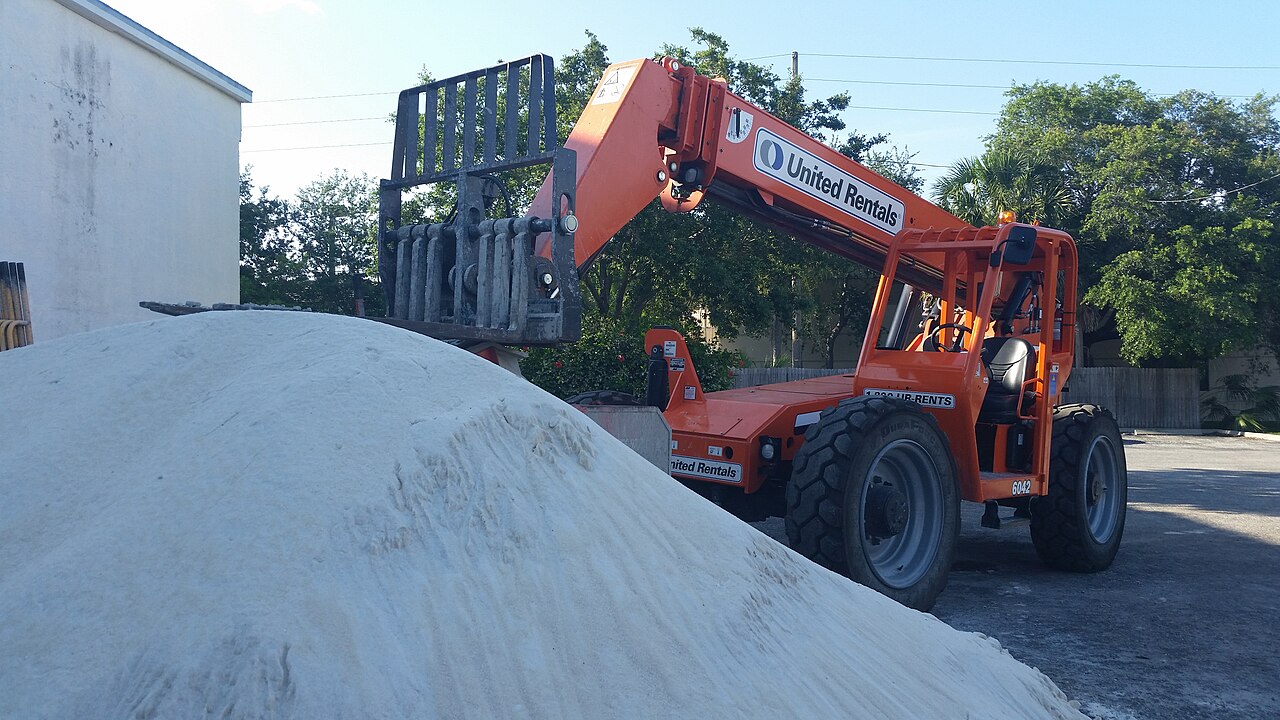
- Wikimedia Commons, "File:United Rentals 6042 (18234541932).jpg" - source page for the 2015 United Rentals equipment photograph used as the article image.