A higher grain price can still produce a worse sale once storage and financing costs are paid. A warehouse receipt makes the waiting possible by turning stored crops into collateral; the economic payoff depends on the price improvement left after the bills.[1][6]
That distinction starts at the elevator door. Delivering a harvest for storage need not mean selling it. The producer can retain an interest in the crop's eventual selling value while a lender takes security through its receipt. The Nebraska Bankers Association explicitly describes lending both to grain companies and to farmers who obtain receipts for crops placed in local elevators.[1]
The receipt gives the lender something it can control
The federal framework is a useful place to follow the transaction. Licensing under the United States Warehouse Act is voluntary: operators apply to USDA and agree to its standards. State systems also exist, so the federal rules below should not be read as the terms of every American grain-storage arrangement.[2]
Under those rules, a warehouse cannot issue a receipt for a crop that has not actually arrived. A licensed inspector and weigher must ascertain its quality, condition and weight before issuance. Receipts may cover either separately identified grain or a commingled lot; financing does not require a labeled pile of kernels reserved for each depositor.[3]
The receipt therefore connects a financial claim to an obligation to deliver a described commodity. Crucially, grain covered by a negotiable receipt cannot be delivered until that receipt is surrendered and canceled. Proper presentation and payment or tender of the relevant advances and charges are part of obtaining delivery.[3]
The economic implication is straightforward. A lender accepting the receipt as collateral has a means of controlling release of the grain without moving it into a bank-owned silo. The loan still requires the appropriate security arrangements; possessing a photocopy is not a substitute for establishing the bank's rights.[1]
Electronic possession is more than an emailed document
An electronic warehouse receipt carries the same rights and obligations as its paper counterpart under the federal rule. Only one current holder can be designated, and only that holder may transfer the receipt to a new holder. Authorized agents can act on a holder's behalf, but their authority must be documented.[4]
This is why the record inside the provider's system matters more than an attachment in someone's inbox. The warehouse may cancel an electronic receipt only when it is the holder. USDA's grain-and-rice licensing agreement also prohibits shipping grain represented by an electronic receipt until the receipt is canceled in the provider's system.[4][5]
Follow the practical sequence: grain enters storage; a receipt identifies the obligation; a financing arrangement puts control of that receipt with the lender; repayment and release arrangements eventually permit the receipt to return for cancellation. The crop can remain physically still while the relevant financial rights change hands. That is the financing service being supplied, not a forecast of the harvest's future price.
Nor does the electronic record relieve the warehouse of keeping grain available. USDA's agreement requires operators to maintain sufficient stocks of the appropriate kind, class, quantity and quality to meet storage obligations.[5] A clean chain of transfers and a sound stock of grain answer different questions. Both matter.
The higher bid has to pay for the interval
Consider a deliberately simplified comparison, expressed per bushel. A producer can sell now for $4.00, or hold the same marketable quantity and later sell for $4.20. Over the intervening period, commercial storage costs $0.12 and the total cost of keeping capital tied up in the crop is $0.10.
The later sale leaves $3.98 after those incremental carrying costs. Its headline price is higher, but its economic result is lower than the immediate-sale alternative. These are hypothetical inputs, not current grain bids, storage tariffs or loan quotations. Production costs are common to both choices and excluded; the result compares marketing alternatives rather than calculating farm profit.
The capital-cost allowance includes financing or opportunity cost as appropriate, counted once. Loan principal is not another storage expense to deduct: borrowing supplied cash earlier, and repayment returns that advance. Treating the entire principal repayment as a new cost would confuse the financing cash flows with the cost of waiting.
Iowa State's storage-cost framework explains why this comparison needs more than an elevator's posted fee. Selling can free money to repay borrowing or earn a return elsewhere. Additional drying, shrinkage, handling and quality deterioration can also affect the result.[6] The example assumes those extra effects are absent. If they occur, the later sale must clear a higher hurdle.
Waiting can still be worth buying
The strongest counterweight is the value of flexibility. Storage can allow a producer to seek a seasonal price improvement or a stronger local bid relative to futures, the relationship known as basis. Iowa State treats selective use of storage as a marketing tool, rather than assuming that holding grain always improves returns.[6]
A receipt-backed loan can make that choice feasible when bills fall due before the desired sale. Its usefulness need not depend on a dramatic price rally. A better local buyer, more favorable delivery timing or a sufficiently cheap period of storage may make the interval worthwhile. Those are possible benefits to establish for the actual transaction, not returns embedded in the receipt.
The case for financing a wait is invalidated if achievable sale proceeds, after all incremental carrying costs and quantity or quality losses, do not exceed the immediate-sale alternative. An expected price increase alone does not pass that test. Neither does successful issuance of the receipt.
The next evidence arrives at three concrete events:
- At receipt issuance and loan funding: reconcile the commodity description with inspection and weight records, and confirm who controls the receipt and its release.[1][3][4]
- At the next storage invoice and interest charge: update the cost of waiting using the actual tariff and funding cost, including any extra handling or conditioning charges.[5][6]
- Before accepting the sale and authorizing load-out: compare the net result with the original immediate-sale alternative, then coordinate repayment, receipt cancellation and delivery. A better bid is useful only if the grain and its paperwork can complete the transaction.[3][5]
Sources
- Nebraska Bankers Association, "Secured Transaction," section VII, "Security Interests in Negotiable Warehouse Receipts" — farmer and grain-company financing and the arrangements for pledging receipts.
- USDA Agricultural Marketing Service, "United States Warehouse Act" — voluntary federal licensing and program scope.
- 7 CFR § 869.300, "Warehouse receipt requirements," via Cornell Legal Information Institute — actual storage, inspection, negotiability and delivery conditions.
- 7 CFR § 869.303, "Electronic warehouse receipts," via Cornell Legal Information Institute — holder designation, transfer, agency authorization and cancellation.
- USDA Agricultural Marketing Service, WA-402, Licensing Agreement for Grain and Rice Warehouse Operators, October 24, 2023, sections E and F — storage obligations, receipt contents and release controls.
- Iowa State University Extension and Outreach, "Cost of Storing Grain," Ag Decision Maker A2-33, updated May 2023 — commercial storage, capital costs, physical losses and selective storage.
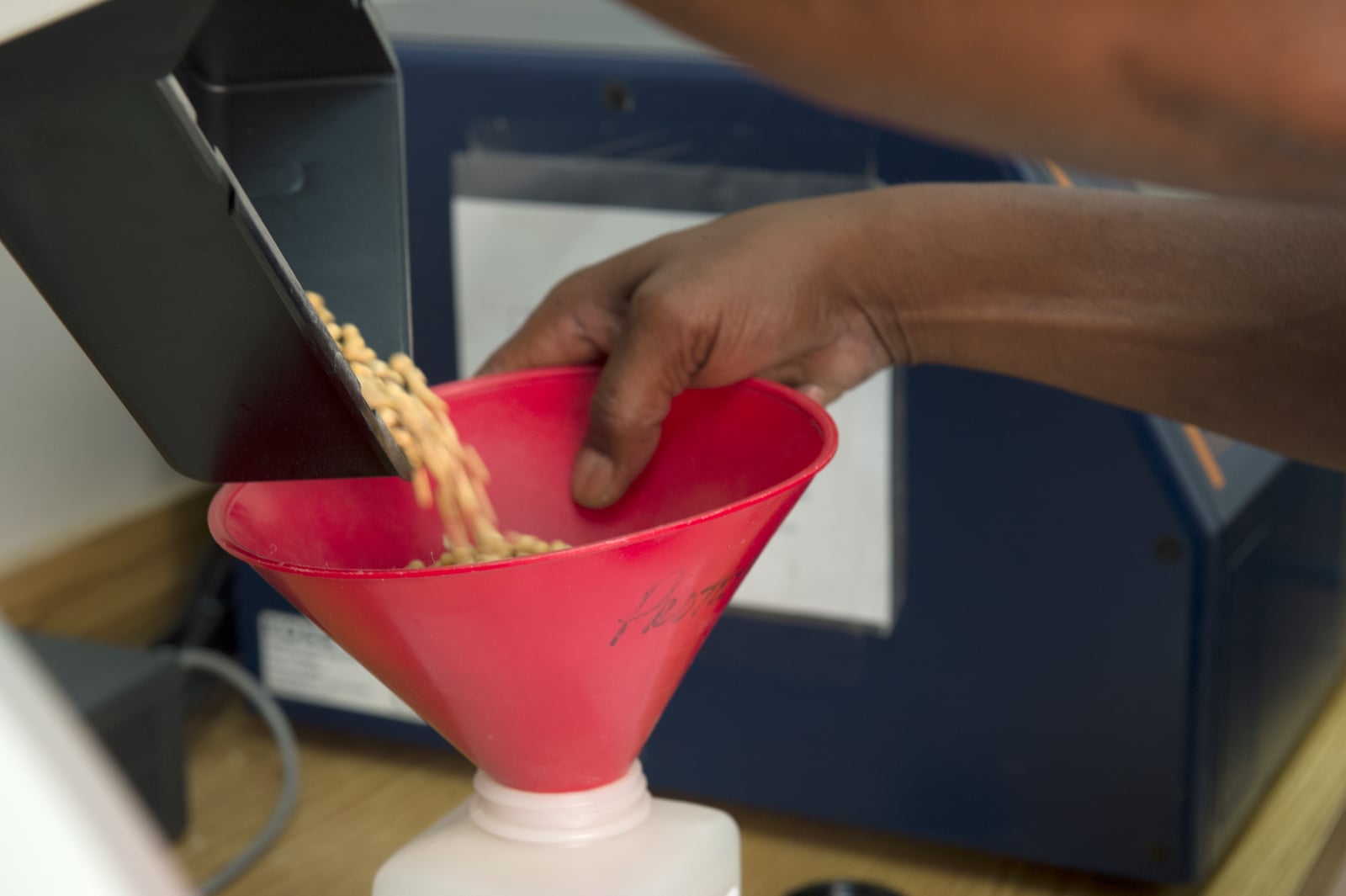
- USDA / Anson Eaglin, soybean testing at the Federal Grain Inspection Service laboratory, New Orleans, November 18, 2013, photograph 20131118-OC-RAE-0014, via Wikimedia Commons — image and provenance.