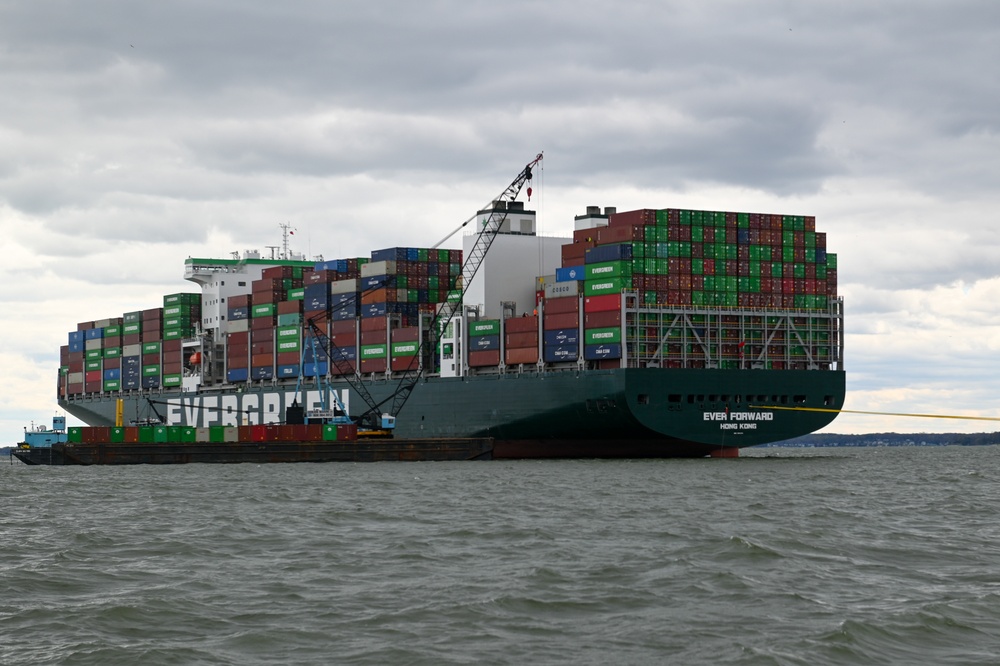
Treating cargo insurance as cover only for crushed or missing goods understates what the premium buys: it can also provide the guarantee needed to collect a shipment that survives intact. General average can turn a successful rescue into a cash demand on the importer before the final bill is known.[3][5]
That changes the economics of going uninsured. A business might be able to absorb its eventual share of a maritime loss yet struggle to immobilize cash while the amount is being established. The relevant question is how much funding must remain available alongside the inventory already at sea.
Sources checked on 16 October 2026. All monetary amounts below are illustrative assumptions or calculations, not a quotation, forecast or reported casualty adjustment.
How the rescue reaches the cargo owner
General average shares qualifying sacrifices and expenditure made for the common safety of a maritime venture. Under the York-Antwerp Rules, the action must be extraordinary, intentional and reasonable, directed at preserving property from danger. A grounding can create the occasion; the emergency measures taken to save the ship and cargo create the potential shared claim.[1]
An average adjuster establishes allowable costs and each interest's contribution. The ship participates alongside the cargo; the bill is apportioned by relevant property values rather than divided equally among containers. The applicable contract matters because the rules acquire contractual force through carriage terms.[2]
For a cargo owner, this creates an unusual exposure: successful preservation of its goods can leave it with a contribution to pay. Chubb's cargo guidance expressly warns that release can require a bond or cash deposit even when the goods themselves suffered no damage.[3]
A final bill and an earlier demand
Imagine an importer whose undamaged cargo has a final contributory value of $1 million. The total adjusted contributory value of the venture, including this cargo and the ship, is $100 million. Assume the adjuster establishes $10 million of allowable general-average expenditure.
The importer's contribution is $100,000: its cargo value divided by the total contributory value, multiplied by the allowed expenditure. These are already-adjusted values, with no sacrifice credit due to this importer and no additional interest or charges. Real valuations require adjustments under the rules; an invoice alone is not the entire calculation.[1]
Now move back to the moment when delivery becomes possible. The final accounting is unfinished, and the notice requires the uninsured importer to lodge $150,000 as cash security, alongside the requested undertaking. That amount is an assumption about this particular notice, not a standard industry deposit.
The larger deposit provides security against an uncertain eventual liability. Once the assumed contribution is settled from it, $50,000 comes back, ignoring interest and fees. CMI's guidance explains that a cash deposit can leave a refundable balance after the adjustment is completed.[2]
The cash forecast therefore needs a funding outflow followed by a partial return. Adding the full deposit to the final contribution would double-count the portion used to settle the bill. Budgeting only for the contribution makes the opposite mistake: it overlooks the extra cash unavailable in the meantime.
For a distributor, that temporary difference may finance the next purchase order. Inventory can be economically worth rescuing while the cash needed to collect it interrupts the replenishment cycle.
What an insurer's signature buys
The insured version of the same shipment changes the funding sequence. CMI's brief guidance describes the usual process: the cargo owner supplies the required bond and invoice, while the insurer provides a general-average guarantee. The notice controls the particulars, and some cases do not require a separate bond.[5]
Assume the policy covers the contribution in full, the insurer's guarantee is accepted, and no cash collateral is required from the importer. The importer then avoids the illustrative deposit. The eventual contribution still exists, but the insurer handles the covered obligation; the business can preserve cash for another use.
This is the strongest counterweight to a frightening headline about stranded cargo. An established insurance arrangement can make the security demand manageable. Chubb also emphasizes the insurer's operational role in expediting release, and the importance of adequate terms, valuation and limits when relying on someone else's cover.[3]
The economic benefit has two parts: transferring a covered loss and supplying acceptable security while that loss is quantified. Comparing a premium only with the expected cost of damaged goods leaves the second service out of the calculation.
The boundaries that still matter
An insurer's guarantee does not restore a missed selling season. Institute Cargo Clauses (A), in their January 2009 wording, cover general-average and salvage charges subject to exclusions. Their delay exclusion remains, with an express exception for expenses payable under the general-average clause. A covered rescue contribution therefore does not establish cover for lost sales caused by late arrival.[4]
Nor does general average settle every question about responsibility. Rule D preserves remedies and defences concerning fault. Providing security on the CMI standard terms does not itself concede that the claimed contribution is legally payable.[1][2]
A separate salvage-security demand can also arise. CMI cautions that satisfying the general-average requirements may leave that additional requirement outstanding.[5] The example assumes it does not arise; otherwise the funding calculation needs another line.
The liquidity argument fails if arranging the guarantee ties up as much of the importer's cash or borrowing capacity as the deposit would. A policy certificate alone cannot establish relief. Confirmation of accepted security and its collateral conditions can.
Three events determine whether the financial exposure is contained:
- When the security notice arrives: establish the documents and security actually required, including any separate salvage demand. An early estimate of the eventual contribution is insufficient for a release forecast.[5]
- When the insurer responds and release is authorized: confirm coverage, acceptance of the guarantee and any collateral requirement. Then test the delivery date against customer commitments; basic cargo cover leaves the delay question open.[3][4]
- When the adjustment and settlement arrive: reconcile the legally payable contribution with security already lodged, and track any deposit refund. Cash remains committed until it is actually returned.[2]
Sources
- Comité Maritime International, York-Antwerp Rules 2016, current published English text — Rules A, D and XVII on qualifying acts, fault and contributory values.
- Comité Maritime International, Guidelines Relating to General Average, second edition, October 2022 — apportionment, contractual effect, security, retained defences and deposit refunds.
- Chubb, “Ocean Cargo Frequently Asked Questions” — undamaged cargo, release security, insurance services and coverage adequacy.
- Lloyd's, Institute Cargo Clauses (A), CL382, 1 January 2009 — clause 2 on general average and salvage, and clause 4.5 on delay.
- Comité Maritime International, Brief Guidelines Relating to General Average, October 2022 — security notices, bonds, insurer guarantees, cash deposits and separate salvage security.
- Kimberly Reaves, U.S. Coast Guard, “Container removal operations for Ever Forward,” 10 April 2022, DVIDS image 7136994 — photograph and original caption.