A cashless-Europe investment thesis can correctly anticipate more card payments and still misread demand for banknotes. The ECB’s latest annual report records a growing banknote stock, while its consumer survey shows cash losing share at physical checkouts: the missing link is what people hold between purchases.[1][2]
As of September 26, 2026. Payment shares below refer to the 2024 consumer study; the annual circulation figures describe the end of 2025.
A payment is a flow. A banknote is a holding.
In the ECB’s SPACE survey, cash accounted for 52% of euro-area point-of-sale transactions in 2024, down from 59% in 2022. This is a share of the number of payments at physical locations, not of all household spending or financial wealth. The study records payment behaviour through diaries; it does not follow every banknote between owners.[1]
Meanwhile, the nominal value of euro banknotes outstanding reached €1,619.5 billion at the end of 2025, up 2.0% over the year. These are different measurements over different periods, not competing estimates of the same activity.[2]
Consider an illustrative household that switches its supermarket purchases to a card but keeps an emergency envelope untouched. Its contribution to cash payment volume falls; its precautionary cash holding does not. If it adds to the envelope after a disruption, payment use and holdings can move in opposite directions. Nothing in that sequence requires the household to become richer or to spend more.
“Circulation” is particularly easy to misread. The ECB’s banknote statistics count notes issued by national central banks minus notes returned to them. They do not establish whether an outstanding note is moving through shops, sitting in a safe or being held abroad. Nor are all currency series interchangeable: the monetary statistics measure that excludes banks’ vault cash differs from the banknote circulation measure.[3]
The practical consequence is straightforward. A rising outstanding stock is evidence of net demand for physical currency. It is insufficient evidence of stronger retail sales, faster turnover or growing revenue for a cash-services company.
The money the checkout cannot see
ECB research separates euro banknote demand into domestic transactions, domestic storage and holdings abroad. In a study published in 2021, the return-frequency method put the central estimate of the share used for domestic transactions at about 20% of circulation value in 2019. That is a historical, model-based estimate, not a measured share for today.[4]
The method exploits a physical clue: notes used repeatedly in everyday trade tend to find their way back to central banks more often than notes kept aside. Researchers also examine seasonal movements and the replacement of old banknote series. None of these methods identifies each holder or motive. Their estimates depend on assumptions about how different denominations move.[4]
Foreign holdings add another blind spot. Euro notes can leave through tourism and remittances as well as formal bank shipments. Someone outside the currency union may want euros as a store of value even while a resident of the euro area increasingly pays by phone. A domestic payment diary cannot capture that demand.[4]
My reading is that the two trends can coexist for a long time. Digital payments compete directly for purchases; they need not replace every reason for holding physical money.
A blackout exposes the timing problem
The Iberian blackout on April 28, 2025 made the distinction concrete. The ECB’s subsequent analysis found that withdrawals fell in affected areas as ATMs went offline, then rose sharply when service returned. Withdrawals also increased in unaffected Spanish territories, consistent with precautionary demand. There was no comparable significant spike in wholesale central-bank flows.[5]
That last detail matters. A local surge in households’ desire for cash can initially be met from bank inventories rather than fresh central-bank issuance. Conversely, a fall in ATM withdrawals during an outage can reflect blocked access rather than a sudden preference for digital money.[5]
The inference is about timing: cash already held can perform a job that the promise of a later withdrawal cannot. Its usefulness during a disruption and its frequency of use on an ordinary shopping day are separate questions.
A durable stock does not guarantee a profitable network
The strongest counterweight is the cost of holding cash. A banknote earns no interest. As returns on alternative liquid assets rise, holders have more reason to economise on physical balances. The ECB’s 2025 annual report describes circulation levelling out during the period of rising rates before nominal growth recovered. A record euro amount also needs to be read against prices and the size of the economy.[2]
There is a separate commercial constraint. A stored note does not automatically generate another ATM withdrawal, collection visit or sorting fee. My inference is that investors evaluating cash logistics must distinguish the quantity of currency outstanding from the paid activity needed to maintain it. Contracts, service coverage and handling volumes determine how much of the system’s continuing usefulness becomes revenue.
The ECB’s cash-policy discussion stresses the continuing need for bank services and ATM networks, including the ability to deposit cash. Retailers need a route back into their accounts as well as customers needing a route out. Preserving that network is an operational task, even when many notes spend long periods idle.[6]
My working thesis is that storage and contingency demand provide a durable support for physical currency. A falsifier would be a sustained fall in banknote holdings relative to nominal GDP, alongside falling precautionary holdings in comparable surveys, while interest rates are stable or declining. That combination would undermine the inference that non-payment uses are offsetting the loss of checkout activity. One weak monthly issuance figure would not establish it.
What would change the reading
- At the October 2026 banknote-data update: compare circulation with the same month a year earlier and inspect the denomination mix. The ECB’s monthly series is not seasonally adjusted; a month-to-month fall alone can mislead.[3]
- When the next comparable SPACE results appear: read reported cash reserves and access alongside checkout shares. Falling payment use with resilient reserves would support the distinction; falling reserves would weaken the durability thesis.[1]
- At the next results release of a cash-services operator under review: check handling volumes, network costs and contract repricing. A growing aggregate banknote stock cannot substitute for evidence that customers are paying enough to sustain the service.
Sources
- European Central Bank, Study on the payment attitudes of consumers in the euro area 2024 — payment shares, diary methodology, access and cash reserves.
- European Central Bank, Annual Report 2025, section 6.1, published May 4, 2026 — year-end banknote value, annual growth and the interest-rate context.
- European Central Bank, “Banknotes and coins circulation” — statistical definitions, treatment of vault cash, seasonal-adjustment status and monthly release cadence.
- Alejandro Zamora-Pérez, “The paradox of banknotes: Understanding the demand for cash beyond transactional use,” ECB Economic Bulletin, Issue 2/2021 — historical estimates, indirect methods and foreign-demand channels.
- Francesca Faella and Alejandro Zamora-Pérez, “Keep calm and carry cash: lessons on the unique role of physical currency across four crises,” ECB Economic Bulletin, Issue 6/2025, section 2.3 — ATM withdrawals and wholesale issuance around the Iberian blackout.
- Piero Cipollone, “Making euro cash fit for the future,” ECB Blog, August 4, 2025 — the infrastructure needed for cash access, acceptance and circulation.
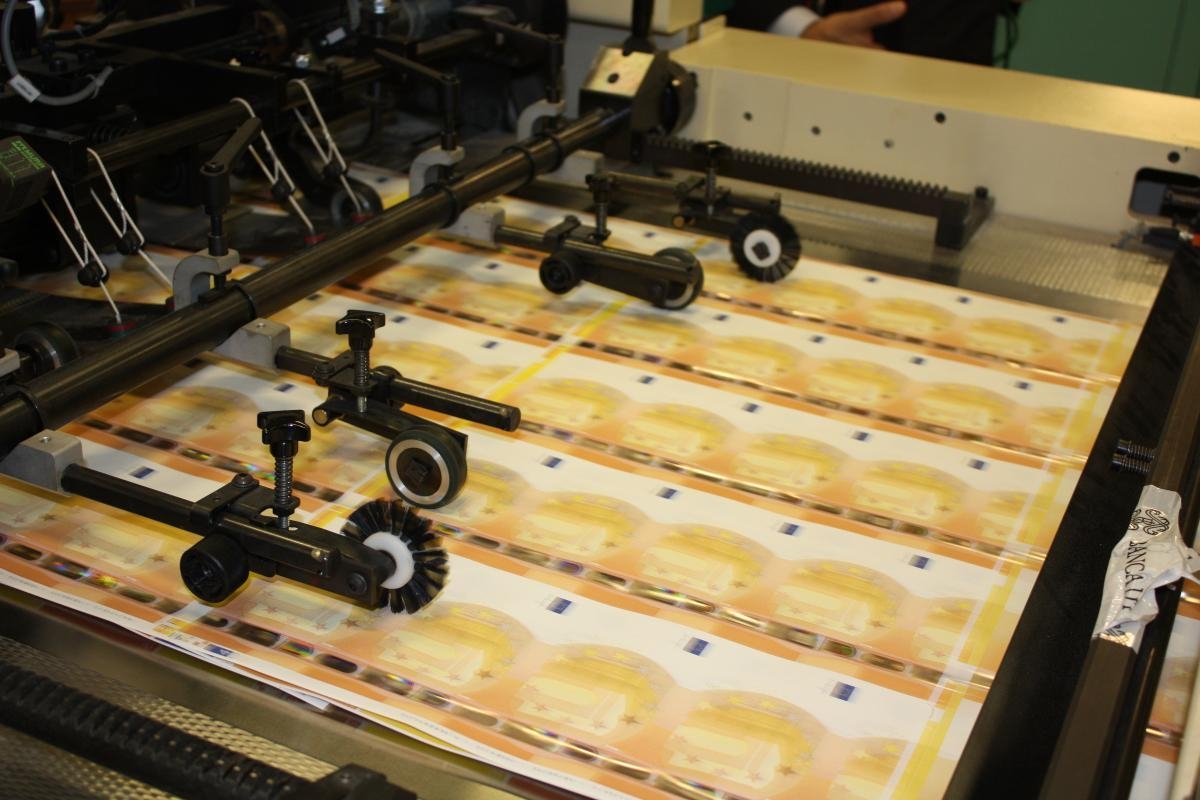
- European Commission Audiovisual Service, “Euro – European Central Bank,” collection P-038925, January 15, 2016 — source of the banknote-production photograph.