Priced: copper above $13,800 a tonne looks like a market declaring global shortage. New: the strongest evidence is narrower and more urgent—buyers in China are paying up for cathode that can reach them now, even while the latest global accounting still shows a refined surplus.[1][2][3]
That distinction is the trade. As of 09:15 UTC on July 21, three-month copper on the London Metal Exchange was up 1.7% at $13,851 a tonne, its strongest level since June 15. The rally has physical confirmation, but it is confirmation of tightness by location and delivery window, not proof that the world has run out of copper.[1]
Six Numbers Define the Tape
The first number is the price: $13,851 on the LME three-month contract.[1] The second is the 435-yuan-a-tonne premium that buyers were paying over Shanghai Futures Exchange prices in the spot market, up from zero a week earlier and the highest since May 2025.[1]
The third is the warehouse draw. Copper stocks monitored by SHFE had fallen 82% from early May. The fourth is the shape of the London curve: the LME cash contract had moved to an $8 premium over three-month copper after trading at a $66 discount on July 10.[1] That $74 swing matters more than the outright price alone. A cash premium says nearby metal has become more valuable than later metal; holders are being paid to release units now rather than carry them forward.
The fifth number is China's June import volume. Refined-copper imports reached 281,307 tonnes, a nine-month high, as domestic output weakened during smelter maintenance and concentrate scarcity. The Yangshan import premium reached $100 a tonne on July 17, another sign that bringing metal into China had become commercially attractive.[2]
Then comes the counterweight: the International Copper Study Group estimated an apparent global refined surplus of 221,000 tonnes for January through May. Even after adjusting for estimated changes in Chinese bonded stocks, the surplus was about 189,000 tonnes.[3] A market can have a surplus on a calendar-year balance sheet and still experience a violent prompt squeeze if the available metal is in the wrong warehouse, registered against the wrong exchange, or slow to clear the route to the buyer.
The Mechanism Is a Location Trade
The causal chain begins inside China. Smelter maintenance and limited concentrate availability reduce domestic cathode output. Fabricators and traders keep drawing from visible Shanghai stocks. Spot premiums rise because immediately deliverable plates are scarce. A higher import premium then opens the door for foreign cathode, pulling units toward China and tightening the pool available elsewhere.[1][2]
That last step reaches London through the forward curve. The LME contract is physically settled, so a cash premium is not merely a mood indicator. It raises the reward for delivering registered metal into the nearby window. Falling LME inventories and a cash-to-three-month flip therefore corroborate the Shanghai signal: the marginal unit has become harder to source promptly.[1]
But “harder to source promptly” is not the same claim as “structurally unavailable.” ICSG's preliminary May bulletin estimated that global refined production rose 3% in the first five months of 2026, while refined usage rose 2.2%. Secondary production from scrap increased 5.5%, helping supply outrun reported use. At the end of June, combined LME, COMEX, and SHFE stocks were 43% above their December level and the highest since May 2003.[3]
The inventory map explains the apparent contradiction. ICSG recorded end-June stock growth at the LME and COMEX but a decline at SHFE.[3] By mid-July, the Shanghai draw had accelerated.[1] The global pile was large; the Chinese pile that mattered to nearby buyers was shrinking. Copper is pricing the cost and uncertainty of moving that pile, not only the total tonnage printed in a global balance.
Why the Surplus Does Not Kill the Rally
Annual balance estimates deliberately smooth over frictions that set the daily price. ICSG notes that its Chinese apparent-use calculation excludes changes in several unreported stock pools, including state, producer, consumer, merchant, and bonded inventories.[3] Those pools can release metal, absorb it, or obscure where it is available. A 221,000-tonne apparent surplus is therefore a strong counterweight, but it is not a promise that a Shanghai buyer can call for cathode tomorrow at yesterday's premium.
The June import jump supports that reading. China's second-quarter refined imports rose 42% from the first quarter, yet first-half imports were still 14.3% lower than a year earlier.[2] The sequence looks less like a broad, uninterrupted consumption boom than a recent scramble to repair a local supply gap. That is bullish for the prompt spread. It is less conclusive for the long end of the copper curve.
There is also a macro floor beneath the physical signal. China's official manufacturing PMI returned to expansion at 50.3 in June, with production and new orders above the 50 threshold, although raw-material inventories remained below it.[4] That combination is consistent with factories using inputs faster than they are rebuilding stocks. It does not prove copper demand by itself, but it makes the Shanghai draw harder to dismiss as warehouse bookkeeping alone.
Counterweight: High Prices Recruit Supply
The strongest bear case is not that the physical signals are false. It is that they are already doing their job. A richer Yangshan premium attracts imports. Backwardation coaxes metal out of storage. A high outright price improves scrap collection and substitution economics. Maintenance ends. Each response can refill the prompt market before structural mine scarcity becomes the dominant price setter.
ICSG's production mix shows that relief channel already operating: secondary refined output grew faster than primary output in the first five months.[3] If more scrap and imported cathode reach Chinese fabricators while end demand merely holds steady, the spot premium can collapse well before the global mine pipeline changes.
The bull counterweight is timing. Cargoes, warrants, customs clearance, financing, and brand acceptance do not move at the speed of a futures quote. If Shanghai stocks keep falling while the import premium remains positive, a statistically comfortable global balance can stay commercially uncomfortable for longer than a short seller can tolerate.
Falsifier
The thesis is that copper's breakout has real physical backing, but that the backing is a Shanghai-centered delivery squeeze rather than a demonstrated worldwide deficit. It fails if the next SHFE reports show inventories stabilizing or rising, the Shanghai spot and Yangshan premiums retreat toward zero, and the LME cash contract returns to a discount—yet copper holds above the breakout on improving global consumption data. That result would say the rally had broadened beyond the location mechanism described here.
The bullish part fails more simply if those physical indicators reverse and the outright price falls with them. In that case, July's move was the price cure for a temporary inventory mismatch, not the opening phase of a durable scarcity repricing.
Watchlist
First, read the July 24 SHFE weekly inventory report against the July 17 draw.[6] Another material decline, paired with a positive Shanghai spot premium, would confirm that buyers are still consuming deliverable stock faster than imports and domestic output can replace it. A rebuild would show that the arbitrage response is arriving.
Second, watch China's official July manufacturing PMI on July 31 at 09:30 Beijing time. The June baseline was 50.3, with production and new orders expanding but raw-material inventories contracting.[4][5] The useful signal is not the headline alone: new orders need to stay firm while input inventories remain tight. If orders weaken and inventories recover, the physical squeeze will have lost its demand-side support.
The copper tape is not saying “ignore the surplus.” It is saying that surplus metal has an address. Until enough of it reaches the buyers bidding in Shanghai, location is the scarcity—and the spot premium, not the grand narrative, is the cleanest proof.
Sources
- Reuters via TradingView, “Copper touches one-month high on Chinese shortages and Iran peace hopes” (July 21, 2026) — LME and SHFE prices, Shanghai spot premium, exchange-stock draw, and cash-to-three-month spread.
- Reuters via TradingView, “China June refined copper imports hit nine-month high as domestic supply falls” (July 20, 2026) — import volume, Yangshan premium, smelter maintenance, and quarterly and first-half comparisons.
- International Copper Study Group, “Copper: Preliminary Data for May 2026” (July 21, 2026) — mine, refined-production, usage, balance, bonded-stock adjustment, price, and exchange-inventory data.
- National Bureau of Statistics of China, “Purchasing Managers' Index for June 2026” (July 1, 2026) — headline PMI and production, orders, raw-material inventory, employment, and delivery-time sub-index direction.
- National Bureau of Statistics of China, “Regular Press Release Calendar of NBS in 2026” — scheduled July 31 release time for the July manufacturing PMI.
- Shanghai Futures Exchange, “Market” — official access point for the exchange's weekly inventory reports.
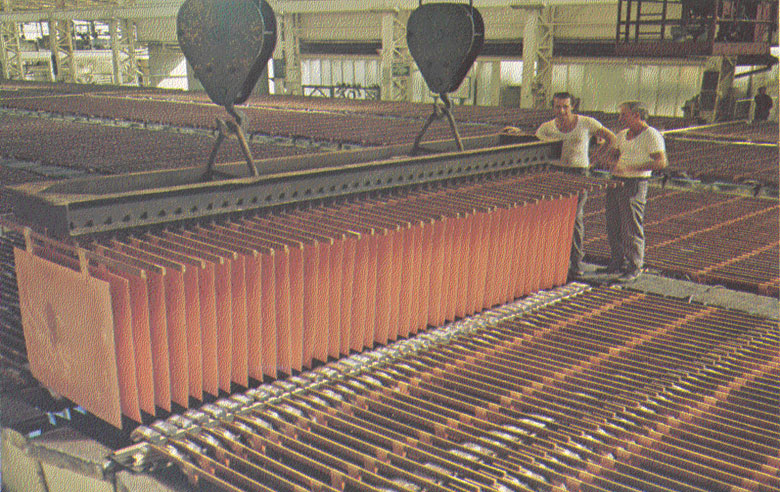
- Wikimedia Commons, Xstrata Technology, “Rack of copper cathode starter sheets” — source page and provenance for the archival refinery photograph used as the article image.