Chipotle still trades on a familiar long-run idea. Priced is the notion that it can keep adding restaurants, keep pushing Chipotlanes into the new-box mix, and keep using digital and operational discipline to grow into a much larger global chain.[1][3][5] New in the first quarter of 2026 is narrower and more interesting: transactions finally turned positive again, but that traffic improvement still did not translate into margin repair. Revenue rose 7.4% to $3.1 billion and comparable restaurant sales rose 0.5% because transactions increased 0.6%, yet operating margin fell to 12.9% from 16.7% a year earlier.[1]
That is why this quarter matters. Chipotle did enough to show that the brand can still bring people back through the line. It did not yet prove that better traffic is strong enough to outrun beef inflation, freight, wage pressure, and lower average restaurant sales volumes.[1][3][4]
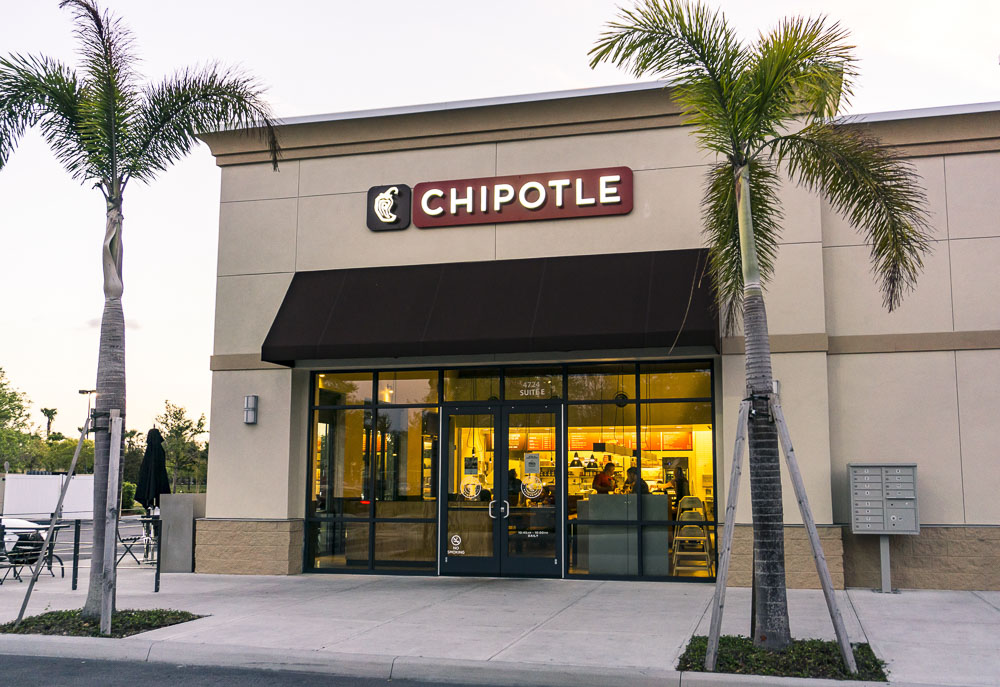
Image context: the cover uses a real Wikimedia Commons photograph of a Chipotle restaurant exterior.[6] That choice fits the argument because this quarter is less about abstract platform narrative than about the physical store: how many guests walk in, how fast the line moves, how expensive labor and ingredients feel inside the four walls, and whether a new unit can still throw off attractive returns.
Why positive transactions mattered so much
The cleanest bull signal in Q1 was simply that transactions moved back above zero. Chipotle ended 2025 with weaker traffic. In the fourth quarter, comparable restaurant sales fell 2.5% because transactions declined 3.2%. For full-year 2025, comparable restaurant sales fell 1.7% and transactions declined 2.9%.[2] Against that backdrop, a quarter with positive transactions is not cosmetic. It says the business has at least stopped sliding the wrong way on guest count.
That matters because Chipotle's growth story works best when unit growth sits on top of healthy brand traffic rather than compensating for traffic weakness. If openings are doing all the work, revenue can still rise, but the quality of that growth gets thinner. Q1 therefore cleared an important first bar: traffic is no longer a pure drag.[1][2]
The problem is that the traffic turn was still small. Average check slipped 0.1%, so the whole comp gain came from transactions.[1] That is encouraging from a demand-quality perspective, but it also means Chipotle is not leaning on price to manufacture the quarter. The burden now shifts to execution: can a modest traffic recovery become enough throughput to absorb cost inflation?
Why margins still own the rerating
This is where the quarter stayed incomplete. Food, beverage, and packaging costs rose to 29.6% of revenue from 29.2% a year earlier, driven primarily by beef and freight inflation plus higher produce usage.[1] Labor rose to 26.1% of revenue from 25.0%, with wage inflation, lower average restaurant sales volumes, and higher benefits expense all pushing the wrong way.[1] General and administrative expense also rose to $203.7 million from $172.8 million, partly because the company held its biennial All Managers Conference in the quarter.[1]
Put differently: the traffic line improved, but the cost stack still widened faster than the store economics could absorb. Adjusted restaurant-level operating margin fell to 23.7% from 26.2%, and diluted EPS dropped to $0.23 from $0.28.[1] A stock can live with one quarter of messy costs if investors believe the direction of travel is clear. What the market still needs is proof that positive transactions can do more than stabilize the story. They have to start rebuilding margin.
That is the key distinction between a good quarter and a rerating quarter. Good quarters tell you the brand still works. Rerating quarters show that the brand is working efficiently enough that incremental traffic falls through into better earnings quality.
The growth engine is still being funded
The other half of the thesis remains intact. Chipotle opened 49 company-owned restaurants in Q1, including 42 with a Chipotlane.[1] As of March 31, 2026, it owned 4,090 restaurants, including 3,983 in the United States and 107 international company-owned stores, plus 14 international partner-operated restaurants.[4] Management also maintained its full-year plan for 350 to 370 openings in 2026, with around 80% of company-owned openings including a Chipotlane.[1][5]
That matters because the company is still behaving like a builder, not like a mature cash cow protecting yesterday's footprint. The 2025 annual report laid out $834.1 million of expected 2026 capital expenditures, including roughly $531.8 million for new restaurants and $266.9 million for existing restaurants, equipment, and technology investments.[5] The supplemental Q1 deck fills in the operational logic: Chipotle's high-efficiency equipment package was already deployed in more than 600 U.S. restaurants, with 2,000 planned by year-end, and management linked the rollout to better prep productivity, throughput gains, and comp outperformance.[3]
That is the real mechanism investors should watch. If Chipotlane-heavy openings and productivity investments are working, they should eventually show up not only in restaurant count growth but in better line speed, lower labor friction, and a cleaner margin bridge. If they do not, then the opening machine can keep revenue growing without delivering the same quality of incremental profit the market once assumed.
Six numeric anchors
- Revenue: Q1 total revenue rose 7.4% to $3.1 billion.[1]
- Traffic: comparable restaurant sales rose 0.5% because transactions increased 0.6% while average check fell 0.1%.[1]
- Margin pressure: operating margin fell to 12.9% from 16.7%, and adjusted restaurant-level operating margin fell to 23.7% from 26.2%.[1]
- Cost inflation: food, beverage, and packaging rose to 29.6% of revenue, while labor rose to 26.1%.[1]
- Unit growth: Chipotle opened 49 company-owned restaurants in Q1, 42 with a Chipotlane, and ended the quarter with 4,090 owned restaurants.[1][4]
- Capital commitment: management still plans 350 to 370 openings in 2026 and $834.1 million of capital expenditures, with about 80% of new company-owned units including a Chipotlane.[1][5]
Strongest counterweight
The strongest pushback is that the quarter may already contain the ingredients of a better second half. Management kept its 2026 comparable-sales outlook at about flat, rather than cutting it, and it kept buying back stock, repurchasing $700.8 million at an average price of $36.14 in Q1, with $1.0 billion still authorized at quarter end.[1] If the transaction turn is real, if the All Managers Conference cost is non-recurring, and if beef and freight pressure cool, then Q1 may look more like the trough in margins than the start of a worse trend.
That is a legitimate bull case. It just needs a second act. Positive traffic by itself is not enough to re-establish the old premium narrative if every extra guest is arriving into a higher-cost store base.
Falsifier
The cautious read is wrong if the next two quarters show transactions staying positive, restaurant-level margins stabilizing or improving, and the productivity package starting to offset wage and ingredient pressure in a visible way.[1][3] If that happens while the company still tracks toward 350 to 370 openings, then Q1 will read less like an incomplete recovery and more like the first quarter of a cleaner earnings reacceleration.[1][5]
Watchlist
- Q2 2026 earnings: the next report needs to show whether positive transactions can persist without another leg down in restaurant-level margin.[1]
- Opening cadence against the 2026 target: by midyear, investors should be able to judge whether the company is still on pace for 350 to 370 openings and roughly 80% Chipotlane mix.[1][5]
- Cost lines in the next filing: food, beverage, and packaging versus the current 29.6% baseline, and labor versus the current 26.1% baseline, will show whether Q1 was a temporary squeeze or a more durable new margin structure.[1][4]
- Productivity rollout: management's plan to move the high-efficiency equipment package from 600+ U.S. restaurants toward 2,000 by year-end is the most concrete operating lever in the story.[3]
Takeaway
Chipotle's first quarter of 2026 did something important: it put transactions back in positive territory. That repaired one part of the story. The valuation question now shifts to a harder test. Traffic recovery has to become margin repair. Until that happens, Chipotle remains a credible unit-growth story with an unresolved earnings-quality question attached to it.
Sources
- Chipotle Mexican Grill, "CHIPOTLE ANNOUNCES FIRST QUARTER 2026 RESULTS" (April 29, 2026).
- Chipotle Mexican Grill, "CHIPOTLE ANNOUNCES FOURTH QUARTER AND FULL YEAR 2025 RESULTS" (February 3, 2026).
- Chipotle Mexican Grill, "Supplemental Q12026 Investor Information" PDF (April 28, 2026).
- Chipotle Mexican Grill, Form 10-Q for the quarter ended March 31, 2026, via the investor-relations filing portal.
- Chipotle Mexican Grill, Form 10-K for the year ended December 31, 2025, via the investor-relations filing portal.
- Wikimedia Commons, "File:Chipotle Mexican Grill Restaurant.jpg" (photograph by MiosotisJade, taken March 27, 2018).