As of 2026-05-06 UTC, Booking Holdings did not report a broken travel market. It reported a travel market strong enough to keep growing through a geopolitical shock, but not clean enough for management to leave the guide alone. First-quarter room nights rose to 338 million, up 6% year over year; gross bookings reached $53.8 billion, up 15%; revenue reached $5.532 billion, up 16%; and adjusted EBITDA rose to $1.29 billion, up 19%.[1][2]
The finance question now sits one layer below the headline beat. Priced is that Booking still controls one of the strongest scaled travel platforms in the market: broad global demand, a durable direct channel, disciplined marketing, and enough cash generation to keep retiring stock aggressively.[1][2][3] New is that the quarter's best internal signal, stronger U.S. direct-channel momentum, arrived at the same time as the company's clearest external drag. Management said the conflict in the Middle East reduced first-quarter room-night and gross-booking growth by about 2 percentage points, and its Q2 and full-year planning assumptions now carry disruption through the end of June 2026.[2] The stock does not need another proof that people still want to travel. It needs proof that Booking can keep taking share and holding margins while the summer booking curve absorbs a real geopolitical interruption.
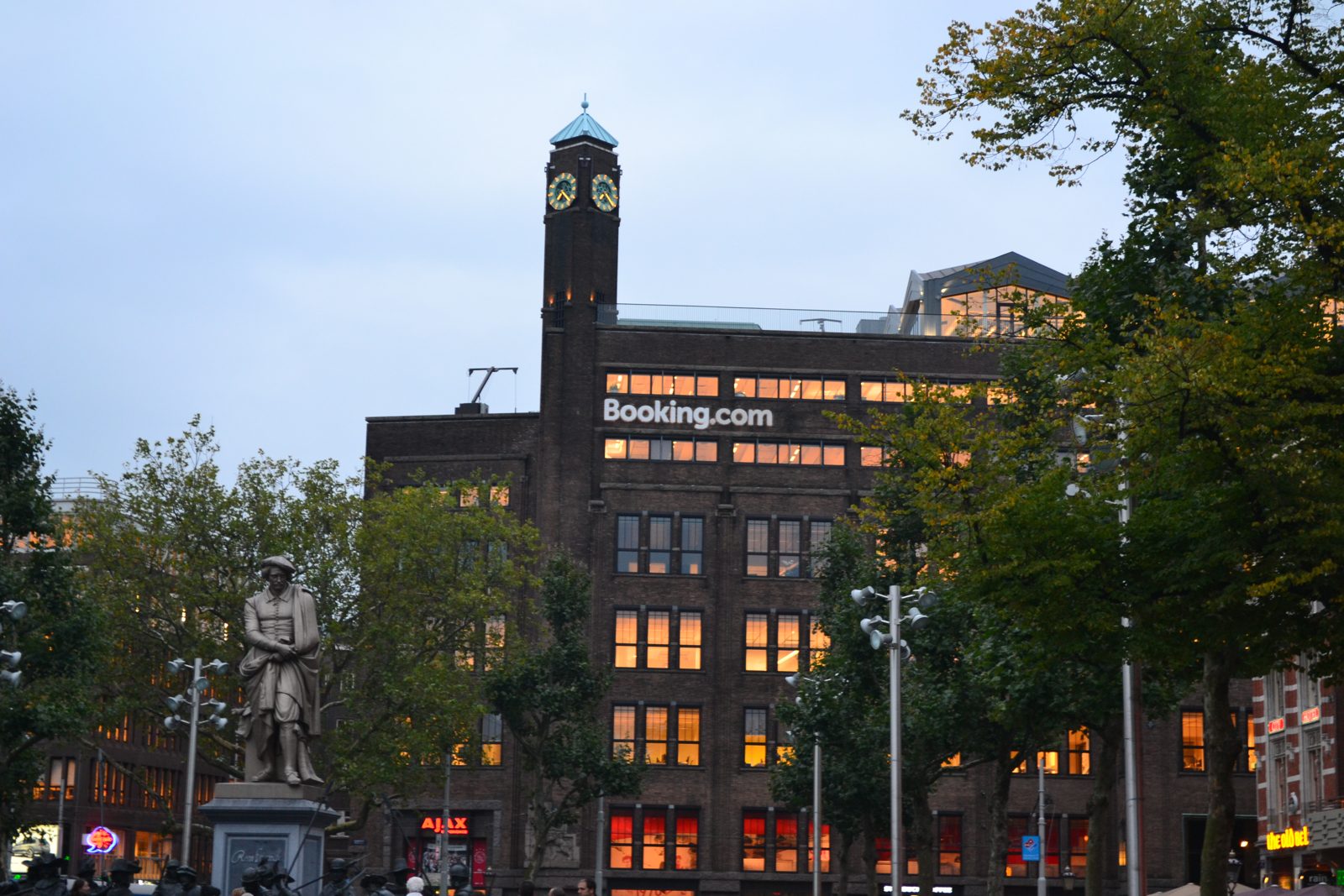
Image context: the lead image is a real photograph of Booking.com's Amsterdam headquarters.[5] That is the right visual anchor because this quarter was not about a macro abstraction. It was about whether a specific operating machine, traffic acquisition, direct demand, payments, and cross-border inventory, can keep compounding through a noisier travel backdrop.
Priced vs new
The priced part is easy to see. Booking still produced the kind of quarter that most travel companies would take without negotiation. Alternative-accommodation room nights at Booking.com grew 5.5%, constant-currency accommodation ADRs rose about 1%, and marketing expense stayed at 3.8% of gross bookings, unchanged from the prior year.[1] Total operating expenses rose 15%, still slower than the 16% increase in revenue, while adjusted fixed operating expenses rose 14%.[1] That is not a business losing control of its cost base.
The new part is where the growth came from and what management now thinks it needs to assume next. In prepared remarks, the company said U.S. room-night growth accelerated to the low teens for the fourth consecutive quarter, driven primarily by strong domestic demand, and that Booking.com's direct channel in the U.S. also posted double-digit growth.[2] Asia also remained healthy, with room-night growth in the high single digits and intra-Asia travel growing at a low double-digit pace.[2] Those are strong internal indicators. But the guide is no longer being written by those positives alone. It is being written by whether the Middle East drag fades on the timetable management now assumes.
Why the quarter still graded well
The strongest argument for the quarter is that Booking grew through the disruption rather than around it. Management said room-night growth would have been about 8% instead of 6% without the conflict effect.[2] That matters because it tells investors the underlying travel machine is still moving at a higher speed than the reported number suggests.
The margin structure also stayed firm. Net income reached $1.083 billion, up from $333 million a year earlier, and net income margin expanded to 19.6% from 7.0%.[1] Adjusted EBITDA margin rose to 23.3% from 22.9%.[1] On the cash side, net cash provided by operating activities was $3.215 billion, and free cash flow was $3.108 billion.[1][3] Those are not the numbers of a company buying growth at any price.
Capital allocation sharpened the signal. Booking repurchased $3.77 billion of stock in the quarter and paid $343 million in dividends.[3] That does not prove the stock is cheap. It does show management is confident enough in the resilience of the model to keep capital returns heavy even as it trims the midpoint of the full-year outlook.[2][3]
There is also a useful quality signal inside product behavior. Prepared remarks said connected transactions, trips involving more than one vertical, grew in the high teens and represented a low double-digit percentage of Booking.com's total transactions.[2] That matters because the investment case is stronger when Booking deepens its role inside an itinerary rather than just winning one hotel click.
Why the guide matters more than the beat
The real debate starts with the outlook. Booking said it currently expects second-quarter room-night growth of 2% to 4%, and gross bookings, revenue, and adjusted EBITDA growth of 4% to 6%.[2] For the full year, it now expects gross bookings to rise high single digits to low double digits, revenue to rise high single digits, adjusted EBITDA to grow slightly faster than revenue, adjusted EBITDA margin to expand by 0 to 25 basis points, and adjusted EPS to rise low to mid-teens.[2]
That is still a respectable guide. It is just not the guide investors would have expected from a quarter with this much underlying U.S. and direct-channel strength if the external environment had remained quiet. Booking explicitly said its full-year assumptions now include direct and indirect effects from the Middle East conflict through the end of June, followed by a recovery in the second half.[2] It also said broader second-order effects such as higher jet-fuel costs, airline capacity reductions, or weaker traveler sentiment were not built into the guidance ranges because they are harder to estimate.[2]
That is the subtle risk boundary. The headline quarter says the franchise is working. The guide says the franchise is now carrying more event risk into the summer than the Q1 beat alone would imply.
Six numeric anchors
- Room-night growth held up, but with a visible conflict drag: room nights reached 338 million, up 6%, and management estimated the conflict reduced growth by about 2 percentage points.[1][2]
- Top-line momentum stayed strong: gross bookings rose to $53.8 billion, up 15%, and revenue rose to $5.532 billion, up 16%.[1][2]
- Margins improved: adjusted EBITDA rose to $1.29 billion, up 19%, with a 23.3% margin; net income reached $1.083 billion, with a 19.6% margin.[1]
- Expense discipline held: marketing expense stayed at 3.8% of gross bookings; total operating expenses rose 15% and adjusted fixed operating expenses rose 14%.[1]
- Cash generation remained large: operating cash flow was $3.215 billion, free cash flow was $3.108 billion, and stock repurchases reached $3.77 billion in the quarter.[3]
- The guide softened despite the beat: Q2 room-night growth is guided to 2% to 4%, while full-year gross bookings are now expected to rise only high single digits to low double digits.[2]
These anchors point to a narrower conclusion than the quarter's headline might suggest. Booking is still a high-quality travel platform. The harder issue is whether the current external disruption is merely a temporary routing shock or the start of a softer summer demand tape.
Strongest counterweight
The strongest pushback is that the current caution may be too anchored to the guide and not anchored enough to the underlying business. U.S. room-night growth accelerated again, the direct channel in the U.S. grew double digits, Asia stayed healthy, connected transactions kept scaling, and management still held marketing intensity flat while growing revenue faster than fixed costs.[1][2] If the June cutoff proves roughly right and travel corridors normalize into the summer peak, then the Q2 guide may end up looking conservative rather than ominous.
That counterweight deserves respect. The franchise clearly has more internal momentum than the softer midpoint guide alone would suggest. The narrower point is that the next rerating depends on whether those internal gains can dominate the external drag quickly enough.
Falsifier
This cautious read is wrong if the next reporting window shows three things together: first, room-night growth lands at or above the top end of the current 2% to 4% Q2 range; second, marketing expense stays near the current 3.8% of gross bookings rather than creeping up to protect demand; and third, management speaks about the end-of-June disruption window as intact rather than slipping deeper into the summer.[1][2] If that combination appears, then the present guide debate will look more temporary than structural.
Watchlist
- June 2, 2026 annual meeting: this is the next dated venue where management can refine how it talks about the conflict window, summer demand, and capital returns.[4]
- June 30, 2026 planning cutoff: management's full-year framework assumes the direct and indirect impact from the Middle East conflict continues through the end of June and then improves in the second half.[2]
- The next Q2 print: investors should care less about the next headline revenue beat than about whether room nights can outrun the current 2% to 4% guide while marketing stays disciplined.[2]
- U.S. direct-channel and connected-trip disclosure: if double-digit U.S. direct growth and high-teens connected-transaction growth persist, Booking has more internal offset power than the headline guide currently gives it credit for.[2]
Takeaway
Booking Holdings reported a good quarter. Demand held up, margins improved, U.S. direct momentum strengthened, and the cash engine stayed large.[1][2][3]
The sharper finance question now belongs to the guide. The quarter says the operating machine is healthy. The outlook says a meaningful part of summer 2026 still depends on a geopolitical recovery schedule management cannot control.[2] If disruption fades on the company's current timetable, the U.S. direct-channel story can reclaim the narrative. If it does not, then Q1 will still read as a strong quarter, but less as the start of a clean acceleration than as a high-quality franchise absorbing a messy travel tape.
Sources
- Booking Holdings Inc., "Booking Holdings Reports Financial Results for 1st Quarter 2026" (Exhibit 99.1 to Form 8-K, April 28, 2026).
- Booking Holdings Inc., "CEO and CFO Prepared Remarks for 1st Quarter 2026" PDF (April 28, 2026).
- Booking Holdings Inc., Form 10-Q for the quarter ended March 31, 2026.
- Booking Holdings Inc., 2026 Proxy Statement / Annual Meeting notice, setting the virtual annual meeting for June 2, 2026.
- Wikimedia Commons, "File:Booking.com HQ.jpg" - source page for the Amsterdam headquarters photograph used as the article image.