Buffer ETFs have already won the marketing argument. Priced is that many investors want equity participation without taking the full emotional shock of a drawdown. New is that the protection is not a blanket promise. It is a time-stamped options contract inside an ETF wrapper, and the investor's actual result depends on the remaining cap, the remaining buffer, the purchase date, and the next reset.[1][2][3]
That is the right way to read the category in 2026. These funds can be useful, especially for investors who know they are trading away part of the upside for a defined downside profile. They become dangerous when "buffer" is heard as "safe." Cboe's market overview says outcome-based ETFs had passed $70 billion of assets by July 2025, with 98% of those assets in buffer strategies: more than $52 billion in 9%-15% buffers, nearly $13 billion in 15%-40% buffers, and just under $3.5 billion in 100% buffers.[4] The size says the product has become mainstream enough that the mechanics matter.
The Mechanism
A buffer ETF usually starts with a reference asset, often an ETF linked to a broad equity index, then uses FLEX options to create a target payoff over a stated outcome or hedge period. The appeal is simple: the fund seeks to absorb a specified slice of losses, while allowing gains up to a cap. The cost is equally simple: upside above the cap belongs to someone else.[1][2][3]
The timing is the first catch. Innovator's June U.S. Equity Buffer ETF lists an outcome period from June 1, 2025 to May 31, 2026, a 9% starting buffer, a 16.26% starting cap before fees and expenses, and a 0.79% expense ratio.[1] Those numbers describe a contract window. If an investor bought on the first day and held to the end, the fund's intended payoff was relatively easy to understand. If the same investor bought late in the period, after the reference asset had already moved, the experience could be very different.[1]
iShares' Max Buffer Jun ETF shows the same point from the other direction. As of June 18, 2026, the fund listed a 99.50% starting buffer, a 7.06% starting cap, a hedge-period end date of June 30, 2026, and only 12 days remaining. At that point, the remaining cap was just 0.17%, while the remaining downside before buffer was -6.90%.[2] A buyer looking only at "max buffer" could miss the live trade: near the end of a hedge period, the upside may already be mostly gone even though downside exposure still exists.
That is why the cap reset is the real risk. A buffer ETF is not one permanent bargain. It is a sequence of bargains. Each new hedge period starts with a fresh set of market conditions: interest rates, dividends, implied volatility, option prices, and the level of the underlying asset. iShares warns that a new cap is established during each rebalance period and can change significantly from one hedge period to the next.[3] In other words, last year's cap is not the investor's entitlement. It is history.
Scenario 1: The Base Case
The base case is that buffer ETFs keep gathering assets because the use case is real. A retiree, foundation, or taxable investor may not need the full equity index. They may need a more legible range of outcomes for a specific funding window. A 9%, 15%, or deeper buffer can help keep that investor in risk assets when the alternative is panic-selling or sitting entirely in cash.[1][4]
In this branch, the investor buys close to the start of the outcome period, understands the cap, and sizes the allocation as an equity-risk sleeve rather than a cash substitute. The fund does its job if the reference asset falls inside the buffered range or rises modestly without blowing through the cap. The investor gives up some upside, but receives a payoff shape that is easier to hold through noise.
The catch is performance comparison. If the market rises strongly, a plain index fund may look obviously better after the fact. That is not evidence the buffer failed. It is evidence the investor bought an options trade. The correct benchmark is not regret-free upside. The correct benchmark is whether the investor was paid enough in downside comfort to accept the cap.
Scenario 2: The Upside Case
The upside case is a choppy market with enough implied volatility to fund attractive caps. In that environment, the options market may allow new hedge periods to reset with protection that still leaves useful participation. Cboe's overview notes that ETF FLEX options are well suited to structured mandates and to the ETF primary market, which helps explain why product issuers can package these outcomes repeatedly rather than building one-off notes for each client.[4]
This is where buffer ETFs can be a cleaner alternative to some structured products. The ETF wrapper gives daily exchange trading, visible holdings and terms, and generally broader access than bespoke notes. FINRA's ETF overview describes ETFs as pooled investment opportunities that commonly hold baskets of securities and trade on exchanges, while also warning investors to understand product structure, costs, and risks rather than assuming every exchange-traded product behaves the same way.[5]
The constructive case is therefore not "free downside protection." It is better framed as operational convenience plus a defined options budget. The investor can choose a monthly or quarterly series, compare caps and buffers across issuers, and decide whether the tradeoff is acceptable before committing capital. If the market is volatile but not in a persistent melt-up, that tradeoff can be rational.
Scenario 3: The Downside Case
The downside case has three versions. The first is a strong rally after purchase. The fund may hit its cap quickly and then lag the reference asset. The second is a decline that exceeds the buffer. If a fund buffers the first 9% of losses, it does not necessarily protect against the next 20%. The third is poor timing: buying after the outcome period has already moved close to the cap, or selling before the period ends.
The issuer disclosures are blunt on this point. Innovator says shareholders are subject to an upside cap and that a buyer entering after the fund has risen near the cap may have little or no ability to achieve gains while still being vulnerable to downside risks.[1] iShares similarly says investors who buy after a hedge period begins or sell before it ends may not fully realize the buffer or cap and may be exposed to greater risk of loss.[2][3]
The options themselves add another layer. iShares notes that buffer and accelerated outcome ETFs invest in FLEX options, which can carry counterparty risk, may be less liquid than other instruments, and can be affected by interest rates, dividends, volatility, and time remaining until expiration.[3] That does not make the funds unsuitable by default. It does mean the product is not just "equity minus some downside." It is equity plus path, time, volatility, and option-pricing exposure.
The Falsifier
This cautious framework is wrong if the next several reset cycles keep offering generous caps, investors mostly enter near the beginning of outcome periods, funds track their stated payoff profiles cleanly, and drawdowns stay within the buffered range. Under that outcome, buffer ETFs would have converted market anxiety into a disciplined allocation tool without imposing too large an opportunity cost.
The framework is right if the opposite happens: investors chase the word "protection" late in hedge periods, caps reset lower when rates or volatility conditions change, strong markets expose benchmark lag, or severe drawdowns push losses beyond the buffer. The product can still work, but only for investors who underwrite the whole payoff map rather than one comforting label.
Watchlist
- Remaining cap at purchase: the live cap matters more than the original cap if the outcome period is already underway.[1][2]
- Remaining buffer and downside before buffer: a deep starting buffer can look different late in the period after the reference asset has moved.[2]
- Next reset terms: compare the new cap with the prior cap, because option-market conditions can change the bargain materially.[3]
- Reference-asset return versus fund return: strong rallies are the cleanest test of how much upside was sold.[1][2]
- Trading costs and scale: bid-ask spread, fund assets, and exchange liquidity decide whether the wrapper is easy to use in real portfolios.[2][5]
The practical conclusion is narrow. Buffer ETFs are not cash, not bonds, and not magic downside insurance. They are listed funds that package an options-defined payoff. Used at the start of an outcome period, sized as equity risk, and judged against a known cap, they can solve a real behavioral and portfolio problem. Bought casually because the word "buffer" sounds safe, they can turn protection into a misunderstanding before the next reset even begins.[1][2][3]
Sources
- Innovator ETFs, "BJUN - Innovator U.S. Equity Buffer ETF" - outcome period, starting cap, starting buffer, expense ratio, exchange listing, and risk disclosures.
- iShares, "iShares Large Cap Max Buffer Jun ETF (MAXJ)" - NAV, assets, expenses, starting payoff values, remaining cap, remaining buffer, hedge-period dates, and timing risks.
- iShares, "Pursue your investment goals with outcome ETFs" - buffer ETF risk disclosures, cap reset language, FLEX options risk, and timing factors.
- Cboe, "How Outcome Based ETFs Are Reshaping Investor Demand" (August 7, 2025) - outcome-based ETF asset growth, buffer category mix, and FLEX options market-structure context.
- FINRA, "Exchange-Traded Funds and Products" - investor education on ETF and ETP structure, exchange trading, product variation, costs, and risks.
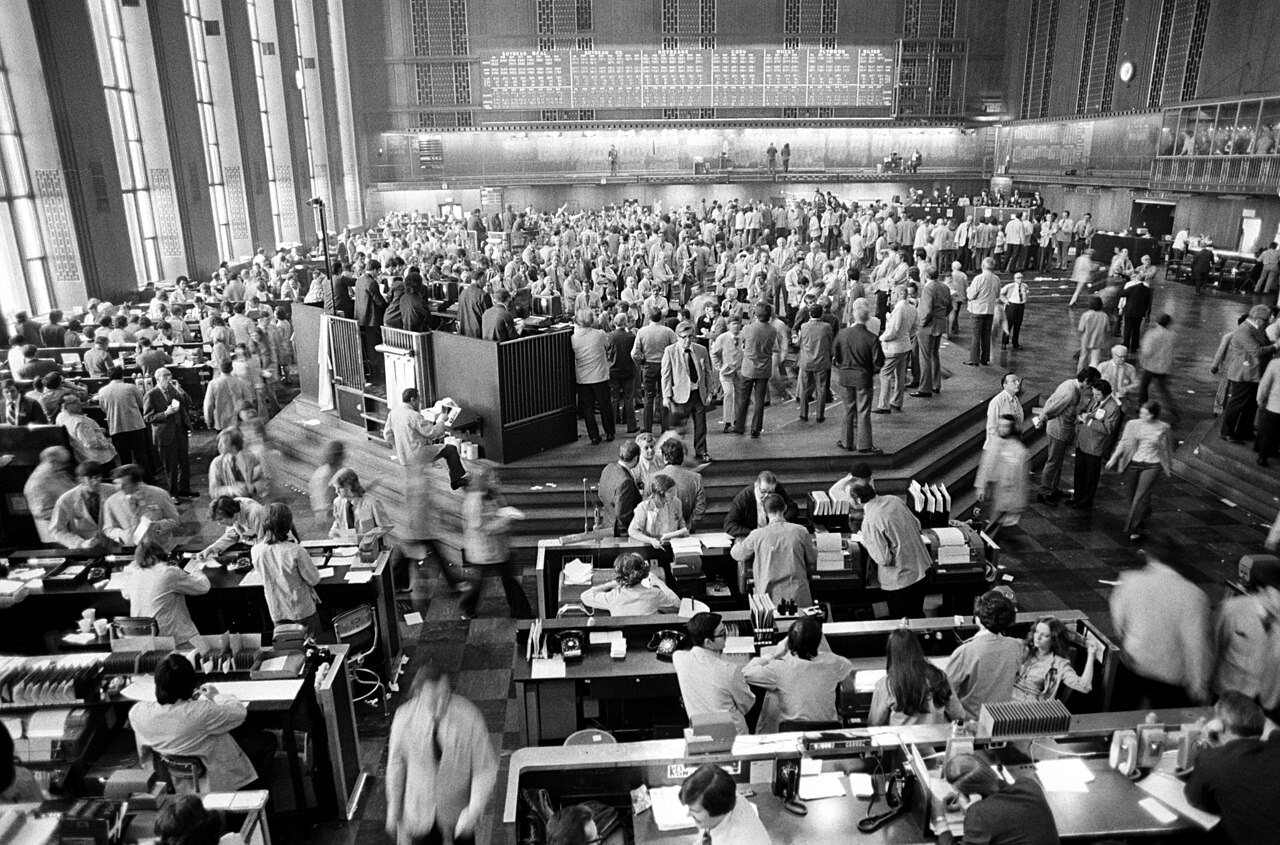
- Wikimedia Commons, "File:20120105-OC-AMW-0425 (7042322619).jpg" - USDA/National Archives photograph of traders at the Chicago Board of Trade on May 31, 1973, used as the article image source.