As of 2026-05-06 UTC, the easy Ares story is already public. The firm reported $644.3 billion of assets under management, $399.6 billion of fee-paying AUM, $158.1 billion of available capital, and $29.5 billion of fundraising in the first quarter, with management fees up 25% year over year and fee-related earnings reaching $464.4 million.[1][2] That is the part the market is supposed to admire.
The harder finance question sits one layer below the headline size. Priced is that Ares has become one of the largest alternative managers in the market, with broad investor relationships, multiple product lanes, and enough scale to keep gathering capital even in a choppier tape.[1][3][4] New, or at least still under-read, is that scale by itself is not the cash register. The real proof is conversion: whether fundraising keeps moving into fee-paying assets, whether deployment stays fast enough to monetize the backlog, and whether performance-income realization becomes regular enough that Ares looks like an earnings machine rather than a permanent holding tank for undeployed capital.[1][2][5]
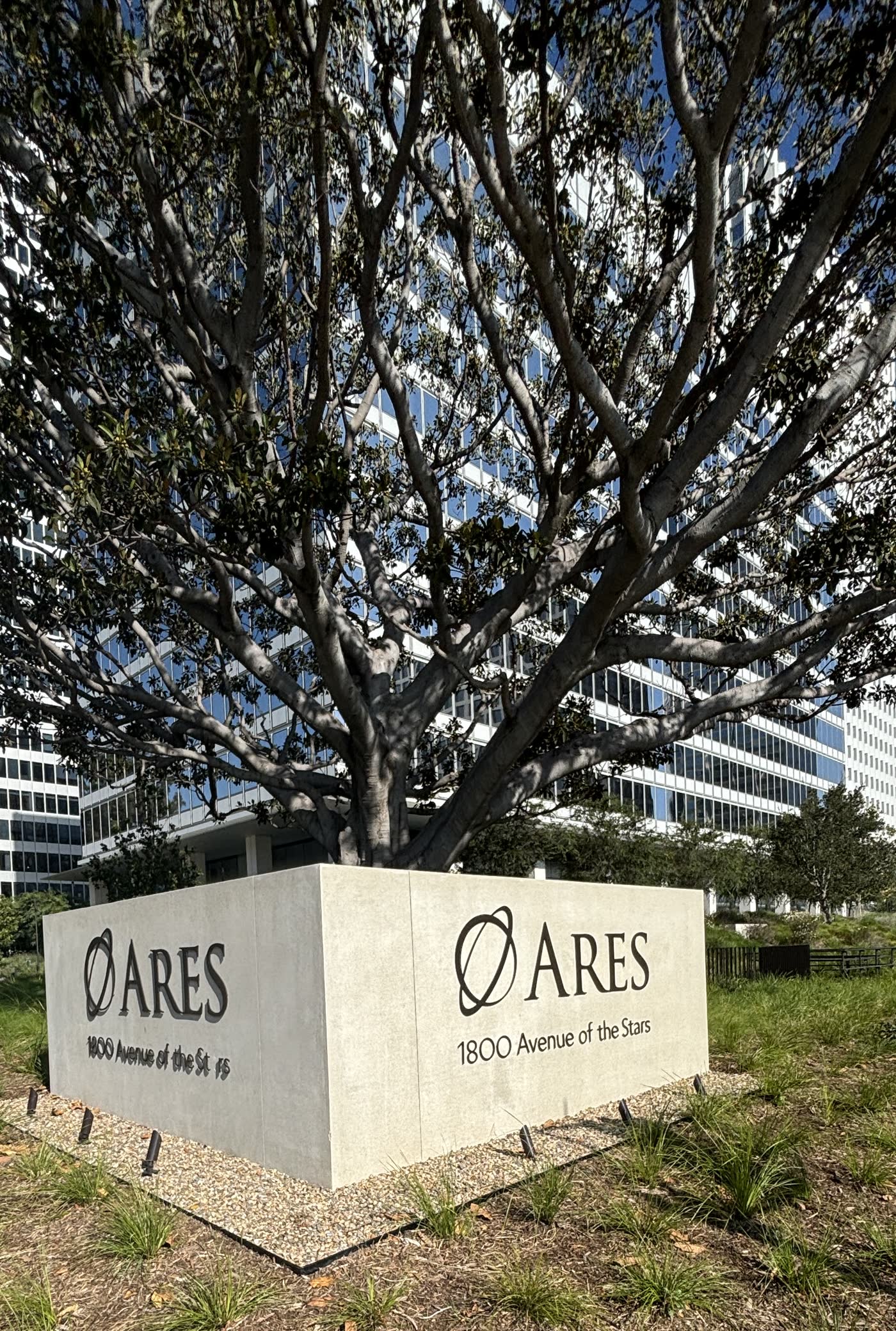
Image context: the lead image is a real 2024 photograph of the ARES building sign at 1800 Avenue of the Stars in Los Angeles, the headquarters address also listed in the company's first-quarter 2026 earnings materials.[2][7] That is the right visual here because this is a platform-scale article, not a rates chart or a generic skyline story.
The scale story is no longer hidden
Start with what is already obvious. Ares ended 2025 with more than $620 billion of AUM, more than $100 billion of fundraising, and more than $100 billion of deployment for the year, according to its annual letter.[4] That letter also frames the strategic expansion clearly: the GCP International acquisition broadened industrial real estate and data-center development, the firm launched a $2.4 billion first data-center development fund, and it offered more than 38 investment products in 2025.[4]
The first-quarter 2026 release is therefore not a surprise pivot. It is continuation at larger scale. Ares said first-quarter fundraising was a record $30 billion, up more than 45% year over year, while AUM and fee-paying AUM grew 18% and 19%, respectively.[1] If the market chooses to pay a premium for that operating footprint, the basic logic is easy to defend. This is no longer a niche private-credit shop dependent on one fundraising cycle. It is a diversified alternatives platform with enough breadth that one strong sleeve can keep the aggregate machine moving when another pauses.[1][3][4]
That is the priced part of the stock story. The market already knows Ares is big, broad, and still gathering assets.
Why deployment matters more than fundraising bragging rights
The more useful question is what happens next to the capital after the headline close. The earnings presentation says Ares still has $79.4 billion of AUM not yet paying fees and $158.1 billion of available capital.[2] Those are not bad numbers. They are the backlog that supports the future. But backlog only becomes visible earnings once it is deployed, fee clocks start, and eventually performance-fee logic begins to matter.
That is why the quarter's deployment figures deserve at least as much attention as the fundraising total. Ares deployed $32.3 billion of capital in the quarter, including $17.2 billion through its drawdown funds.[2] In U.S. direct lending alone, the firm said its credit funds closed approximately $9.5 billion of commitments across 70 transactions in the first quarter and about $53.0 billion across 348 transactions in the trailing twelve months ended March 31, 2026.[6]
Read that sequence carefully. Fundraising gives the market a reason to extrapolate. Deployment is what lets Ares turn extrapolation into revenue timing. If capital sits in the queue too long, the AUM headline still looks impressive, but the earnings case gets softer because a growing share of the platform remains economically pre-harvest. If deployment stays fast, then the quarter's big fundraising number is not just a trophy. It becomes the raw material for future management fees and, later, performance income.[2][6]
The fee engine is already strong; the monetization runway is the real debate
The fee engine itself already looks healthy. In the first quarter, Ares reported $989.5 million of GAAP management fees, $1.0755 billion of unconsolidated management fees and other fees, $19.6 million of fee-related performance revenues, $464.4 million of fee-related earnings, and $502.7 million of realized income.[2] After-tax realized income was $1.24 per share of Class A and non-voting common stock.[1][2]
Those are strong numbers. They are also why the conversation naturally shifts forward. Ares's 2024 Investor Day materials estimated about $3.6 billion of realized net performance income over the next 10+ years from funds that had been raised as of Q1 2024.[5] That figure matters because it points to the deepest bull case: not simply that Ares can gather more capital, but that the existing platform already contains a large deferred monetization layer that has not fully surfaced in reported results yet.[5]
This is where the stock case gets more demanding. The market does not need Ares to prove it can raise another flagship vehicle. It needs evidence that the fee-paying ratio stays thick, that undeployed capital keeps moving, and that the long-promised performance-income conversion becomes regular enough to deserve a richer multiple. Otherwise the risk is subtle rather than catastrophic: the business still grows, but the stock stops getting paid for size and starts getting judged on timing.[1][2][5]
Six numeric anchors
- Platform scale: Ares reported $644.3 billion of AUM and $399.6 billion of fee-paying AUM at March 31, 2026.[2]
- Dry powder and future fee base: available capital was $158.1 billion, and $79.4 billion of AUM was not yet paying fees.[2]
- Quarterly fundraising strength: Ares raised $29.5 billion in Q1 2026, with net inflows of $27.9 billion.[2]
- Deployment pace: the firm deployed $32.3 billion in the quarter, including $17.2 billion through drawdown funds.[2]
- Current earnings quality: fee-related earnings were $464.4 million, realized income was $502.7 million, and after-tax realized income was $1.24 per share.[1][2]
- Direct-lending throughput: Ares said U.S. direct lending commitments totaled about $9.5 billion across 70 first-quarter deals and $53.0 billion across 348 trailing-twelve-month deals.[6]
Those numbers describe a business that is already large enough to impress on sight. They also describe a business that still depends on movement, not just accumulation.
Strongest counterweight
The strongest pushback is that this framing may still be too demanding. Ares does not need every dollar of available capital to be deployed immediately for the stock case to work. The company already has rising fee-paying AUM, a broader real-asset and infrastructure footprint, and enough investor demand that management can be selective rather than desperate.[1][2][4] In that branch, the backlog is not a problem. It is optionality.
That counterweight is real. It becomes even stronger if volatility keeps creating better entry points for private credit and real assets, because Ares can use its $158.1 billion of available capital as an offensive advantage rather than a drag.[2] The narrower point is only that premium finance stories eventually migrate from size to conversion. Ares is arriving at that stage now.
Falsifier
This conversion-focused read is too cautious if the next few quarters show that Ares can keep fee-related earnings compounding strongly even without a visible drawdown in undeployed capital. Concretely, if fee-paying AUM continues to rise near the pace of total AUM, deployment stays above fundraising often enough to keep the fee backlog moving, and realized performance income begins to show up with greater regularity, then the market would be right to treat the platform as a higher-quality compounder than this article assumes.[2][5][6]
Watchlist
- The next earnings release: the most important ratio is not total AUM alone, but whether fee-paying AUM keeps tracking close enough to it that the platform is monetizing scale rather than merely warehousing it.[1][2]
- Direct-lending origination updates: Ares's U.S. direct-lending commitment data are one of the cleanest recurring reads on whether deployment remains industrial rather than episodic.[6]
- Realized performance income cadence: the long-dated conversion logic in the Investor Day materials becomes more believable only if harvested income starts showing up more regularly in reported results.[5]
- Available-capital trajectory: the current $158.1 billion dry-powder figure is bullish only if the firm can keep finding investable opportunities without sacrificing underwriting discipline.[2]
Takeaway
Ares has already won the scale argument. The first-quarter 2026 numbers made that plain: record fundraising, a very large fee base, meaningful dry powder, and a platform broad enough to keep expanding across credit, real assets, secondaries, and new product lanes.[1][2][4]
The better finance question now is stricter. Investors do not need more proof that Ares can gather capital. They need proof that the firm can keep converting that capital into fee-paying assets and, over time, into more regular performance-income harvests. Scale is already priced. Conversion is where the next proof lives.
Sources
- Ares Management Corporation, Form 8-K / press release, "Ares Management Corporation Reports First Quarter 2026 Results" (May 1, 2026).
- Ares Management Corporation, "First Quarter 2026 Earnings Presentation" (Exhibit 99.2, May 1, 2026).
- Ares Management, "About Ares Management Corporation" corporate profile page, including platform overview and market-capitalization note.
- Ares Management Corporation, "2025 Annual Letter" PDF, covering year-end 2025 AUM, fundraising, deployment, product expansion, and data-center fund launch.
- Ares Management Corporation, "Investor Day 2024" PDF, including estimated realized net performance income potential from funds raised as of Q1 2024.
- Nasdaq syndication of Ares Management's press release, "Ares Management Announces First Quarter 2026 U.S. Direct Lending Origination Activity" (May 1, 2026).
- Wikimedia Commons, "File:ARES Building Sign, 1800 Avenue of the Stars (Los Angeles).jpg" - photograph of the ARES building sign in Los Angeles.