Using end-June market interest-rate expectations, the Bank of England projects a £120 billion net lifetime Treasury cash outflow to its Asset Purchase Facility in present-value terms. Changing the assumed exit speed barely moves that total; the interest-rate path matters more.[1] A smaller quarterly cheque could offer the Chancellor breathing room without making quantitative easing cheaper overall.
As of September 16, 2026. Projections use the August 4 second-quarter report and its end-June assumptions, rather than a live yield curve.
The bonds stayed fixed. Their funding did not
The Asset Purchase Facility, or APF, holds the bonds bought through quantitative easing. Its purchases were financed by a loan from the Bank of England, with interest charged at Bank Rate. The Bank created interest-bearing reserves to finance the operation. The APF received coupons from its bonds, while its funding bill could change with monetary policy.[2]
That mismatch explains the reversal from earnings to expense. When funding was cheap, coupon income generated a surplus. When Bank Rate rose, the same portfolio became more expensive to carry. Selling bonds can create another cash requirement if the proceeds fall short of the financing that must be repaid.[2]
The Treasury had received £123.9 billion in undiscounted cumulative net transfers at their September 2022 peak. By the end of June 2026, after payments began flowing the other way, that benefit had dwindled to £16.2 billion.[1] These are payments already made, not forecasts.
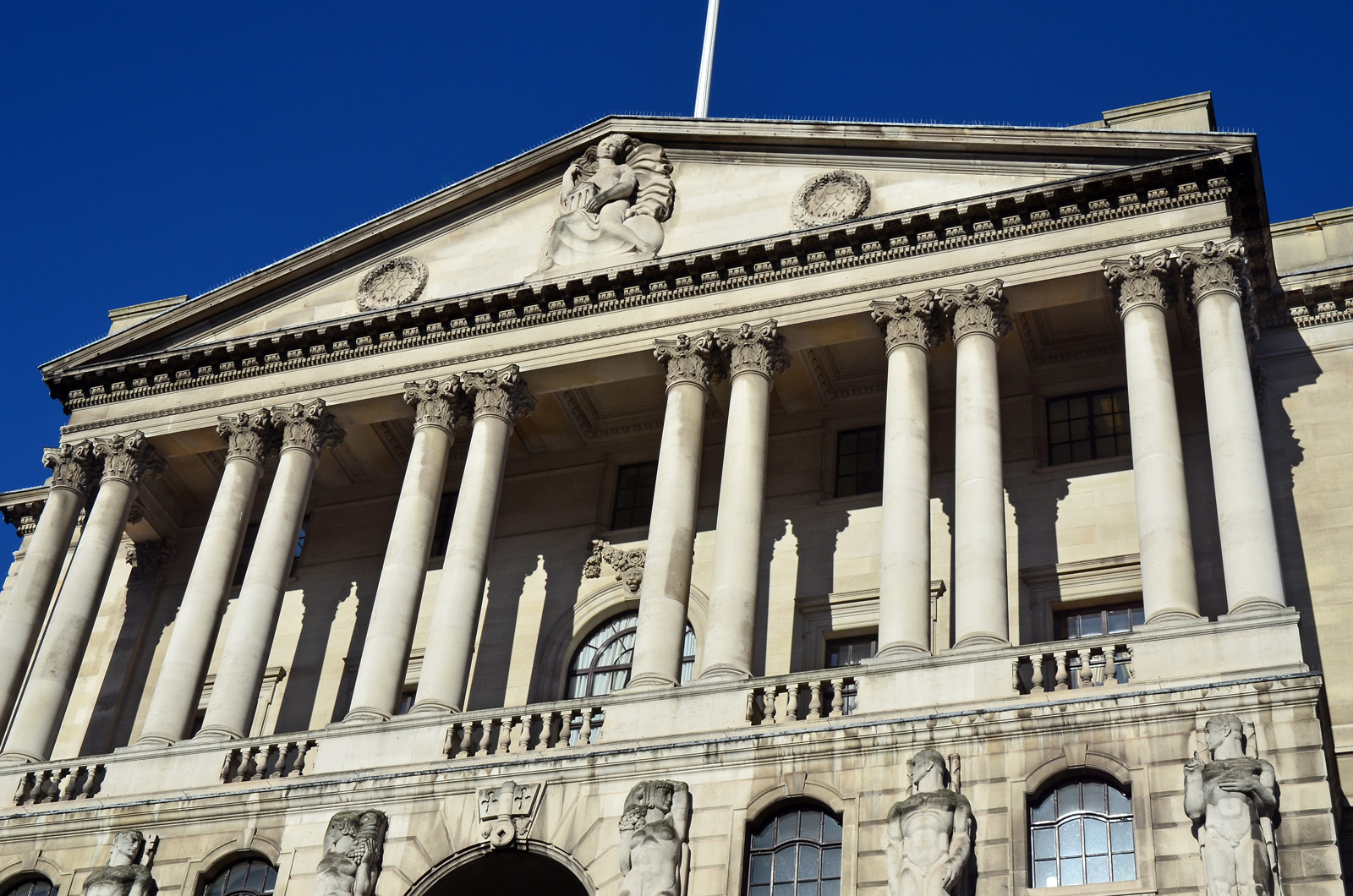
The Bank of England's Threadneedle Street façade, shown in George Rex's February 2014 photograph, locates the institution behind this balance-sheet machinery.[7] The consequential contrast is less visible: long-lived assets supported by funding whose price can reset quickly.
Waiting changes the bill's timing
Holding a bond to maturity sounds like an escape from a loss. It can avoid selling at a depressed market price today, but it does not suspend the cost of financing the position. And where the APF originally bought a gilt above its face value, redemption still returns less principal than the purchase cost. Earlier coupons and the eventual repayment belong in the same calculation.[2]
In its April 2024 response to Parliament, the Treasury made the financing trade-off explicit. Slower sales leave the portfolio outstanding longer; where interest paid at Bank Rate exceeds coupon income, that means additional net interest expense. Faster sales bring losses forward but reduce the period of exposure. The response also argued that unwinding QE helps restore the public finances' insulation from changes in short-term borrowing costs.[3]
This is why comparing annual cheques alone is misleading. A government can improve the appearance of one year's cash requirement by moving a payment into another year. To establish a saving, it must count the intervening funding expense and compare the cash flows on the same discounted basis. That is an analytical test of the timing argument, not a claim that every possible sales schedule is equally good.
The latest report illustrates the distinction. Its alternative interest-rate path, in which Bank Rate moves gradually toward an estimated equilibrium level, produces a net present cash outflow of about £60 billion. Within each rate-path pair, the different unwind schedules produce similar totals.[1] The exercise offers sensitivity analysis, not odds: the lower-cost outcome is not a promise that rates will fall far enough to deliver it.
The strongest objection is about the year in front of you
Annual cash needs still matter. A Treasury facing difficult funding choices cannot spend a future present-value saving today. Moreover, sales take place in an actual gilt market, where their timing and the ability of investors to absorb them may affect outcomes.
The Treasury Committee's February 2024 report pressed precisely this challenge. It accepted that monetary policy should put the inflation objective first, but urged the Bank and Treasury to explore how value for money and the Treasury's spending capacity could enter decisions about QT's pace and timing. It also challenged the idea that the original indemnity arrangements should automatically govern a future round of QE.[4]
That is a substantive counterweight to the model. Similar discounted totals do not make the distribution of payments irrelevant, and a projection based on orderly markets cannot settle every question about execution. The useful disagreement concerns the costs of alternative schedules, including their market effects. Simply delaying recognition of a loss does not demonstrate that those costs have fallen.
The transfer account is only part of QE's fiscal record
There is another boundary. The APF's cash flows do not capture the Treasury's benefit from issuing debt at lower yields during QE. In its November 2025 analysis, the Bank estimated those debt-issuance savings at £50 billion–£125 billion in present-value terms, with part of the benefit still arriving through lower coupons on outstanding debt.[5]
These are modelled savings against an unobservable world without QE. Their size depends on how much the purchases reduced yields and how long that effect lasted. They are not a separate pot of money available to cancel the next indemnity payment. Nor does this calculation include the full fiscal consequences of changes in employment and economic activity.[5]
The distinction cuts both ways. A cash loss cannot, by itself, prove that the whole policy failed. A plausible estimate of wider benefits cannot make the cash loss disappear. Judging the intervention requires the broader comparison; financing its exit requires the actual payment calendar.
What would change the conclusion
The testable claim here is that postponing sales, by itself, offers limited lifetime savings under the published framework. It would be invalidated by a like-for-like analysis showing materially lower discounted costs from slower sales after accounting for continued funding, sale prices and market effects, under the same interest-rate assumptions. A smaller near-term transfer alone would not pass that test.
- September 17 MPC decision: read any update to the unwind plan alongside the rate decision. Distinguish a change in sale timing from a change in the expected funding path.[6]
- November 5 Monetary Policy Report: examine whether the inflation outlook supports a different rate path. That would change the financing premise behind the APF scenarios.[6]
- November 10 APF quarterly report: compare realised transfers with the revised lifetime estimates, keeping their valuation dates and assumptions aligned.[1]
Sources
- Bank of England, “Asset Purchase Facility Quarterly Report — 2026 Q2” (August 4, 2026): cumulative transfers, interest-rate scenarios, discounted lifetime cash flows and next publication date.
- Filippo Busetto and colleagues, “QE at the Bank of England: a perspective on its functioning and effectiveness” (May 18, 2022), especially Box D: APF funding, coupons, transfers and above-par purchases.
- House of Commons Treasury Committee, “Quantitative Tightening: Government, Bank of England and Debt Management Office Responses” (April 18, 2024), Appendix 1: Treasury explanation of funding costs and the timing of losses.
- House of Commons Treasury Committee, “Quantitative Tightening” (February 7, 2024), chapter 4: fiscal effects, annual losses, value for money and the indemnity arrangements.
- Bank of England, “Asset Purchase Facility Quarterly Report — 2025 Q3” (November 11, 2025), Box A: estimated debt-issuance savings, counterfactual assumptions and limits.
- Bank of England, “Monetary Policy Committee dates for 2026 and 2027”: confirmed September and November 2026 publication dates, checked September 16, 2026.
- George Rex, “Bank of England Threadneedle St.” (February 1, 2014), Wikimedia Commons: photograph used above, CC BY-SA 2.0.