Bank funding is not repricing like a risk-free curve. Priced is that the Federal Reserve already cut the target federal funds rate by 25 basis points at each of its September, October, and December 2025 meetings, and the effective federal funds rate sat at 3.64% in the Federal Reserve's April 24, 2026 H.15 release.[1][3] New is that deposit relief is still arriving with a floor under it: banks are defending uninsured balances, carrying a heavier interest-bearing deposit mix, and still telling investors that another drop in short-end rates would pressure net interest income.[3][4][5][6]
That is the financing gap equity investors still have to respect. When the policy rate falls, many people expect bank funding costs to slide lower in a straight line. The actual transmission is slower and more mechanical. Deposits are a product, not just a liability line. Once customers relearn that cash can move, betas stop behaving like a sleepy back-office assumption and start behaving like competition.
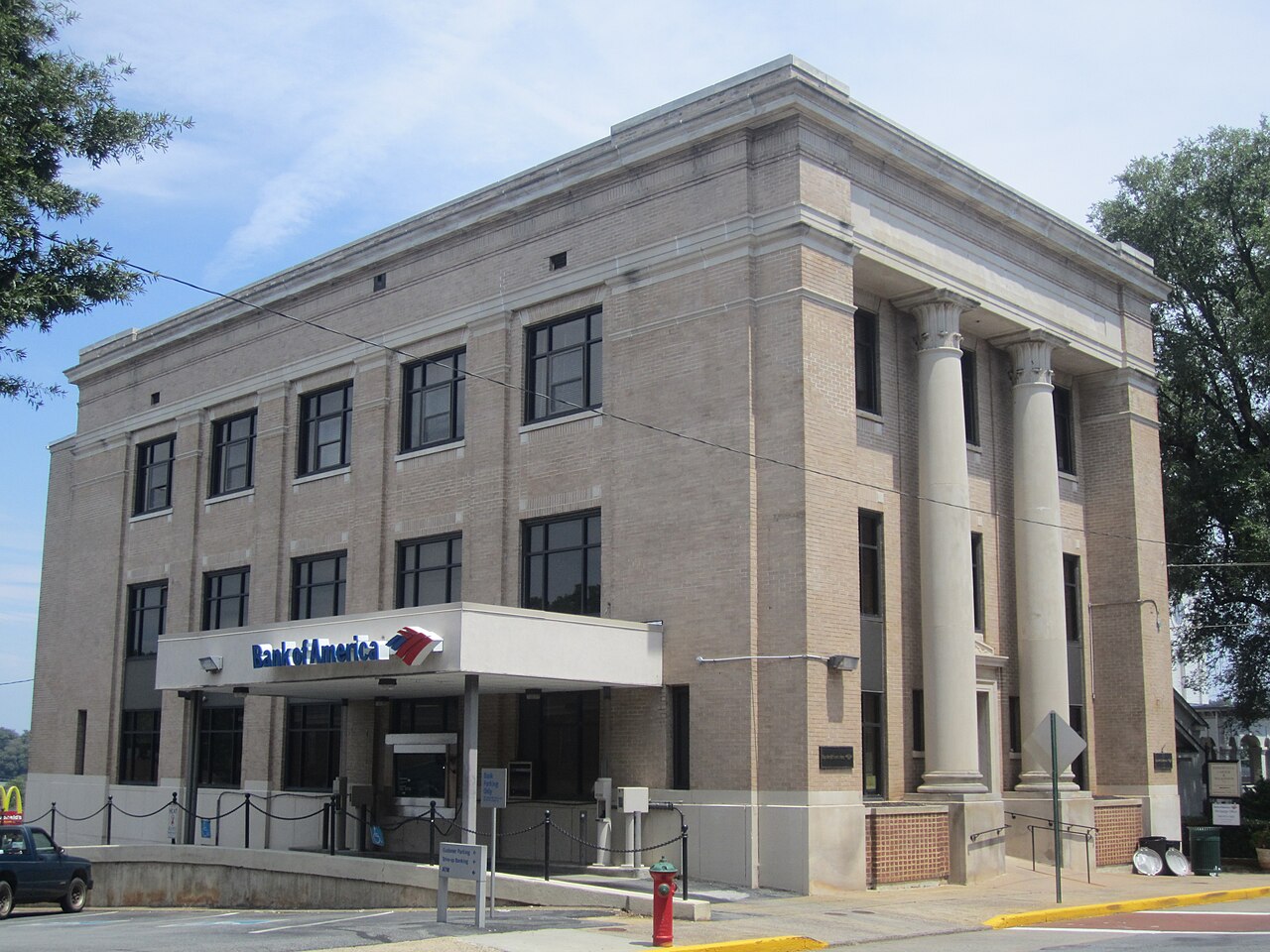
Image context: the cover uses a real 2011 photograph of a Bank of America branch in Orange, Virginia. That is the right visual anchor because the funding story is not really about a line on a Treasury chart. It is about banks trying to hold everyday retail and commercial balances in a world where depositors pay closer attention to yield, insurance coverage, and alternatives than they did before the tightening cycle.[7]
Priced vs new
Priced: the policy anchor is no longer at the 2024 high. In the Federal Reserve's April 24, 2026 H.15 release, the effective federal funds rate was 3.64% and bank prime was 6.75%.[1] The FDIC also says lower short-end rates in 2025 helped reduce funding costs and modestly improve net interest margins.[3]
New: the pass-through is not resetting to the old world. The Federal Reserve's 2025 funding-cost paper argues that bank funding betas are cycle-dependent but remarkably stable at the aggregate system level, with nondeposit liabilities adjusting more than deposits.[2] The FDIC's 2026 Risk Review adds the crucial mix detail: industry deposits grew 3.9% in 2025, but that growth was led by 7% growth in uninsured deposits rather than a return to cheap, sleepy funding.[3]
That is why the better question is not, "Did the Fed cut?" It is, "What is the new floor under bank funding costs now that depositors and treasurers have been retrained by a high-rate cycle?"
Mechanism: where the floor moved
The first piece is the policy anchor itself. Fed funds at 3.64% is lower than the peak, but it is still high enough that cash alternatives remain visible, and bank prime at 6.75% shows how much pricing power still sits above the policy floor.[1] Lower policy rates help, but they do not erase the spread structure that banks built during tightening.
The second piece is deposit composition. The FDIC's Risk Review makes the important distinction between "deposit growth" and "cheap deposit growth." In 2025, deposits rose, but uninsured deposits grew faster.[3] That matters because uninsured balances are more rate-aware, more mobile, and more likely to ask a bank to compete rather than merely accept whatever rate lands in a branch account. Even when balances stay inside the banking system, they can migrate toward interest-bearing products that are more expensive for the bank to fund.
The third piece is earnings sensitivity. Bank of America's first-quarter 2026 materials show $2.038 trillion of deposits at period-end, up from $1.990 trillion a year earlier, and net interest income of $15.7 billion, up 9% year over year.[4] That sounds like a clean easing dividend until the next line: a 100 basis point parallel shift below the March 31, 2026 forward curve is still estimated to reduce Bank of America's net interest income by $2.0 billion over the next twelve months.[4] Lower rates are helpful on one line and painful on another.
JPMorgan tells a similar story. Its first-quarter 2026 supplement shows total deposits of $2.676 trillion, up 7% year over year, while net interest income excluding Markets rose to $23.280 billion, up 3% from a year earlier.[5] Yet the same filing shows earnings-at-risk from a -100 basis point rate shift at -$2.2 billion.[5] In other words, scale does not erase funding sensitivity; it just changes where the offset comes from.
Wells Fargo adds the cleanest deposit-pricing detail. Its first-quarter 2026 supplement shows an average deposit cost of 1.43%, down from 1.58% a year earlier, but only 1 basis point lower than the prior quarter.[6] Average deposits were $1.415 trillion, up 6% year over year, and net interest income was $12.096 billion, up 5% from a year earlier.[6] That is the right picture for 2026: costs are rolling down, but they are not collapsing.
Six numeric anchors
- Policy is easier, not easy: effective fed funds was 3.64% and prime was 6.75% in the Federal Reserve's April 24, 2026 H.15 release, leaving a 311 basis point gap between the overnight policy anchor and prime lending.[1]
- The easing path so far was measurable but limited: the FDIC says the FOMC cut 25 basis points at each of its September, October, and December 2025 meetings, for a total of 75 basis points.[3]
- System deposit growth was not the same thing as cheap funding growth: industry deposits rose 3.9% in 2025, underpinned by 7% growth in uninsured deposits.[3]
- Bank of America still carries real downside to lower rates: deposits were $2.038 trillion, NII was $15.7 billion, and a -100 basis point shift below the forward curve would cut expected NII by $2.0 billion over twelve months.[4]
- JPMorgan still shows the same asymmetry at larger scale: deposits were $2.676 trillion, NII excluding Markets was $23.280 billion, and a -100 basis point shift implies -$2.2 billion of earnings-at-risk.[5]
- Wells Fargo shows the roll-down is gradual, not automatic: average deposit cost was 1.43% in 1Q26 versus 1.58% a year earlier, while average deposits reached $1.415 trillion.[6]
Read together, these anchors say something narrower than "banks hate cuts." The point is that a bank can benefit from easing and still keep a sticky funding floor because customers, product mix, and asset sensitivity do not all reprice at the same speed.
Strongest counterweight
The strongest pushback is that the floor may already be softening faster than this framing implies. The FDIC says lower short-end rates helped reduce funding costs in 2025, Wells Fargo's average deposit cost is lower than it was a year ago, and wholesale funding reliance has been coming down as institutions cut FHLB borrowings and brokered deposits.[3][6] If deposit competition cools further, banks could hold balances while letting more deposit categories drift lower in price.
That counterweight is real. It is why this is not a stress thesis. It is a transmission thesis. The caution is simply that funding relief may keep showing up as a slow grind in betas and mix rather than as an immediate step-change in margins.
Falsifier
This view is wrong if the next quarter shows a cleaner sequence all at once: meaningful deposit-cost roll-down, stable or improving deposit balances, and less downside earnings sensitivity to lower short-end rates at the large banks.[4][5][6] If that happens, then the new funding floor is lower than this article assumes and easing is passing through faster than the current evidence suggests.
Watchlist
- April 28-29, 2026 FOMC meeting: another dovish shift would test whether banks can absorb lower short-end rates without giving up more NII than they recover through deposit repricing.[8]
- May 20, 2026 release of the April FOMC minutes: the minutes matter because they show how policymakers are thinking about transmission through credit conditions and funding channels, not just the policy rate itself.[8]
- June 16-17, 2026 FOMC meeting with SEP: this is the bigger path-setting date for the front end and therefore for how much additional beta relief banks can realistically expect in the second half.[8]
- Second-quarter 2026 bank earnings in July: the key lines are average deposit cost, period-end deposit balances, and any update to NII sensitivity disclosures from Bank of America, JPMorgan, and Wells Fargo.[4][5][6]
Takeaway
The easy version of the story says rate cuts should make bank funding cheaper. The better version says funding costs fall only after banks finish negotiating with depositors, product mix, and their own asset sensitivity. In 2026, the real floor under bank funding is no longer just fed funds. It is competition.
Sources
- Federal Reserve Board, "H.15 Selected Interest Rates (Daily)" release dated April 24, 2026, showing the effective federal funds rate at 3.64% and bank prime at 6.75%.
- Board of Governors of the Federal Reserve System, Daniel A. Dias and Sophia C. Scott, "Monetary Policy and Bank Funding Costs: Patterns and Predictability in the Transmission of the Policy Rate to U.S. Banks' Funding Costs" (Finance and Economics Discussion Series, September 2025).
- FDIC, "2026 Risk Review" (updated April 22, 2026), on 2025 rate cuts, deposit growth, uninsured-deposit mix, and funding conditions.
- Bank of America, "1Q26 Financial Results" presentation materials (April 15, 2026), including deposits, NII, and rate-sensitivity disclosures.
- JPMorgan Chase & Co., "1Q26 Earnings Supplement" (April 2026), including deposits, NII excluding Markets, and earnings-at-risk disclosures.
- Wells Fargo & Company, "1Q26 Quarterly Supplement" (April 2026), including average deposit cost, deposits, and net interest income.
- Wikimedia Commons, "File:Bank of America, Orange, VA IMG 4304.JPG" by Billy Hathorn, photographed July 28, 2011.
- Federal Reserve Board, "Meeting calendars and information," accessed April 25, 2026, listing the April 28-29 and June 16-17, 2026 FOMC meetings and minutes-release timing.