At roughly $350.73 on April 28, 2026, Alphabet does not trade like a company the market thinks is losing control of search.[1] The stock instead reflects a view that Google has already crossed the first AI hurdle: Search kept growing, Cloud accelerated, and the company is still funding its own infrastructure build at extraordinary scale.[2][3]
That is why the finance question has narrowed. Priced is search resilience. New is whether AI answers become economically denser before the cost stack catches up. Alphabet told investors that Search revenue grew 17% in the fourth quarter, Google Search and Other advertising revenue reached $63.1 billion, and Google Services operating margin held at 41.9%.[3] Those are franchise numbers. The harder 2026 question is whether AI Mode, AI Overviews, and Gemini-inflected search behavior can keep widening commercial throughput fast enough to justify a $175-185 billion capex year, faster depreciation, and a product shape that sometimes answers the query before the user ever clicks away.[3]
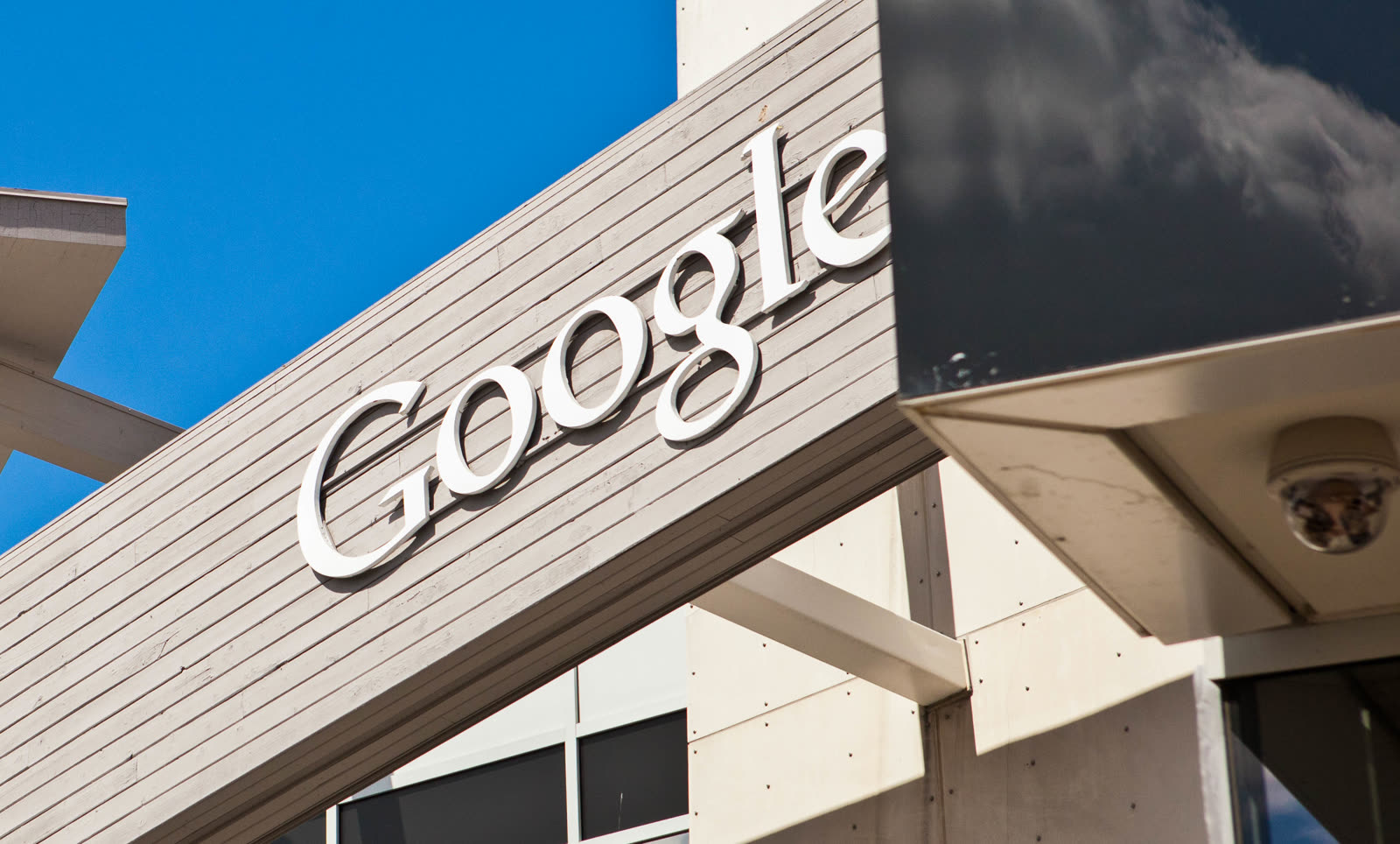
Image context: the cover uses a real Wikimedia Commons photograph of the Google headquarters sign in Mountain View. That is the right visual anchor because this is not a generic AI theme piece. It is a finance article about one specific company trying to preserve search economics while it rewires the product around longer, more compute-heavy, more conversational demand.[8]
Why the market has already paid for the easy part
Alphabet's easier argument is that demand has not cracked. Management said fourth-quarter consolidated revenue reached $113.8 billion, full-year revenue reached $403 billion, and net income for 2025 reached $132.2 billion.[3][4] Search did not merely hold steady inside that mix. Sundar Pichai said Search "continued to accelerate," while Philipp Schindler described the 17% increase in Search and Other revenue as broad-based across major verticals, with Retail the largest contributor.[3]
The user behavior story also moved in Google's favor. Alphabet said the Gemini app now has more than 750 million monthly active users. In Search, daily AI Mode queries per user in the U.S. had doubled since launch, AI Mode queries were 3x longer than traditional searches, and nearly one in six AI Mode queries had already become non-text, using voice or images.[3] Those are encouraging numbers for product engagement because they suggest AI is not only defending the old search box. It is expanding the amount of intent Google can capture and interpret.
That expansion matters because a maturing search franchise usually gets judged on saturation risk. Alphabet instead is presenting a different picture: users ask harder questions, stay in session longer, return with follow-up queries, and shift more of the commercial journey into Google's own surfaces.[3] If that picture holds, the market is correct to stop worrying about search demand first and to start worrying about monetization mechanics second.
Where the economic test actually sits
The real test is not whether AI makes Search more useful. It already does. The test is whether useful AI search becomes more profitable or simply more expensive.
There are two moving parts. First, AI answers can compress the old web-click sequence. A more direct answer can reduce the need to scroll through ten blue links, which means Google has to prove that the new surface still carries enough sponsored inventory and enough merchant intent to protect revenue density. Alphabet has been explicit that it is still early here: Schindler said the company is experimenting with ads below the AI response in AI Mode, piloting Direct Offers, and building checkout flows that let users buy directly in AI Mode and Gemini from select merchants.[3] That is promising, but it is still a buildout, not a settled monetization regime.
Second, the infrastructure bill is now large enough to matter every quarter. Alphabet said 2026 capex is expected to be $175-185 billion, up from $91.4 billion in 2025.[3] Anat Ashkenazi also said depreciation rose by nearly $6 billion, or 38%, in 2025, and that 2026 depreciation growth would accelerate in the first quarter and rise meaningfully for the full year.[3] When the product becomes more inference-heavy at the same time the capital base steps up that sharply, investors have to ask whether each additional search session is getting more monetizable quickly enough.
This is the key causal chain: AI Mode creates longer sessions and richer intent; richer intent can support new ad units, shopping actions, and more valuable commercial matching; those gains have to outrun higher compute, depreciation, and traffic-acquisition-adjacent operating costs. If they do, Alphabet has expanded the franchise. If they do not, Search remains strategically strong but financially less elegant.
Why Cloud changes the debate
The strongest reason the market is willing to underwrite this transition is that Alphabet is not asking Search alone to carry the AI build. Cloud is now a second monetization engine for the same infrastructure spine.
In the fourth quarter, Google Cloud revenue rose 48% to $17.7 billion, operating income reached $5.3 billion, operating margin reached 30.1%, and backlog climbed 55% sequentially to $240 billion.[3] At Cloud Next on April 22, 2026, Google said its first-party models were processing more than 16 billion tokens per minute via direct customer API use, up from 10 billion the prior quarter, and that just over half of 2026 machine-learning compute investment was expected to go toward the Cloud business.[6]
That matters because it changes the financing frame. If Search were the only place AI compute could be monetized, the capex question would look harsher. But Alphabet now has enterprise infrastructure demand, model demand, Gemini Enterprise seat growth, and cloud backlog all leaning on the same technical stack.[3][6] The company even said revenue from products built on its generative AI models grew nearly 400% year over year in the fourth quarter.[3] A larger capex envelope still needs discipline, but it no longer reads like a one-business subsidy.
Six numeric anchors
- Stock context: GOOGL traded at roughly $350.73 on April 28, 2026.[1]
- Search scale: Google Search and Other advertising revenue reached $63.1 billion in Q4 2025, up 17% year over year.[3]
- Core margin still held: Google Services revenue reached $95.5 billion and Google Services operating margin was 41.9% in Q4 2025.[3]
- The investment step-up is real: 2026 capex is expected to be $175-185 billion, versus $91.4 billion in 2025.[3]
- Depreciation is now part of the thesis: Alphabet said 2025 depreciation rose by nearly $6 billion, or 38%, and 2026 depreciation growth would accelerate.[3]
- Cloud is monetizing the same stack: Google Cloud revenue rose 48% to $17.7 billion, backlog reached $240 billion, and customer API use of first-party models surpassed 16 billion tokens per minute by April 2026.[3][6]
These anchors point to one conclusion: Alphabet does not need to prove AI relevance. It needs to prove AI economics.
Strongest counterweight
The strongest pushback to caution is that Google's new surfaces may be better businesses than skeptics assume. Management said longer and more complex queries are easier to understand with Gemini, that these improvements have already increased Google's ability to monetize queries that were previously hard to monetize, and that AI Overviews and AI Mode are driving greater usage rather than cannibalizing it.[3] If Google keeps more of the shopping journey inside its own surfaces, sponsored inventory may end up looking more targeted, not thinner.
There is also a financing argument in Alphabet's favor. The company exited 2025 with $126.8 billion in cash and marketable securities and generated $73.3 billion of free cash flow for the full year, even before the latest capex guide steps up further.[3] That balance-sheet and cash-generation profile gives management room to absorb a transition year without needing the market to extend endless patience.
Falsifier
This article's caution is too tight if the next quarter shows three things at once: Search growth stays close to the current mid-teens pace, management keeps the $175-185 billion capex frame from drifting higher, and Google demonstrates that AI Mode monetization is moving from experiment to repeatable surface through ads, offers, or checkout behavior.[3] If those three conditions hold together, then AI answers are not diluting the franchise. They are making it wider.
Watchlist
- May 19-20, 2026 Google I/O: the clearest product checkpoint for how aggressively Google pushes AI Mode, Gemini, shopping flows, and agentic search into the mainstream experience.[5]
- June 5, 2026 annual meeting: the next formal governance checkpoint for how management frames capital allocation, infrastructure scale, and shareholder priorities after the capex reset.[7]
- June 30, 2026 quarter close: the next operating boundary for testing whether search momentum and cloud monetization are carrying the heavier depreciation and compute bill.
Takeaway
Alphabet's easy case is already in the stock. Search still throws off enormous revenue, Cloud is scaling fast, and the company has enough cash generation to fund an infrastructure year that would overwhelm most peers.[1][3]
The narrower 2026 finance question is therefore not whether Google has AI products. It is whether AI answers become commercially dense fast enough. If AI Mode turns longer sessions, more complex queries, and native shopping actions into a richer monetization surface, Alphabet will have widened the search franchise while it rebuilt it. If not, investors will still own a formidable company, but one whose flagship product has become more capital-intensive than the old margin story assumed.
Sources
- Stooq, "GOOGL.US" daily price history, used for the April 28, 2026 stock-price reference.
- Alphabet Investor Relations, "Alphabet Announces Fourth Quarter 2025 and Fiscal Year Results" (February 4, 2026).
- Alphabet Investor Relations, "2025 Q4 Earnings Call" transcript and event page (February 4, 2026).
- U.S. Securities and Exchange Commission, Alphabet Inc. Form 10-K for the fiscal year ended December 31, 2025.
- Google, "Save the date! Google I/O 2026 is May 19-20." (February 17, 2026).
- Google, "Cloud Next '26: Momentum and innovation at Google scale" (April 22, 2026).
- U.S. Securities and Exchange Commission, Alphabet Inc. 2026 proxy statement / notice of annual meeting (filed April 24, 2026).
- Wikimedia Commons, "File:Google Headquarters Google Logo (52640780843).jpg," source page for the article image.