Coca-Cola did not need first-quarter 2026 to prove that it still owns one of the world's strongest beverage systems. That part was already priced. The new question is narrower. After net revenues rose 12% to $12.5 billion, organic revenue grew 10%, and comparable EPS reached $0.86, investors still have to decide how much of this quarter reflects durable consumer and pricing strength and how much reflects a quarter with six additional days in it and concentrate sales that ran 5 points ahead of unit case volume.[1][2]
That distinction matters because management did more than report a good quarter. It also kept its 4% to 5% full-year organic revenue growth target, updated comparable EPS growth to 8% to 9% versus $3.00 in 2025, and said comparable net revenues should see only a 1% to 2% currency tailwind while acquisitions and divestitures create an approximate 4% headwind, assuming the pending Coca-Cola Beverages Africa sale closes in the second half.[1] The market already trusts Coca-Cola's brand and pricing engine. The harder proof now sits one layer lower: can the system still convert that strength cleanly after the calendar boost fades?
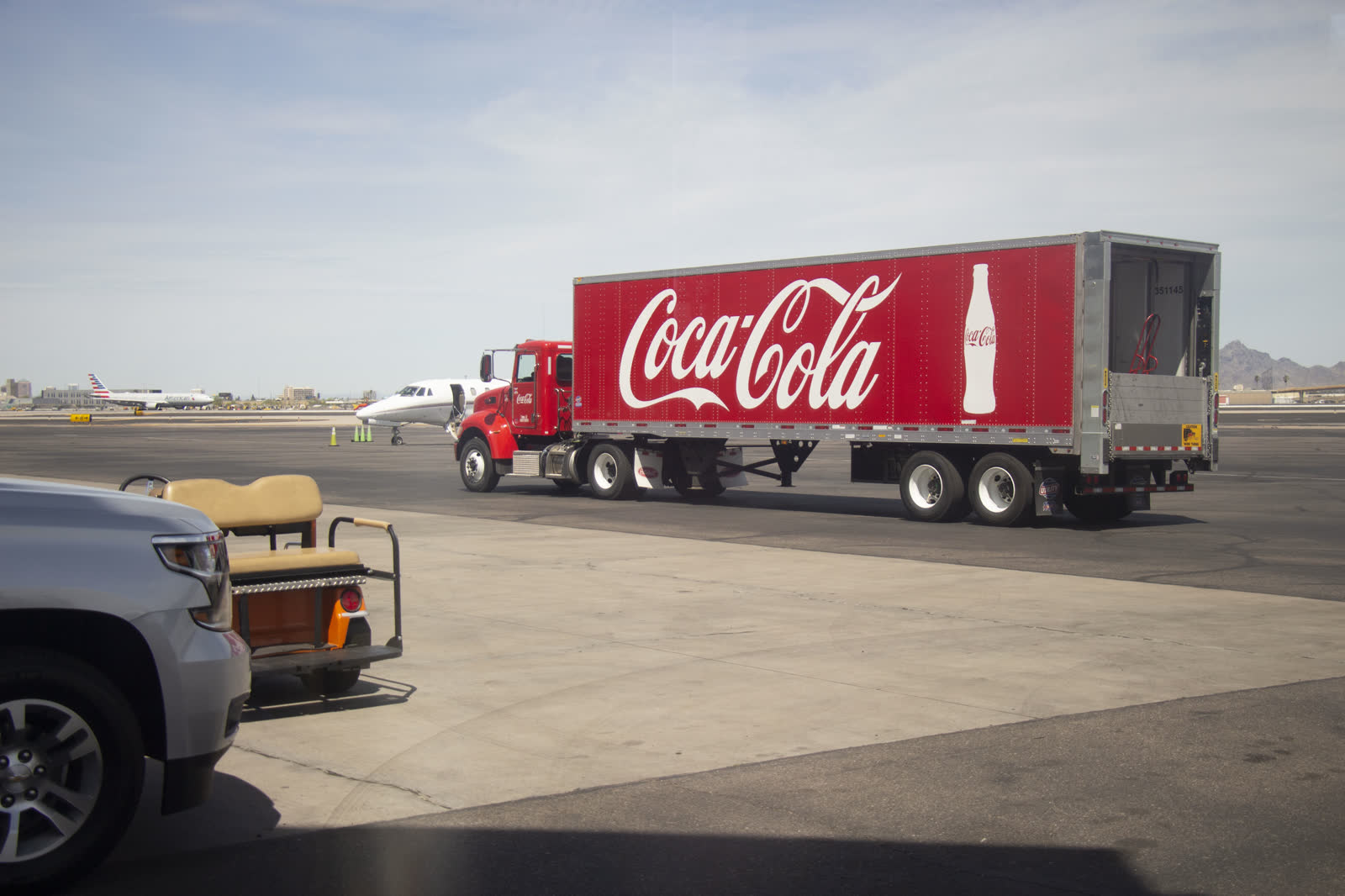
Image context: this Phoenix Coca-Cola truck belongs here because the quarter is really about beverage throughput in the physical world. Cases, bottles, coolers, route density, and channel mix explain the earnings release more honestly than any symbolic market graphic could.[6]
What the quarter actually proved
The strongest evidence in the release is that Coca-Cola did not rely on price alone. Global unit case volume grew 3%, led by China, the United States and India, while price/mix grew 2%.[1] That is important because it keeps the quarter from reading like a mature staple simply raising prices against static demand. Management also said the company gained value share in total nonalcoholic ready-to-drink beverages and increased weekly drinkers globally during the quarter.[1]
But the release also tells you not to read the topline too mechanically. Concentrate sales increased 8%, or 5 points faster than unit case volume, largely because of the extra days in the quarter, partly offset by shipment timing.[1] In other words, the system sold more syrup and concentrate into the channel than the consumer-volume line by itself would suggest. That does not make the quarter low quality. It does mean investors should separate true end-demand from timing benefits before capitalizing the entire beat as if it were clean run-rate growth.
The regional picture supports that split reading. North America unit case volume grew 4%, price/mix grew 1%, and operating income grew 20%.[1] That is a healthy result for the market Coca-Cola most needs to stabilize at scale. Europe, Middle East and Africa also looked strong, with 11% organic revenue growth and 12% comparable currency neutral operating income growth.[1] Asia Pacific was the counterweight: unit case volume grew 5%, yet price/mix declined 6% and comparable currency neutral operating income fell 17%, a sign that affordability initiatives and input-cost pressure are still real in parts of the system.[1]
Why the guide now turns on post-calendar conversion
The margin line was genuinely better. Operating margin reached 35.0% versus 32.9% a year earlier, and comparable operating margin rose to 34.5% from 33.8%.[1] Comparable currency neutral operating income grew 12%, and comparable currency neutral EPS grew 15% before the added 3-point currency help that lifted comparable EPS growth to 18%.[1] Cash flow from operations was $2.0 billion, and free cash flow was $1.8 billion in the quarter.[1]
Those are real numbers, but they do not end the debate. They move it. Coca-Cola's own guidance tells you why. Management kept the organic revenue growth goal at 4% to 5%, expects comparable net revenues to get only a 1% to 2% currency tailwind, expects an approximate 4% headwind from acquisitions and divestitures, and still targets about $12.2 billion of free cash flow for the year.[1] That is a confident guide, but it is also a guide that now has to survive with less calendar assistance and with a pending portfolio change around CCBA.
The most useful sentence in the entire release may be the least glamorous one: first-quarter 2026 results were affected by six additional days, while fourth-quarter 2026 will have six fewer days versus the prior year.[1] Because unit case volume is computed on average daily sales, the volume line is cleaner than the concentrate line. That makes the next proof straightforward. If price/mix and volume can keep advancing while concentrate sales no longer outrun volume for calendar reasons, then Coca-Cola will have demonstrated balanced growth rather than a temporarily flattered shipment profile.[1]
Strongest counterweight
The strongest argument against a timing-first reading is that Coca-Cola may simply be doing exactly what a scaled global beverage company should do in a mixed macro environment. Trademark Coca-Cola volume grew 2%, Coca-Cola Zero Sugar volume grew 13%, and water, sports, coffee and tea grew 5%.[1] Meanwhile, March CPI data still showed nonalcoholic beverages and beverage materials up 4.7% year over year, a reminder that pricing power has not vanished across the U.S. consumer landscape.[4]
If the company can still recruit drinkers, gain share, defend price, and widen margins while continuing to invest in marketing, then investors should be careful not to over-penalize one quarter for having favorable calendar geometry. That is a serious counterweight. It is why the correct question is not whether the quarter was good. It was. The question is whether the quality of the growth still looks the same after the calendar boost leaves the frame.
Falsifier
This timing-sensitive reading breaks if the next quarter shows that Coca-Cola can keep delivering healthy organic growth with volume and price/mix doing most of the work even after the first-quarter day benefit is gone. Concretely, if the company continues to hit its 4% to 5% organic growth path, maintains share gains, and no longer needs concentrate sales to run well ahead of unit case volume for calendar reasons, then the market should treat first-quarter skepticism as too conservative.[1]
Watchlist
- April 29, 2026: Coca-Cola's 2026 Annual Meeting of Shareowners is the next company-specific checkpoint for how management frames capital allocation, the CCBA sale path, and brand investment after the quarter.[3]
- April 30, 2026: BEA's release of Personal Income and Outlays for March 2026 will show the next read on household spending and the PCE inflation backdrop that shapes beverage affordability and pricing tolerance.[5]
- May 12, 2026: BLS will publish April 2026 CPI, the next clean U.S. inflation check for food-away-from-home and nonalcoholic beverage pricing pressure.[4]
Sources
- The Coca-Cola Company, "Coca-Cola Reports First Quarter 2026 Results and Updates Full Year Guidance" - quarterly revenue, organic growth, margins, EPS, regional operating details, guidance, calendar effects, and cash-flow figures.
- SEC, Form 8-K filed by The Coca-Cola Company on April 28, 2026 - confirms the quarter's earnings release was furnished as Exhibit 99.1.
- The Coca-Cola Company, 2026 proxy statement - annual meeting date, time, and voting materials for the April 29, 2026 meeting.
- U.S. Bureau of Labor Statistics, "CPI Home" - March 2026 CPI readings and the scheduled release date for April 2026 CPI.
- U.S. Bureau of Economic Analysis, "Personal Income and Outlays, February 2026" - latest PCE backdrop and the scheduled April 30, 2026 release date for March 2026 data.
- Wikimedia Commons, "File:Coca-Cola Truck.jpg" - source page for the article image, a 2019 photograph of a Coca-Cola delivery truck at Phoenix Sky Harbor Airport.