At roughly $49.64 on April 28, 2026, PayPal does not trade like a business the market thinks is collapsing.[1] The platform is still large, still profitable, and still generating serious cash. In the fourth quarter of 2025, net revenue reached $8.676 billion, total payment volume reached $475.1 billion, and transaction margin dollars excluding interest on customer balances reached $3.741 billion.[2] For the full year, PayPal still processed $1.794 trillion of TPV and produced $5.31 of non-GAAP EPS.[2]
That is why the finance question has narrowed before the May 5, 2026 earnings call.[5] Priced is platform durability. New is whether the company can turn branded-checkout repair into enough transaction-margin density to outrun lower interest on customer balances and a board-led demand for faster execution. PayPal's own February guide pointed to a mid-single-digit decline in first-quarter GAAP and non-GAAP EPS, and to a full-year non-GAAP EPS outlook ranging from a low-single-digit decline to slightly positive.[2] The easy part of the story is that PayPal still has scale. The harder part is whether the first quarter under new CEO Enrique Lores, who took the role on March 1, 2026, starts to prove that branded checkout can improve fast enough to justify a rerating.[6]
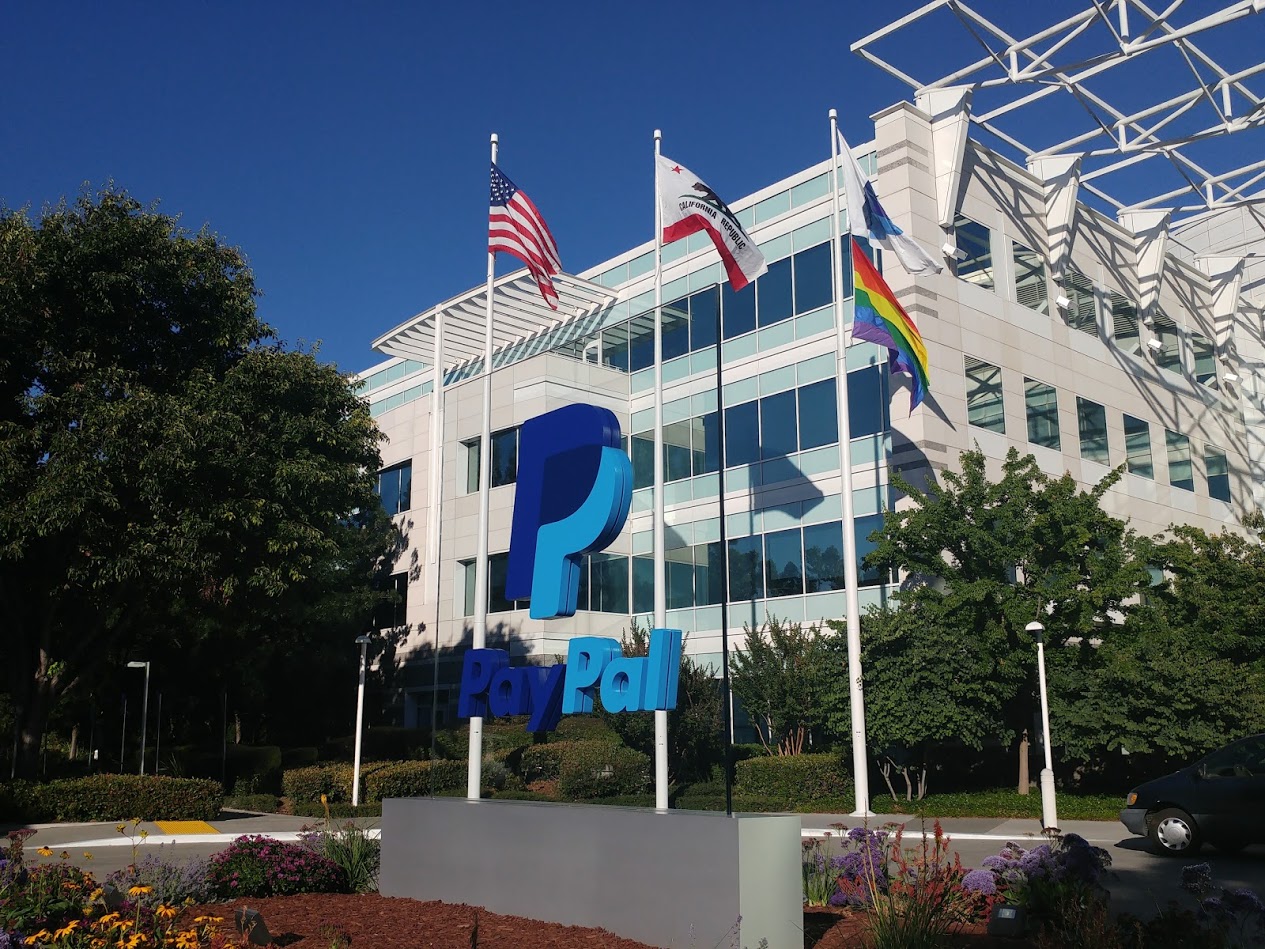
Image context: the cover uses a real Wikimedia Commons photograph of PayPal's San Jose offices. That is the right anchor because this article is not about digital payments in the abstract. It is about one company trying to convert product fixes, merchant placement, and wallet engagement into measurable financial proof.[7]
What the market has already accepted
The market has already accepted that PayPal still owns a real platform. Fourth-quarter revenue grew 4% year over year, GAAP operating income rose 5% to $1.511 billion, and FY2025 GAAP operating margin improved to 18.3% from 16.7% a year earlier.[2] Cash, cash equivalents, and investments ended 2025 at $14.8 billion, while debt stood at $11.6 billion.[2] On a trailing 12-month basis, the company repurchased about 86 million shares for $6.0 billion.[2]
The product base is broader than checkout alone. Active accounts reached 439 million at year-end 2025.[2] PayPal's 10-K also describes PayPal and Venmo person-to-person flows as an engagement and acquisition channel, not just a low-margin utility: the wallet, debit, credit, and P2P surfaces are supposed to keep users inside one consumer loop that later feeds merchant selection and checkout behavior.[4] That matters because a platform with several consumer entry points can tolerate a slower repair in one surface for a while.
This is the part of the thesis investors have mostly internalized. PayPal is no longer being judged on whether it can survive. It is being judged on whether it can convert a still-huge installed base into a better branded-checkout business.
Why branded checkout owns the rerate
The most useful parts of PayPal's February call were not the headline totals but the operational clues around checkout. Management organized the repair around three words: experience, presentment, and selection.[3] That framing matters because it makes the problem measurable. If PayPal redesigns the paysheet, improves biometric enrollment, wins better button placement, and attaches better consumer incentives, then branded checkout should become easier to choose and harder to displace.
The company gave investors two concrete anchors. First, management said biometric authentication amplifies the paysheet redesign and has produced 2 to 5 points of conversion improvement in tests with some of PayPal's largest and most complex merchants.[3] Second, management said the strategic-merchant set where it is concentrating these changes represents nearly 25% of branded-checkout volume today.[3] Those numbers do not prove success yet, but they are large enough to matter if they scale.
There is also a consumer-side hint that the loop can work. On the same call, management said consumers with recent app use are about 40% more likely to select PayPal during checkout the following week.[3] That turns Venmo, the PayPal app, offers, and wallet engagement into more than side stories. They become leading indicators for checkout selection.
The problem is that all of this still sits inside a prove-it phase. The board's February 3 leadership announcement was unusually direct in saying PayPal had made progress but that "the pace of change and execution was not in line with the Board's expectations."[6] That is why first-quarter reporting matters more than a routine quarterly beat or miss. Investors are now waiting for proof that product fixes are moving from isolated tests into a wider commercial system.
The base case: solid quarter, no clean rerate yet
The base case is that PayPal reports a decent first quarter without resolving the argument. In that scenario, revenue and TPV still look healthy enough, transaction margin dollars excluding interest on customer balances remain positive, and management keeps the year framed as one in which diversified growth is being partly offset by lower rates and deliberate investment.[2]
That outcome would support the current stock but not necessarily expand the multiple. If first-quarter numbers land close to the February guide and management again emphasizes gradual rollout across strategic merchants, investors are likely to keep PayPal in a transition bucket. The platform would still be durable, but the branded-checkout repair would remain more of a project than a result.
The upside case: checkout repair starts to show up in the model
The upside case is that PayPal uses the May 5 release to show that branded improvements are beginning to affect the P&L. That would mean stronger transaction-margin performance excluding interest on customer balances, commentary that the strategic-merchant rollout is broadening, and a leadership tone that suggests the current experience-presentment-selection program is moving beyond pilot language.[2][3]
If that happens, the 2 to 5 point conversion-improvement claim stops being a nice test statistic and starts to matter financially.[3] The same goes for the nearly 25% strategic-merchant volume base.[3] Investors do not need every merchant live at once. They need evidence that enough of the right merchants are live for branded-checkout share and margin quality to improve before rate pressure eats the gain.
This is the version in which the market starts to treat 2026 less as another cleanup year and more as the first year of a better operating slope under Lores.
The downside case: good scale, weak proof
The downside case is subtler than a broken quarter. PayPal can still print a large TPV number and disappoint if the branded business lacks convincing momentum. If lower interest on customer balances remains a visible drag, if incentives and presentment investments dilute margin quality, or if management cannot show that checkout improvements are scaling past a narrow merchant cohort, the stock can remain trapped in a low-confidence range.[2][3]
That is the real risk around the May 5 call. A large installed base can hide weak incremental proof for a while. Investors now need evidence that the branded surface is improving faster than the offsetting headwinds.
Six numeric anchors
- Stock context: PYPL closed at about $49.64 on April 28, 2026.[1]
- Quarterly scale: 4Q2025 net revenue reached $8.676 billion and TPV reached $475.1 billion.[2]
- Full-year scale: FY2025 TPV reached $1.794 trillion and non-GAAP EPS reached $5.31.[2]
- Margin-density marker: 4Q2025 transaction margin dollars excluding interest on customer balances reached $3.741 billion; FY2025 reached $14.235 billion.[2]
- Guide boundary: PayPal framed 1Q2026 GAAP and non-GAAP EPS as a mid-single-digit decline, and FY2026 non-GAAP EPS as low-single-digit decline to slightly positive.[2]
- Repair scale: strategic merchants represent nearly 25% of branded-checkout volume, and biometric-plus-paysheet testing has produced 2 to 5 points of conversion improvement with some large merchants.[3]
These anchors point to the same conclusion: PayPal does not need to prove relevance. It needs to prove conversion economics.
Strongest counterweight
The strongest counterweight to caution is that PayPal may be closer to an operating inflection than the stock implies. The company still has 439 million active accounts, app engagement appears to affect checkout choice, and the strategic-merchant program already sits on a large enough volume base to matter if deployment broadens.[2][3] A new CEO with an explicit mandate to accelerate execution can also change timing even when strategy itself does not change.[6]
Falsifier
This article's cautious setup is too tight if the May 5, 2026 release shows three things at once: transaction margin dollars excluding interest on customer balances accelerate cleanly, management demonstrates that branded-checkout upgrades are spreading beyond isolated merchant tests, and the full-year EPS frame holds or improves despite lower-rate drag.[2][3][5] If those conditions appear together, the stock is no longer waiting for proof. It is getting it.
Watchlist
- May 5, 2026 earnings release: revenue, TPV, and transaction margin dollars excluding interest on customer balances are the fastest test of whether the platform is converting scale into better earnings quality.[2][5]
- May 5, 2026 earnings call: listen for specific commentary on strategic merchants, biometric enrollment, second-button placement, and upstream BNPL messaging rather than broad claims about product momentum.[3][5]
- May 5, 2026 full-year framing: the key question is whether management still describes 2026 mainly as a rate-and-investment offset story or starts to talk about a cleaner second-half operating inflection.[2][5]
Takeaway
PayPal's easy case is already in the stock. The platform still has huge payment volume, real cash generation, and multiple consumer entry points that keep the network relevant.[1][2][4]
The narrower 2026 finance question is whether branded checkout stops being a repair story and starts becoming a financial one. If Enrique Lores can turn presentment, selection, and experience improvements into visible transaction-margin proof, then the rerate case gets real. If not, PayPal remains a large and functional platform whose most important consumer surface is still asking investors for patience.
Sources
- Stooq, "PYPL.US" daily price history, used for the April 28, 2026 stock-price reference.
- PayPal Holdings, "PayPal Reports Fourth Quarter and Full Year 2025 Results" (February 3, 2026).
- PayPal Holdings, "PayPal Fourth Quarter 2025 Earnings Call" corrected transcript (February 3, 2026).
- PayPal Holdings, Annual Report on Form 10-K for the fiscal year ended December 31, 2025.
- PayPal Investor Relations, "PayPal's First Quarter 2026 Earnings Call" event page (scheduled for May 5, 2026).
- PayPal Holdings, "PayPal Appoints Enrique Lores as Chief Executive Officer and David W. Dorman as Independent Board Chair" (February 3, 2026).
- Wikimedia Commons, "File:Paypal san jose.jpg," source page for the article image.