An aircraft lease priced only on monthly rent misses a second financing bill: maintenance reserves. Even after paying those reserves, an airline can still need cash for the full workshop invoice before its reimbursement arrives.[1][2]
The distinction matters when comparing leases. A deposit that will eventually come back is an asset, but its recovery schedule can make an apparently affordable aircraft expensive to fund. The useful question is when the airline gets its money back—and what must happen first.
Why the owner collects before the workshop does
Leasing transfers use of an aircraft without transferring ownership. AerCap’s annual report describes an arrangement in which the airline remains responsible for maintenance and repairs. Depending on the airline’s credit quality, the lessor can also collect supplemental maintenance rent, reimbursing qualifying work up to the amount paid.[1]
This protects the owner against receiving an aircraft whose maintenance condition has deteriorated without money to restore it. The reserve therefore serves a different purpose from ordinary rent: it provides financial protection against maintenance exposure.[3][4]
Sun Country’s filing shows the airline’s side. Some of its leases require monthly reserve payments, generally linked to flight hours or cycles. Reimbursement is limited to the smaller of the relevant reserve balance and the qualifying maintenance cost.[2] Flying the aircraft can consequently produce a cash obligation well before the associated heavy maintenance occurs.
Follow the same dollars through the hangar
Consider a hypothetical aircraft with $1.2 million already paid into the reserve for a particular maintenance event. The workshop’s invoice is $1.5 million, all of it eligible under the assumed lease. Assume the airline must pay that invoice before the lessor reimburses it, with no advance, direct settlement or additional lessor contribution. These are illustrative amounts, not market prices for a particular aircraft or overhaul.
Immediately before reimbursement, the airline has paid out $2.7 million across the reserve contributions and workshop bill. It must find the full invoice amount at the workshop payment date. Budgeting only the $300,000 difference between the invoice and reserve would leave a funding hole.
When the lessor returns the reserve, cumulative net cash paid falls to the workshop’s invoice amount. The airline has not incurred two permanent maintenance costs. It has temporarily financed overlapping outflows, with the reserve reimbursement releasing cash afterward. Interest and fees on any bridging finance would be additional costs; this example excludes them.
The timing assumption is decisive. If reimbursement arrives before the workshop payment is due, the peak falls. A forecast that puts both flows in the same month can hide a serious mismatch between their actual settlement dates.
The invoice must pass a second test
A reserve balance does not establish that every line on a workshop invoice is recoverable. Shannon Ackert’s Aircraft Maintenance Handbook for Financiers describes requirements for agreeing the work and estimated cost, using approved maintenance providers, and supplying documentation. It also identifies common exclusions, including shipping and handling charges. The executed lease determines the applicable terms.[3]
That creates separate questions: how much money has accumulated, how much of the work qualifies, and when the resulting claim is paid. A larger reserve solves only the first. Unexpected work or excluded charges can leave an airline with a permanent shortfall as well as a temporary funding need.
The commercial inference is that maintenance planning and treasury planning belong together. An approved work package helps establish the recoverable amount. A settlement calendar establishes whether that amount arrives in time to pay the workshop. Neither document substitutes for the other.
An asset is not an available bank balance
Sun Country records expected recoverable payments as lessor maintenance deposits. After the maintenance event, it bills the lessor and records the amount due as a receivable. Payments deemed unlikely to be recovered are expensed within aircraft rent.[2]
That sequence makes the distinction visible: a balance can move from deposit to receivable before becoming cash. KPMG’s 2024 Leases handbook reproduces the US accounting guidance requiring qualifying maintenance deposits to be recorded as assets and reassessed for recoverability. It separately addresses the accounting for the maintenance itself.[4]
Reading only the expense line can therefore miss an earlier cash commitment. Conversely, treating every reserve payment as an immediate, irreversible expense overstates the burden where recovery remains probable. The analysis needs both the accounting classification and the expected cash date.
The strongest counterweight is in the contract
Cash reserves are not universal. At the end of 2025, 28% of AerCap’s owned aircraft leases required supplemental maintenance rentals. Its report describes many other leases as relying on return-condition requirements and cash compensation for differences at redelivery.[1] Deferring payment changes the timing; it does not erase the maintenance obligation.
The thesis has a concrete falsifier for any particular maintenance event: documented arrangements deliver the eligible reimbursement, or settle it directly with the workshop, by the invoice’s payment deadline. In that case, the overlap illustrated above does not arise. The remaining issue is any uncovered cost.
What to watch when the aircraft comes due
- When the next maintenance work package is approved: reconcile eligible tasks, exclusions and the reserve available for that event. A headline balance is insufficient without matching scope.[3]
- At the workshop invoice deadline and claim settlement: compare actual payment dates. The interval determines how much temporary funding the airline needs.
- At the next lease-return or extension decision: reassess whether planned maintenance still permits recovery. Sun Country identifies return timing and expected utilization among its recoverability assumptions; changing the plan can change the asset.[2]
Sources
- AerCap Holdings N.V., 2025 Form 20-F, “Lease contracts,” page 31 — maintenance responsibilities, reimbursement limits, supplemental-rent coverage and return conditions.
- Sun Country Airlines Holdings, Inc., 2025 Form 10-K, Note 2, “Lessor Maintenance Deposits,” page 90 — payment basis, reimbursement cap, receivables and recoverability assumptions.
- Shannon Ackert, Aircraft Maintenance Handbook for Financiers, first edition, 2018, section 4, especially pages 88–97 — reserve mechanisms, eligible work and reimbursement exclusions.
- KPMG, Handbook: Leases, 2024, pages 451–452 — reproduced ASC 842-20-55-4 through 55-9 guidance on maintenance deposits and recovery.
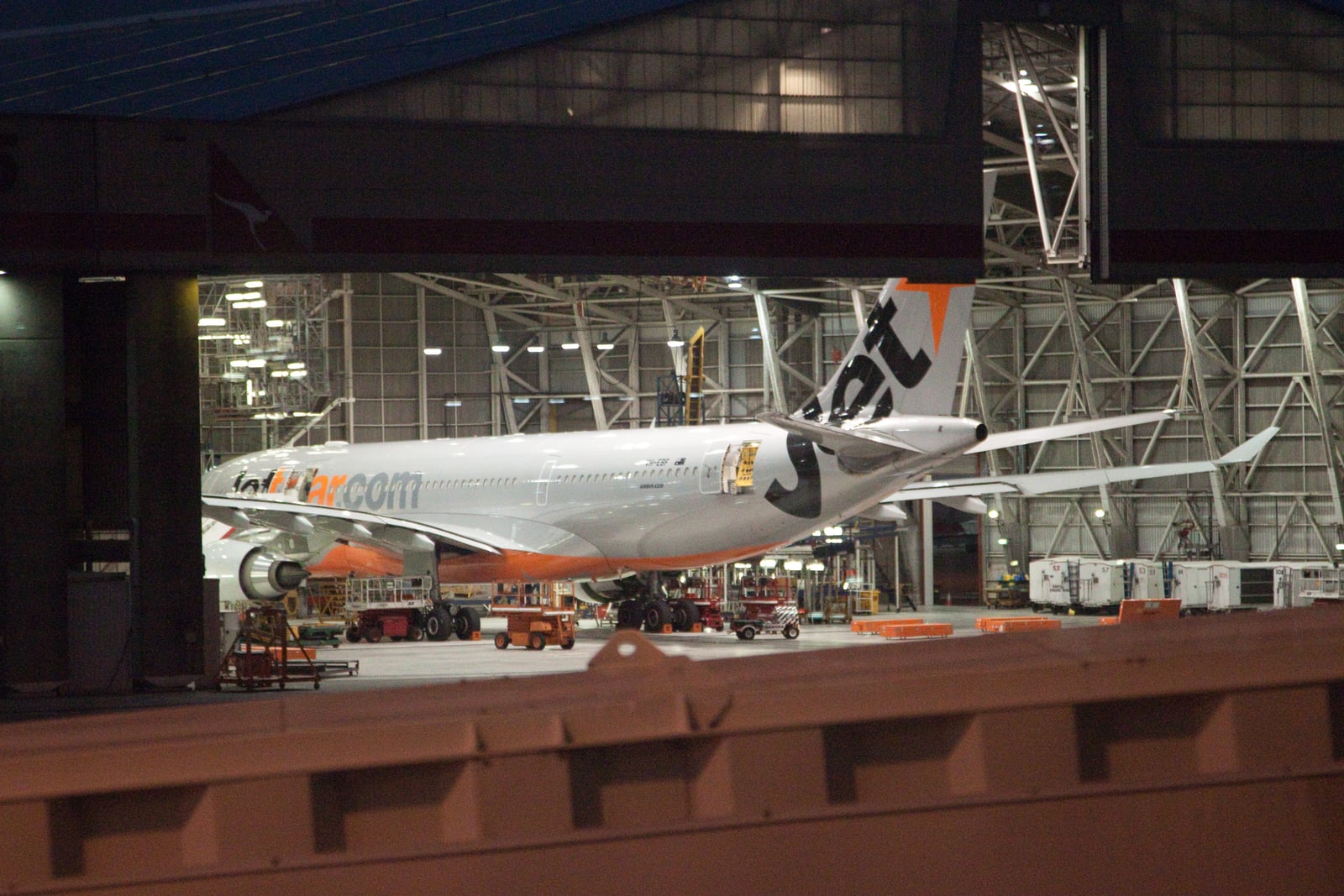
- Jimmy Harris, “Jetstar Airbus A330 undergoing maintenance at Sydney Airport,” May 9, 2009, Wikimedia Commons — photograph and provenance.