Construction aggregates look boring until the market starts paying for local scarcity. Crushed stone, sand, gravel, asphalt feedstock, and ready-mix inputs are not rare in a geological sense, but good permitted quarries near growing roads, bridges, data centers, warehouses, factories, and subdivisions are scarce in the investable sense. The priced view is that public infrastructure keeps volumes supported. The new question is whether quarry owners can turn that demand into per-ton profit after freight, mix, acquisitions, and operating cost inflation.
That is why aggregates should be valued less like a generic construction cycle and more like a localized reserve business with operating leverage. USGS estimates that the United States produced about 1.5 billion tons of crushed stone worth $27 billion in 2025, from roughly 3,500 quarries and more than 180 sales or distribution yards.[4] The average unit value rose to $18.50 per metric ton, and about 72% of crushed stone went into construction aggregate, mostly road construction and maintenance.[4] Those numbers frame the moat: the product is low value per ton, so the quarry that sits close to demand owns an advantage that a distant competitor cannot price away cheaply.
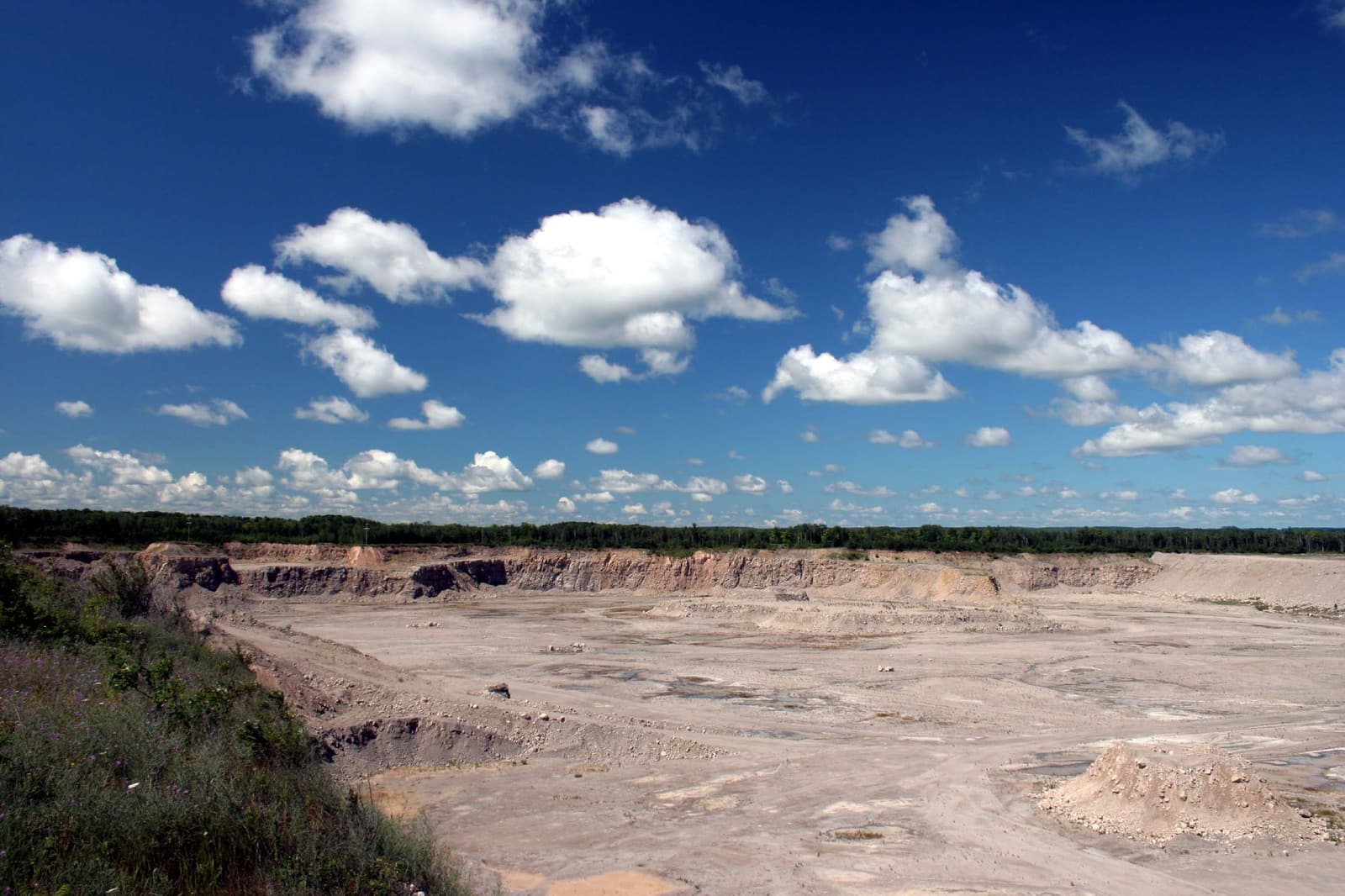
The public-work backdrop is helpful but not enough. Census reported April 2026 total construction spending at a seasonally adjusted annual rate of $2.172 trillion, with public construction at $532.7 billion and highway construction at $149.6 billion.[5] Those figures support the base case for stone demand, especially for large public jobs. They do not guarantee equity upside. If public work lifts volume while price, cost, freight, and mix cancel one another out, the quarry is busy but the shareholder is only half paid.
The priced thesis
The bull case rests on three linked ideas. First, demand is more durable than private residential starts alone. Roads, bridges, public works, utility corridors, reshoring projects, and heavy industrial sites consume enormous tonnage even when housing is uneven. Second, permitted quarry networks are hard to replicate because zoning, environmental review, community opposition, depletion planning, and haul economics make new supply slow. Third, consolidation lets scaled operators put capital behind the best basins while selling or deemphasizing lower-return downstream assets.
Vulcan Materials is the cleanest example of that aggregates-first argument. In Q1 2026, its aggregates segment gross profit rose 12% to $400 million, or $8.01 per ton, while gross margin expanded 90 basis points to 27.6%.[1] Shipments increased 5%, aided by large projects and public construction, and freight-adjusted selling prices rose 3.5% on a reported basis. The important line is not only price; it is cash gross profit per ton, which reached $10.93.[1] That is the number that says whether local scarcity, pricing, and plant execution are beating cost.
The balance-sheet signal also matters. Vulcan ended March 2026 at 1.9 times total debt to trailing-twelve-month adjusted EBITDA, below its 2.0 to 2.5 times target range, and reiterated full-year adjusted EBITDA guidance of $2.4 billion to $2.6 billion.[1] In a quarry business, leverage discipline is not decorative. It decides whether management can buy reserves at the right time, fund plant upgrades, and return capital without being forced into weak-cycle decisions.
Martin Marietta shows the same theme with a sharper warning label. Its Q1 aggregates shipments increased 12.4% to a first-quarter record 43.9 million tons, helped by organic growth and partial-quarter assets acquired from QUIKRETE.[2] But average selling price was flat at $23.70 per ton, and aggregates gross profit fell 3% to $288 million after purchase-accounting inventory effects, higher depreciation, depletion and amortization, and cost pressure. Organic cost of goods sold per ton rose 5.6%, including roughly 300 basis points of freight and timing headwinds.[2]
That is the valuation problem in one paragraph. Volume can be excellent and still fail to create clean margin if the incremental ton comes from lower-priced geography, acquired inventory, higher depletion charges, or freight drag. The market can be right about public infrastructure demand and still overpay for the tonnage if the per-ton bridge does not hold.
Why portfolio shape now matters
Aggregates companies have spent years telling investors that vertically integrated materials businesses deserve a premium when they control quarry supply, asphalt, ready-mix, paving, and local contracting lanes. The current cycle is more selective. Downstream exposure can improve pull-through when it protects quarry volume, but it can also dilute margins when concrete, asphalt, and construction services carry more labor, fuel, project, and working-capital risk than the stone reserve itself.
Vulcan's Q1 release points in that direction. The company discussed divested Houston asphalt and construction operations and the pending sale of California ready-mixed concrete assets, while keeping the message focused on aggregates-led growth.[1] Martin Marietta's February 2026 QUIKRETE asset exchange is another version of the same logic: it acquired aggregates operations producing about 20 million tons annually in Virginia, Missouri, Kansas, and Vancouver, British Columbia, plus $450 million in cash, while QUIKRETE acquired Martin Marietta's Midlothian cement plant, related terminals, Texas ready-mixed concrete plants, and nonoperating land.[2] The transaction sharpened the reserve portfolio, even though near-term accounting and mix effects made the quarter harder to read.
CRH offers the broader building-materials read-through. In Q1 2026, CRH total revenue rose 9% to $7.4 billion, adjusted EBITDA rose 18% to $0.6 billion, and adjusted EBITDA margin improved 70 basis points to 8.0%.[3] Its Americas Materials Solutions segment grew revenue 21% and adjusted EBITDA 75%, with Essential Materials aggregates volumes up 14% but pricing down 1% because of geographic and project mix.[3] International Solutions showed aggregates volumes up 8% and pricing in line with the prior year.[3]
The CRH detail matters because it keeps the sector honest. The highest-level demand story is positive, but mix can still overpower headline pricing. Investors should not underwrite "aggregate inflation" as a single national price. They should underwrite quarry-by-quarry density, state and municipal budget exposure, freight distance, local competitive behavior, reserve life, and how much downstream work is being used to secure versus dilute the quarry margin.
The counterweight
The strongest bear case is not a collapse in construction. It is a margin squeeze hidden inside healthy public work.
First, freight can eat the moat. Aggregates are heavy and cheap relative to weight, so the addressable market around a quarry is bounded by haul cost. If diesel, driver availability, rail access, or external freight rates move the wrong way, a shipment gain can become a lower-margin gain. Martin Marietta's Q1 cost commentary is a useful warning because freight and timing effects materially affected per-ton cost even while shipments set a record.[2]
Second, acquisition math can flatter volume before it proves economics. Buying reserves in good markets is rational, but the first quarters after a deal can bring purchase-accounting noise, integration cost, lower-margin mix, and a harder comparison base. A quarry acquisition is not automatically accretive because the rock is real. It is accretive when the buyer can route tons into better local demand, raise realized price, and manage depletion and maintenance capital without overpaying for the reserve.
Third, public construction can be steady without being explosive. The Census numbers show a large support base, not a straight-line boom.[5] USGS also reported crushed-stone production and apparent consumption at about 1.5 billion tons in 2025, essentially unchanged from 2024.[4] The equity premium therefore cannot rest on volume acceleration alone. It has to rest on scarcity pricing, cost control, and portfolio discipline.
Falsifier
The bullish view fails if per-ton profit stops improving while highway and public construction remain healthy. A clean falsifier would be two consecutive quarters in which major aggregates operators show shipment growth but flat or falling cash gross profit per ton, with management blaming freight, mix, depletion, or acquired-asset integration rather than weather. That would mean the market has priced local scarcity, but the operating bridge is leaking.
The bullish view strengthens if Vulcan keeps cash gross profit per ton moving above the Q1 $10.93 level, Martin Marietta converts its QUIKRETE assets into better price-cost after the purchase-accounting noise fades, and CRH's Americas Materials Solutions keeps margin expanding without depending only on acquisitions.[1][2][3] The best version of the trade is not simply "more tons." It is "more controlled tons in better local markets."
Watchlist
- Vulcan Q2 2026: watch aggregates cash gross profit per ton, shipment growth, and whether the California ready-mix sale closes without weakening local pull-through.[1]
- Martin Marietta Q2 2026: watch whether flat ASP in Q1 was mainly mix noise and whether the QUIKRETE asset exchange begins to show cleaner per-ton economics.[2]
- CRH materials mix: watch Americas Essential Materials volume versus price, because Q1 showed strong volume with negative price mix.[3]
- July 2026 construction-spending release: public highway and street spending is the demand floor; if it rolls over while private activity stays uneven, the volume story becomes harder.[5]
The practical conclusion is narrow. Aggregates deserve a premium when the company owns scarce local reserves, keeps freight inside the moat, uses downstream operations selectively, and converts public infrastructure demand into rising per-ton cash profit. Infrastructure is priced. Quarry discipline is the proof.
Sources
- Vulcan Materials, "Vulcan Reports First Quarter 2026 Results" (May 1, 2026) - aggregates shipments, pricing, gross profit, cash gross profit per ton, leverage, and EBITDA outlook.
- Martin Marietta Materials, "Martin Marietta Reports First-Quarter 2026 Results" (April 30, 2026) - aggregates shipments, ASP, gross profit, cost-per-ton pressure, and QUIKRETE asset exchange details.
- CRH, Q1 Results Announcement 2026 - revenue, adjusted EBITDA, segment performance, aggregates volume, pricing, and mix commentary.
- U.S. Geological Survey, Mineral Commodity Summaries 2026: Crushed Stone - 2025 U.S. production, quarry count, unit value, end-use mix, and production trend context.
- U.S. Census Bureau, Monthly Construction Spending, April 2026 - total, public, and highway construction spending rates.
- Wikimedia Commons, "Michigan Limestone and Chemical quarry.jpg" - Matt Bower photograph of the Michigan Limestone and Chemical quarry at Rogers City, Michigan.
Editor’s Pick Review
This article takes today’s merged standard/add-on editor-pick slot because it is the strongest 24-hour candidate on the measures that matter for curation: a narrow investable thesis, dense numeric anchoring, clear source hierarchy, and a real falsifier tied to per-ton economics rather than generic infrastructure optimism. The quarry photograph also passes the stricter image policy cleanly: it is an immersive, topic-grounded visual of the physical asset behind the moat, not an analytical chart or decorative abstraction. The Chinese edition preserves the same margin-bridge logic with stable finance terminology and readable progression, so the piece works as bilingual analysis rather than an English article with a thin translation layer.