Jabil's third-quarter beat does not need a complicated headline. Priced was that AI infrastructure could pull another electronics manufacturer into the data-center boom. New is that Jabil is starting to show the more valuable version of that story: stronger revenue, higher core operating income, better free-cash-flow guidance, and less drag from end markets that had been weak.[1]
That makes this an earnings-recap question, not a generic AI trade. A contract manufacturer can win enormous programs and still disappoint shareholders if the work arrives with customer concentration, component shortages, inventory swings, low labor absorption, or capital spending that eats the cash. Jabil's June 17, 2026 release shifts the debate from "is demand there?" to "can the company turn demand into margin without letting working capital run away?"
What Changed
Jabil reported preliminary Q3 FY2026 net revenue of $8.751 billion, up from $7.828 billion a year earlier. GAAP operating income rose to $445 million from $403 million, and diluted EPS increased to $2.59 from $2.03. The cleaner operating signal was non-GAAP: core operating income reached $504 million, and core diluted EPS reached $3.16.[1]
Management then raised the bar for the rest of the year. For Q4 FY2026, Jabil guided to $9.2 billion to $10.0 billion of revenue and $3.80 to $4.20 of core diluted EPS. For full-year FY2026, it now expects $35 billion of revenue, a 5.8% core operating margin, $12.70 of core diluted EPS, and more than $1.4 billion of adjusted free cash flow.[1]
Those figures matter because Jabil is not a software business getting paid for scarce code. It is a manufacturing services business that buys components, carries inventory, schedules production, manages supplier risk, absorbs labor and factory overhead, and then collects from large customers. Its own 2025 10-K says cost of revenue includes electronic components, other materials, labor, manufacturing overhead, and excess or obsolete inventory adjustments; it also notes that turnkey manufacturing requires significant working capital and exposes margins to materials purchasing efficiency.[2]
The Mechanism
The bull case has three moving parts. First, Intelligent Infrastructure has become the main growth engine. Jabil's 2025 10-K defines that segment as serving the modern digital ecosystem, including AI infrastructure, capital equipment, cloud and data-center infrastructure, and networking and communications. In FY2025, Intelligent Infrastructure already represented 41% of company revenue, up from 32% in FY2024.[2]
Second, the company has been adding capability around the physical bottlenecks of AI buildout. In January 2026, Jabil completed the roughly $725 million Hanley Energy Group acquisition, plus contingent consideration of up to $58 million, to deepen power-management and energy-optimization capabilities from grid to data-center rack.[3] That acquisition matters because AI infrastructure is not only server assembly. Power distribution, thermal management, rack-level service, and commissioning are becoming part of the same customer problem.
Third, domestic capacity is part of the pitch. North Carolina said in June 2025 that Jabil planned to invest about $500 million over several years in Rowan County to support cloud and AI data-center customers, with 1,181 expected new jobs and a projected $73.2 million annual payroll impact.[4] The investment does not guarantee attractive returns, but it helps explain why Jabil is trying to sell scale, proximity, and supply-chain resilience alongside basic manufacturing.
The Quality Of The Beat
The best part of the quarter is that the guidance raise was not framed as one narrow customer pull-in. CEO Mike Dastoor cited extremely strong AI infrastructure demand, but also better-than-expected performance in Automotive and Connected Living, two areas that had previously been under pressure.[1] That matters because a one-legged AI ramp can produce a fragile multiple. A diversified recovery gives the company more ways to keep factories loaded and overhead absorbed.
The second good sign is the free-cash-flow guide. Jabil's full-year adjusted free cash flow target of more than $1.4 billion is the line that disciplines the AI story.[1] If revenue rises but inventory, receivables, and capex consume the benefit, investors are only renting growth. If revenue rises while cash conversion improves, the company can fund capacity, acquisitions, buybacks, and debt management without making the balance sheet carry the whole strategy.
The third sign is core operating margin. A 5.8% full-year core operating margin may look modest next to asset-light technology companies, but for an electronics manufacturing services model it is exactly where the proof sits.[1] Jabil's gross-margin economics are tied to product mix, materials content, labor and overhead allocation, and customer program economics. The company cannot merely chase the highest revenue backlog; it has to keep the mix rich enough that volume improves returns.
The Counterweight
The strongest counterargument is customer concentration and execution risk. Jabil's 2025 10-K shows one customer accounted for 16% of FY2025 net revenue, primarily in Intelligent Infrastructure, while another was above 10% in FY2024 and tied to Connected Living and Digital Commerce.[2] That is normal for large contract manufacturing, but it means the AI-infrastructure story may be less diversified than the headline segment labels imply.
There is also a working-capital trap. AI racks, power equipment, thermal systems, and networking hardware can require expensive components, long lead times, and customer-specific configurations. Jabil can look like it is accelerating while cash is tied up in inventories, contract assets, or customer-controlled consignment components. The 10-K's discussion of significant working-capital commitments is not boilerplate; it is the core accounting risk in a fast-ramping manufacturing business.[2]
The Hanley acquisition adds another test. Power-management depth is strategically logical, but the integration has to produce customer pull-through rather than just a larger capability deck. The deal price was not tiny, and Jabil's own release flags the usual risks around realizing acquisition benefits, successful integration, transaction costs, unknown liabilities, and operating disruption.[3]
Falsifier
The thesis fails if AI-related demand keeps rising but Jabil cannot hold the cash and margin proof. The concrete falsifier is two reporting periods in which revenue and AI commentary remain strong while core operating margin stalls below the updated full-year path, inventories or receivables absorb the upside, and adjusted free cash flow guidance stops moving higher.
The second falsifier is concentration showing up as customer power. If a small number of hyperscale or infrastructure customers use Jabil's capacity needs to force lower pricing, faster buildouts, or more inventory risk onto the supplier, the AI boom may still be real while shareholder economics get capped.
Watchlist
- Q4 revenue range: the $9.2 billion to $10.0 billion guide is wide enough that mix and timing matter, not just whether the top end is reached.[1]
- Core operating margin: the 5.8% FY2026 target is the cleanest signal that AI infrastructure is improving profitability rather than diluting it.[1]
- Free cash flow: hold management to the more than $1.4 billion adjusted free-cash-flow guide because this is where inventory-heavy growth either pays or fails.[1][2]
- Power and domestic capacity: watch whether Hanley and the Rowan County investment create attachable rack-level programs rather than just bigger fixed costs.[3][4]
The investable conclusion is narrow. Jabil's quarter was strong, but the multiple should not be awarded simply because the company says "AI infrastructure." The premium case is that Jabil can become a high-trust manufacturing and power-management partner for data-center buildouts while keeping working capital, integration, and customer concentration under control. Q3 moved the company closer to that case. Q4 has to prove the margin is real.
Sources
- Jabil, "Jabil Posts Third Quarter Results" (June 17, 2026) - Q3 FY2026 revenue, GAAP and core operating income, EPS, Q4 guidance, FY2026 outlook, and management commentary.
- U.S. Securities and Exchange Commission, Jabil Inc. 2025 Form 10-K - segment definitions, Intelligent Infrastructure revenue share, manufacturing-services working-capital mechanics, customer concentration, and capex context.
- Jabil, "Jabil Acquires Hanley Energy Group to Support AI Data Center Power Management" (January 5, 2026) - acquisition price, rack-level power-management rationale, and integration-risk framing.
- North Carolina Department of Commerce, "Jabil Selects Rowan County for Nearly 1,200 New Jobs and $500 Million Multi-Year Investment" (June 30, 2025) - domestic AI data-center manufacturing capacity, expected jobs, payroll impact, and state incentive context.
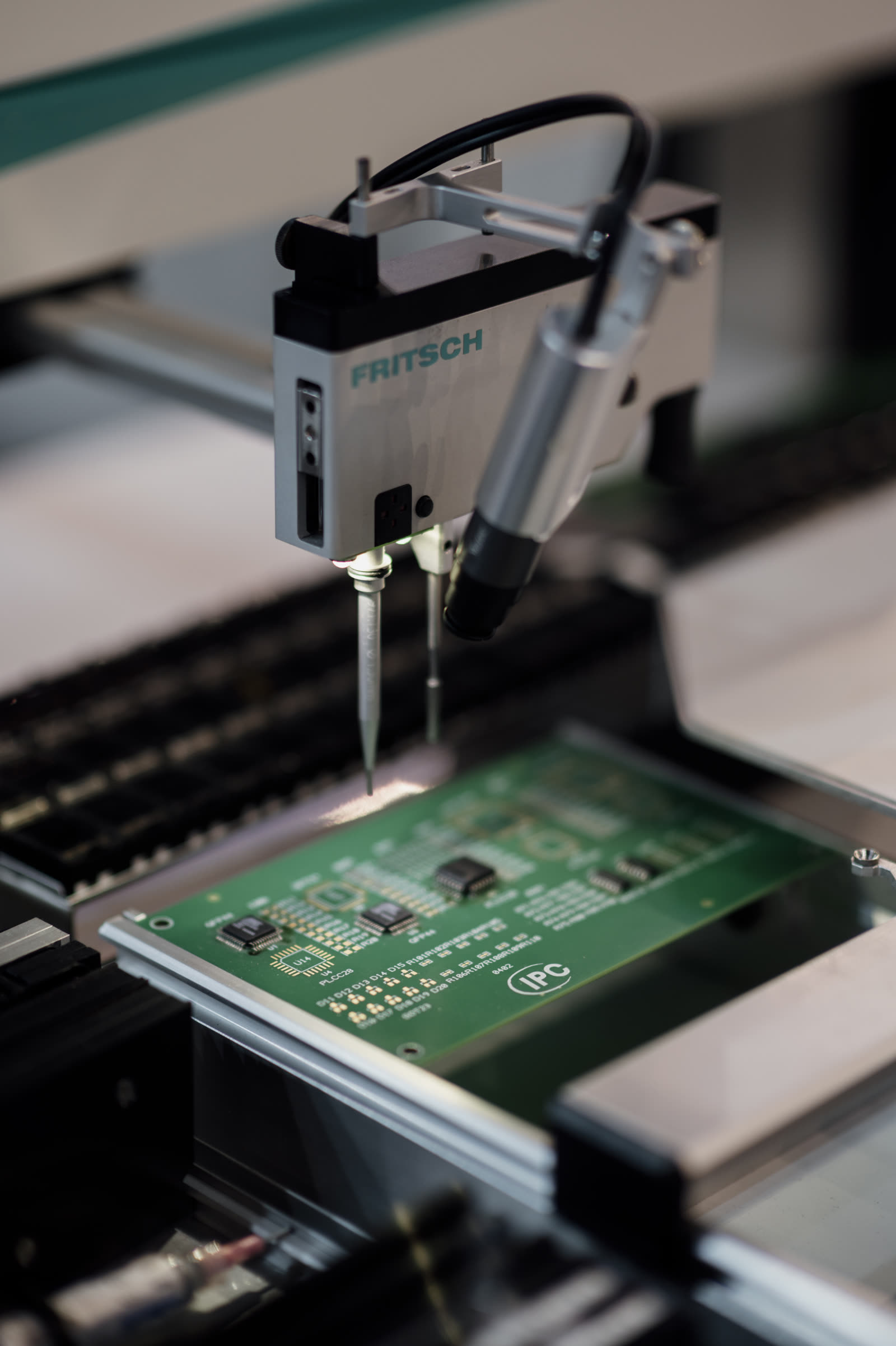
- Wikimedia Commons, "File:Machine places components on a circuit board during manufacturing in a factory environment.jpg" - Shixart1985/Nenad Stojkovic photograph used as the article image.
Editor’s Pick Review
This article takes today’s merged standard/add-on editor-pick slot because it is the strongest candidate created in the last 24 hours under the tightened quality rubric. It scores highest on timeliness, evidence density, numeric anchoring, and decision usefulness: the June 17 earnings release is connected to 10-K working-capital mechanics, Hanley power-management depth, domestic AI-infrastructure capacity, margin targets, free-cash-flow guidance, customer concentration, and a concrete two-period falsifier. The visual also passes the updated image policy: it is an immersive, topic-grounded manufacturing photograph, not an analytical diagram, and it reinforces the article’s core claim that factory execution converts AI-infrastructure demand into cash. The Chinese edition preserves the argument in formal analytical Chinese with stable finance terminology, readable sentence progression, and low translationese, so the pick holds across both language surfaces.