Abbott's second quarter contains two versions of growth. The first is the 13.0% reported sales increase in the headline. The second is the 4.8% comparable increase meant to describe the business after putting Exact Sciences into both periods, removing currency effects, and excluding an unusual Structural Heart compensation stream. The first version says the company became much larger. The second says the underlying portfolio has not yet reached the 6.5% to 7.5% growth Abbott still promises for the full year.[1]
That distinction is the quarter's headline-versus-underlying gap. Abbott's familiar case—durable medical-device growth, a scaled diabetes platform, and a new cancer-diagnostics franchise—did not change. What changed is the burden of proof. With first-half comparable sales up only 4.3%, the second half must accelerate materially. Using Abbott's disclosed full-year base and first-half reconciliation, the annual guide implies roughly 8.6% to 10.5% comparable growth in the second half, depending on the endpoint—our calculation, not a separate management forecast.[1][7] At the same time, $0.53 of GAAP diluted EPS must be reconciled with $1.31 of adjusted EPS before a reader can decide how much of the earnings progress is operational and how much remains outside the reported result.[1]
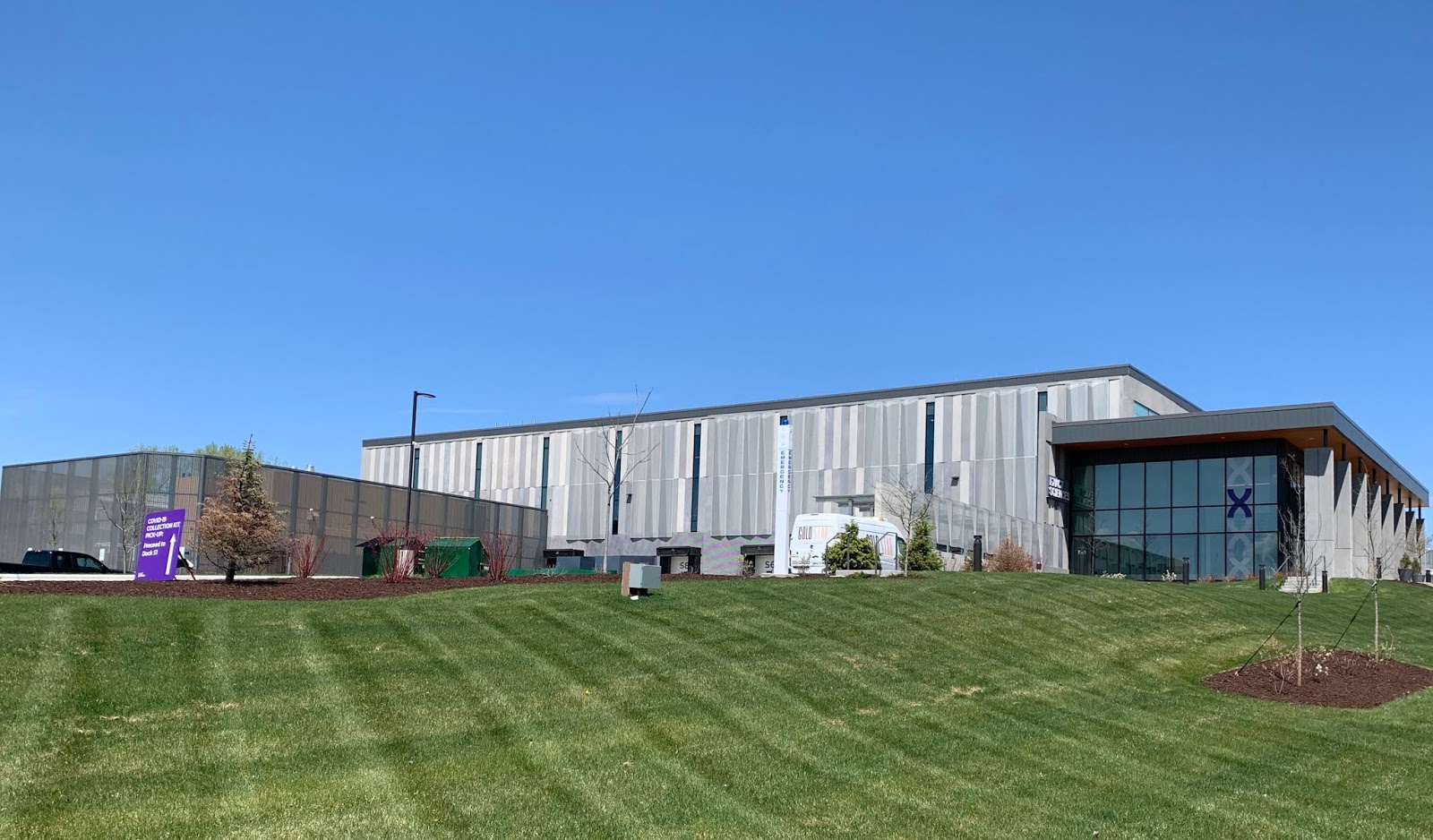
Image context: the cover is a real 2020 photograph of the Exact Sciences laboratory in Madison, not a logo graphic or generated corporate scene. The building makes the quarter's accounting boundary physical: Abbott acquired Exact Sciences on March 23, 2026, and now reports its sales as Cancer Diagnostics. Comparable growth puts those sales into both periods; reported growth does not.[1][4][6]
The 13% Headline Is a Perimeter Change, Not an Organic Print
Second-quarter sales were $12.593 billion, up 13.0% as reported. Abbott's comparable measure rose 4.8%. Its definition matters: the calculation includes Exact Sciences sales in both the current and prior-year periods, excludes foreign exchange, and removes Structural Heart compensation revenue from both periods. It is therefore a pro forma operating comparison, not simply reported growth with currency stripped out.[1]
Diagnostics shows why the reconciliation cannot be skipped. Segment sales rose 42.3% reported after Abbott completed the Exact Sciences acquisition on March 23, but only 2.9% comparable. Inside that segment, the newly reported Cancer Diagnostics business generated $919 million and grew 13.3% comparably. Core Laboratory Diagnostics grew 3.2%, while Rapid and Molecular Diagnostics fell 8.0% as respiratory-test demand weakened.[1][4]
The acquisition is producing a real growth asset; it is not producing 42% underlying Diagnostics growth. Cancer Diagnostics has to keep compounding while the slower legacy lines stop diluting it. That is a harder claim, but also a more useful one.
Devices Still Earn the Benefit of the Doubt
The strongest counterweight sits in Medical Devices. The segment produced $5.853 billion of sales and 8.4% comparable growth. Electrophysiology grew 13.4% comparably, helped by Abbott's pulsed-field-ablation portfolio. Diabetes Care reached $2.188 billion, while continuous-glucose-monitor sales rose 9.5% comparably.[1][2]
Those are not acquisition-created comparisons. They show that Abbott still owns large franchises growing near or above the company target. Established Pharmaceuticals added 8.7% comparable growth as well. The drag was Nutrition, down 3.6% comparably after lower volumes and pricing actions, although its sales improved by $127 million from Q1.[1]
The portfolio mechanism is now clear. Devices and branded pharmaceuticals must supply high-single-digit growth; Cancer Diagnostics must add a new double-digit leg; Nutrition and the weaker Diagnostics categories must stop absorbing so much of that progress. If that mix works, the second-half acceleration is plausible. If it does not, the unchanged sales guide will have depended too heavily on the word “momentum.”
The EPS Beat Needs an Earnings-Quality Bridge
Abbott's adjusted result was solid. Adjusted diluted EPS rose 4.0% to $1.31, the top of the $1.25-to-$1.31 range issued in April. Adjusted net earnings rose 3.5% to $2.290 billion.[1][3] The official call summary says sales and adjusted EPS exceeded expectations, but it does not identify the consensus provider or timestamp; the cleaner benchmark is therefore Abbott's own prior guide.[2][3] Another constraint is visible in the filed rows: net interest expense rose to $299 million from $50 million, a $249 million year-over-year headwind before tax.[7]
The GAAP result moved the other way. Diluted EPS fell from $1.01 to $0.53, and net earnings fell 47.8% to $928 million. Abbott excluded $1.362 billion after tax, or $0.78 per share, to reach its adjusted result. The reconciliation identifies $658 million of pre-tax intangible amortization and another $519 million of expenses associated with acquisitions, legal reserves, investment impairments, and other items. The filed detail puts $385 million of that second bucket in a legal reserve.[1][7]
Two mistakes are possible here. The bullish mistake is to call the entire $0.78 gap harmless acquisition accounting. Abbott's own categories are broader than that, and legal reserves and impairments are not the same thing as non-cash amortization. The bearish mistake is to treat amortization as if it were a fresh cash outflow or proof that Exact Sciences is destroying value. Purchase-accounting expense can be economically informative without being a current cash cost.
The right conclusion is narrower: adjusted EPS describes the operating run rate management wants investors to use, while GAAP EPS shows that the cost of getting to that run rate is still unusually large. The earnings release does not provide a full cash-flow statement, so cash conversion should be judged from the forthcoming Q2 filing rather than inferred from the EPS reconciliation alone.
A Raised EPS Range Defines the Second-Half Allocation
Abbott kept its 2026 comparable-sales guide at 6.5% to 7.5% and raised adjusted-EPS guidance from $5.38–$5.58 to $5.45–$5.60. The lower bound moved by seven cents, the upper bound by two cents, and the midpoint by 4.5 cents. This is a real raise, but not a wholesale change in the earnings path.[1][3]
The arithmetic defines what remains; it does not, by itself, prove unusual seasonality. First-half adjusted EPS was $2.46. The new full-year midpoint is $5.525, leaving $3.065 for the second half—about 25% more than Abbott earned in the first half. Q3 guidance of $1.38 to $1.46 has a $1.42 midpoint; hitting both midpoints would leave roughly $1.645 for Q4. That allocation is consistent with management's forecast of accelerating sales and earnings, and it shows how much execution still sits in the final two quarters.[1][2]
What Would Prove This Reading Too Cautious
The cautious reading is falsified if three things happen together: second-half comparable growth accelerates enough for the full-year result to land inside the 6.5% to 7.5% range; Cancer Diagnostics remains double-digit while Medical Devices holds high-single-digit growth; and the GAAP-to-adjusted EPS gap narrows materially from $0.78 without Abbott trimming its $5.45-to-$5.60 adjusted guide.
That outcome would show the Q2 gap was a temporary combination of transaction accounting and an early-year portfolio lull. The downside signal is the reverse: another sub-guide comparable print, Cancer Diagnostics decelerating toward the rest of Diagnostics, or a wide exclusion gap that persists without clearer cash-flow support.
The Dated Watchlist
By the Q2 Form 10-Q: read the cash-flow statement, acquisition accounting, debt movement, and detailed specified-item footnotes. The release supplies the earnings reconciliation but not enough information to call the $0.78 EPS gap cash-like or non-cash in aggregate.[1]
September 30 — Q3 closes: compare adjusted EPS with the $1.38-to-$1.46 guide, but put total comparable sales growth first. Cancer Diagnostics' 13.3%, Medical Devices' 8.4%, CGM's 9.5%, and Nutrition's negative 3.6% are the operating baselines; the company-wide trajectory must build toward the 8.6%–10.5% second-half requirement.[1][7]
At the next earnings call: Abbott's investor calendar had not yet posted a Q3 2026 date as of July 18.[5] The decisive question is whether acceleration is broad enough to lift the company measure, rather than another quarter in which a 13% reported headline does the rhetorical work.
December 31 — the full-year test: the final scorecard is 6.5% to 7.5% comparable sales growth and $5.45 to $5.60 of adjusted EPS, accompanied by a more legible bridge to GAAP earnings.[1]
Abbott did not report a bad quarter. It reported a quarter in which the best businesses remained healthy, the acquired business added a credible new growth line, and adjusted guidance moved up. But the headline combined those facts with a perimeter change. From here, the investment case needs the underlying number—and eventually the reported earnings—to catch up.
Sources
- Abbott, “Abbott Reports Second-Quarter 2026 Results and Raises Full-Year EPS Guidance” (July 16, 2026) — reported and comparable sales, segment results, GAAP and non-GAAP reconciliation, Q3 guidance, and full-year outlook.
- Abbott, “Abbott's Q2 2026 earnings call: What drove results and what should investors watch next?” (July 16, 2026) — management's official call summary and second-half operating commentary.
- Abbott, “Abbott Reports First-Quarter 2026 Results; Updates Guidance to Reflect Acquisition of Exact Sciences” (April 16, 2026) — prior EPS range, Q2 guide, and pre-quarter operating baseline.
- Abbott, “Abbott completes acquisition of Exact Sciences” (March 23, 2026) — closing date, transaction rationale, and acquired cancer-screening portfolio.
- Abbott Investor Relations, “Events & Presentations” — official earnings-event calendar, checked July 18, 2026.
- Gnesener1900, “Exact Sciences Lab, Madison WI” — Wikimedia Commons source page for the real photograph used as the lead image; photographed May 6, 2020; CC BY-SA 4.0.
- U.S. Securities and Exchange Commission, Abbott's Q2 2026 Exhibit 99.1 (filed July 16, 2026) — filed sales reconciliation, specified-item detail, income-statement rows, and guidance.