Priced: APi Group is no longer valued like a project contractor. At the July 17 close of $40.12, the market assigns the company at least 16.3 times the midpoint of updated 2026 adjusted-EBITDA guidance using the March balance sheet. That deliberately conservative cross-check pairs a pre-acquisition balance sheet with post-deal guidance.[1][3][5]
New: the next proof is not that fire-safety inspections recur. It is whether APi can turn those inspections and its latest acquisitions into a higher service mix while moving consolidated adjusted-EBITDA margin from roughly 13.8% at the 2026 guidance midpoint toward 16% or more in 2028, without allowing leverage or recurring add-backs to absorb the gain.[2][3][8]
The market already pays for a service company
Start with a valuation that is intentionally simple enough to audit. APi had 433.2 million common shares outstanding on April 23. At $40.12, that implies equity value of about $17.38 billion. March 31 debt was $2.76 billion and cash was $645 million, producing net debt of about $2.12 billion and a rough enterprise value of $19.50 billion.[1][5]
APi's June update put 2026 adjusted EBITDA at $1.165 billion to $1.225 billion. Dividing the rough enterprise value by the $1.195 billion midpoint gives 16.3 times.[3] This is a lower-bound cross-check, not a precise pro forma multiple: the balance sheet predates the June closing of Onyx-Fire, while the EBITDA guide includes only the expected 2026 contribution from that acquisition. The exercise is still useful because it establishes the burden of proof. Buyers are already capitalizing APi as a high-quality recurring-services platform.
That distinction matters. A cheap contractor can rerate merely by replacing erratic projects with steadier work. APi has already told investors that story, executed enough of it to earn a premium, and set a new target. The shares now need the inspection flywheel to improve the income statement faster than acquisitions complicate the denominator.
Inspection is the lead, not the finished product
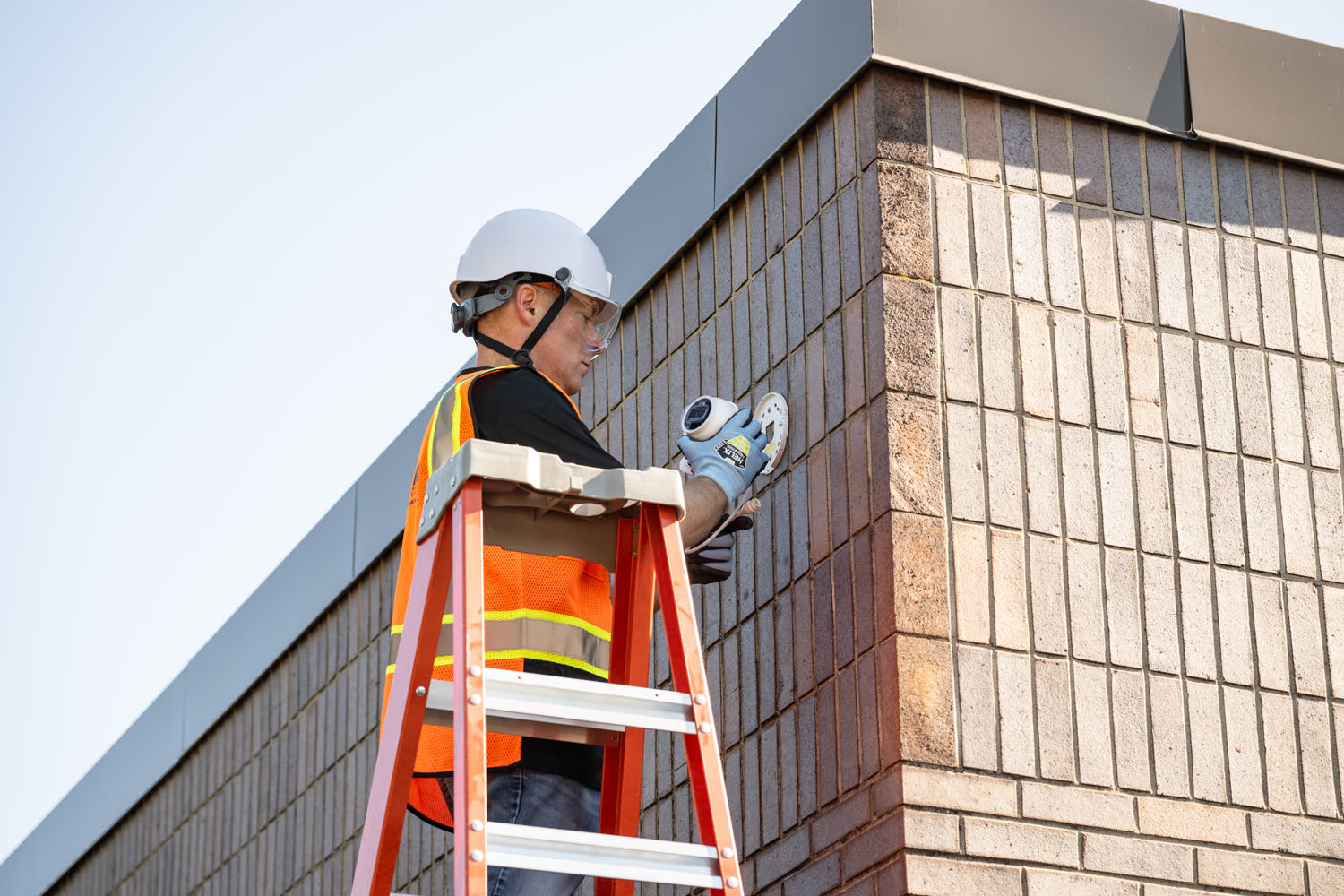
APi's mechanism begins with a mundane visit. Its annual report says inspections of existing life-safety systems are often required by law or insurance mandates and that nearly all facilities with such systems must have them inspected at least annually.[4] The company performs design, installation, inspection, monitoring, maintenance, and repair across fire sprinklers, alarms, suppression systems, security, and other building systems.[4][7]
The inspection itself creates three economic advantages. It puts a technician inside the customer's operating environment on a recurring schedule. It reveals deficiencies that may require repair or replacement. And it gives APi a path from one system or site into monitoring, service, retrofit, or a multi-location account. The causal chain is therefore:
required inspection -> documented deficiency -> repair or monitoring work -> repeat service relationship.
This is stronger than a one-off installation model, but it is not automatic recurring revenue. A customer can tender the repair separately. A local branch can inspect well and sell poorly. A technician shortage can constrain the number of visits. An acquired company can bring attractive contracts but also different systems, pricing, and labor practices. The quality of the model lives in conversion and retention, not in the word “required.”
Q1 passed the growth test and exposed the mix test
The first quarter supplied evidence for both sides. Revenue rose 15.3% to $1.982 billion, including 10.4% organic growth. Adjusted EBITDA increased 21.8% to $235 million, and adjusted-EBITDA margin expanded 70 basis points to 11.9%.[2] Those are premium-business numbers, especially in a seasonally lighter quarter.
Yet adjusted gross margin fell 40 basis points to 31.3%. APi attributed the pressure mainly to business mix, partly offset by customer and project selection and pricing.[2] Safety Services was healthier: revenue reached $1.415 billion, organic growth was 5.4%, gross margin improved 40 basis points to 37.2%, and segment earnings margin rose 60 basis points to 16.3%.[2] The gap between that segment margin and the lower consolidated result shows why mix matters. APi can own a high-quality life-safety engine while project work, Specialty Services, corporate cost, and integration spending still determine what shareholders receive.
The adjusted bridge deserves equal attention. Q1 net income was $57 million and conventionally calculated EBITDA was $185 million, while adjusted EBITDA was $235 million. The $50 million difference included $27 million of systems and business-enablement expense and $19 million of acquisition and divestiture expense.[2] Those may be reasonable exclusions during a buildout. They cannot behave like a permanent second operating budget if investors are asked to value the adjusted margin as durable.
Acquisitions make the service mix richer—and harder to audit
APi invested more than $1 billion across CertaSite, Wtech, and Onyx-Fire, according to its Q1 update.[2] Each deal points toward the same strategic destination, but the disclosed economics differ.
Onyx-Fire operates 18 Canadian branches and generated more than half of its revenue from inspection, service, and monitoring when the transaction was announced. APi expects roughly $190 million of annual revenue from the business.[9] When the deal closed, APi lifted its 2026 revenue midpoint by $100 million and adjusted-EBITDA midpoint by $15 million. That change implies about a 15% margin on the incremental guidance contribution, an inference rather than a separately reported Onyx forecast.[3]
This is promising precisely because it is measurable. If an inspection-heavy acquisition enters near the group's long-term margin target, it should improve mix rather than merely enlarge revenue. But acquisition accounting can obscure the early score: purchase-price amortization, transaction expense, systems investment, financing, and partial-period contributions all move at once. Q2 needs to make the underlying service economics clearer, not simply produce a larger adjusted number.
A simple 2028 valuation grid
APi's “10/16/60+” framework targets at least $10 billion of revenue and at least a 16% adjusted-EBITDA margin by 2028, with more than 60% of revenue eventually coming from inspection, service, and monitoring.[8] At the minimum revenue and margin targets, adjusted EBITDA would be $1.6 billion.
The following sensitivities are not price targets. They hold the April share count constant, use explicit net-debt assumptions, and show how much of the outcome depends on both execution and the exit multiple:
- Downside — about $34 per share: $9.5 billion of revenue, a 14.5% margin, a 12-times enterprise multiple, and $2.0 billion of net debt. Growth lands below target, margin expansion stalls, and the market stops paying a full service premium.
- Base — about $48 per share: $10.0 billion of revenue, a 16.0% margin, a 14-times multiple, and $1.5 billion of net debt. APi reaches the operating targets, but the multiple settles below today's lower-bound 16.3 times.
- Upside — about $62 per share: $10.5 billion of revenue, a 16.5% margin, a 16-times multiple, and $1.0 billion of net debt. Service mix moves beyond the minimum target, acquisitions integrate cleanly, and cash generation reduces leverage.
The spread is instructive. The base case offers only a moderate absolute gain from $40.12 through 2028 despite successful execution, because some of the target is already in the price. The upside requires more than reaching $10 billion: margin, debt, and the premium multiple must all cooperate. The downside does not require a collapse in revenue; a smaller margin shortfall plus multiple compression is enough.
The strongest counterweight
The cautious valuation view can understate how powerful mandatory contact is in a fragmented market. APi can combine local technicians and customer relationships with shared systems, purchasing, training, and national-account coverage. Its annual report describes more than 500 locations across over 20 countries and low customer concentration, while the July earnings notice says the footprint now exceeds 600 locations.[4][6] That is real density, not an abstract subscription metaphor.
The Q1 result also showed operating leverage despite the gross-margin decline: adjusted EBITDA grew faster than revenue, and Safety Services expanded both gross and segment margins.[2] If the acquisitions bring inspection-rich books of business that local branches can cross-sell without sacrificing customer intimacy, the 60% service-mix target may prove conservative.
Falsifier
The valuation caution is wrong if APi can make the premium self-funding. The clean proof would be Q2 and subsequent results that meet or exceed revenue and adjusted-EBITDA guidance, lift inspection/service/monitoring mix, expand gross and consolidated margins, reduce the share of earnings excluded as systems or deal costs, and establish a credible post-acquisition leverage decline.[1][2][3]
The thesis strengthens if revenue grows mainly through acquired or project work while gross margin stays compressed, adjusted EBITDA requires persistent add-backs, or the company reaches toward 60% service revenue without converting that mix into cash and lower leverage. In that case, the market would be paying a service multiple for a roll-up whose clean economics remain just out of view.
Watchlist
- July 30, 2026 — Q2 results: compare revenue with the pre-Onyx guide of $2.175 billion to $2.225 billion and adjusted EBITDA with $300 million to $310 million. More important, separate organic Safety Services growth, gross-margin movement, service mix, and the size of systems and acquisition add-backs.[2][6]
- Full-year 2026 update on July 30: test the current $8.575 billion to $8.775 billion revenue range and $1.165 billion to $1.225 billion adjusted-EBITDA range against the partial Onyx contribution, Wtech timing, and the post-deal leverage path.[3][6]
- Year-end 2026 filing: reconcile adjusted free-cash-flow conversion with actual cash from operations, capital expenditure, acquisition payments, debt, cash, and share count. A service-mix strategy should make the cash bridge easier to read over time, not harder.[1][2]
- 2028 target window: require all three parts of “10/16/60+” to arrive together. Revenue without margin is scale; service mix without cash conversion is labeling; margin without fewer adjustments is incomplete proof.[8]
APi owns a better business than the word “contractor” suggests. Annual inspections create recurring access to systems that building owners cannot simply ignore, and the company's branch network can turn that access into repair, monitoring, and retrofit work. The valuation already recognizes the architecture. From here, the inspection has to become service revenue, the service revenue has to become clean margin, and the clean margin has to reach shareholders before the premium gets inspected too.
Sources
- APi Group, Form 10-Q for the quarter ended March 31, 2026 — common shares outstanding, debt, cash, cash flow, acquisitions, repurchases, and reported financial statements.
- APi Group, “APi Group Reports First Quarter 2026 Financial Results” (April 30, 2026) — consolidated and segment growth, margins, adjusted-EBITDA bridge, acquisition investment, and Q2/full-year guidance.
- APi Group, “APi Group Completes Acquisition of Onyx-Fire Protection Services, Inc. and Updates 2026 Guidance” (June 9, 2026) — closing date, annual revenue contribution, inspection-first positioning, and revised revenue and adjusted-EBITDA ranges.
- APi Group, 2025 Annual Report — inspection-first mechanism, statutory and insurance requirements, branch footprint, service offerings, revenue mix, competitive strengths, and risks.
- StockAnalysis, “APi Group Stock Price History” — July 17, 2026 closing share price used as the valuation freeze point.
- APi Group, “APi Group Announces Date of Second Quarter 2026 Earnings Release” (July 16, 2026) — July 30 release and conference-call timing and updated company footprint.
- APi Group, “Services” — official description of design, installation, inspection, and service work and source page for the article's real fire-safety inspection photograph.
- APi Group, “APi Group Announces New Long-Term Financial Targets” (May 21, 2025) — the $10 billion-plus revenue, 16%-plus adjusted-EBITDA margin, and 60%-plus inspection/service/monitoring framework.
- APi Group, “APi Group to Acquire Onyx-Fire Protection Services Inc.” (April 23, 2026) — branch count, inspection/service/monitoring mix, and expected annual revenue.