On a cloudy afternoon in Copenhagen, you can still see which stars hang over City Hall. Come in from Rådhuspladsen, take the first right before the great hall opens out, and look for a glass case about the size of a shop window. The star map occupies one dial of Jens Olsen’s World Clock. The patch of sky it describes belongs to the building you’re standing in. [1][2][3]
A weekday lunch break is a good time to drop in. Give yourself 15 or 20 minutes and walk straight to the case. The Danish walking guide puts the clock before the great hall on its route. Follow that order and you’ll catch the turn that’s easy to walk past. Visitors reviewing the clock single out the free entry. The Museum of Copenhagen lists the exhibition hours as 9 a.m. to 4 p.m. on weekdays and 9:30 a.m. to 12:45 p.m. on Saturdays. Budget 0 kroner for the clock. The 80-kroner ticket on Copenhagen Visitor Service’s November 2026 listing buys a guided tour of City Hall. You can see Olsen’s work independently, without a booking or a wait for a group to assemble. [1][4][5][6]
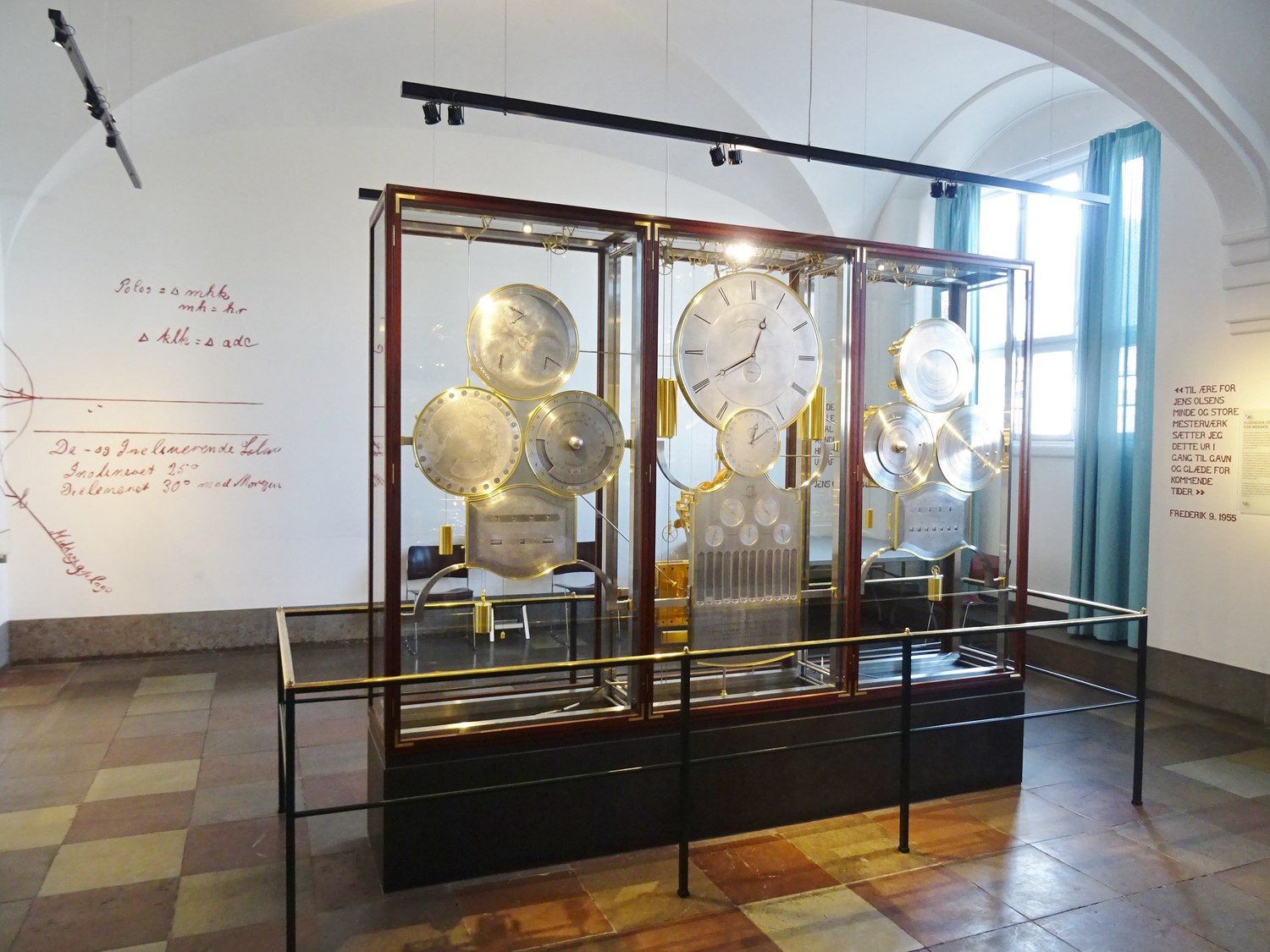
Stand far enough back to see all three panels. Pick out the ordinary time first, then move to the right-hand panel and find the star map above the planetary display. The planets have their own dial because they wander against the background of stars. On the star map itself there is a subtler problem for a clockmaker. Earth’s axis slowly changes the direction it points. A map that kept perfect pace with the turning of the Earth would still, over the centuries, put the celestial pole in the wrong place. Olsen allowed for that with a wheel that takes about 25,753 years to make one revolution. You could spend the entire lunch break looking for that movement. [2][3]
Walk around the end of the case. From the front, a dial can make the position of a planet look as simple to reckon as the minute of the hour. At the back, you can follow the teeth of one wheel into the next and see what it takes to make two things turn at different speeds. There’s gold on the surfaces of the gears. The metal underneath has a more domestic history. During the 1940s, brass utensils from Danish households were melted down to supply much of the brass for the clock. [2][3]
Olsen died in 1945. His clock started ten years later, and someone still has to wind it once a week. Before you leave, come back to the star dial for a second look. That almost imperceptible correction to the Copenhagen sky has been under way since 1955, on a machine that runs a week at a time. [2][3]
Sources
- Muusmann Forlag, Copenhagen walking guide, route through Rådhuspladsen and the City Hall entrance, p. 15
- City of Copenhagen, Jens Olsen’s World Clock, its materials, displays and winding schedule
- William B. Ashworth Jr., Linda Hall Library, “Jens Olsen,” with Bill Robertson’s photographs of the mechanism
- Wanderlog, visitor reviews of the clock and its location inside City Hall
- Museum of Copenhagen, clock exhibition hours and admission
- Copenhagen Visitor Service, guided City Hall visit, price and November 2026 listing
- Leif Jørgensen, photograph of Jens Olsen’s World Clock, Wikimedia Commons, 1 April 2022