The temptation at Jaipur’s Jantar Mantar is to walk straight across the grounds toward the enormous flight of stairs. Stop just inside the entrance instead. The little sundial here, the Laghu Samrat Yantra, gives you a chance to learn where the hand of the big clock will be. On a sunny morning, find the curved scale west of the triangular wall. Pick one engraved line near the edge of the shadow. Give it a minute. The line you picked will be in a different relation to the light, and you’ll know where to look on the great staircase across the grounds. [1][2]
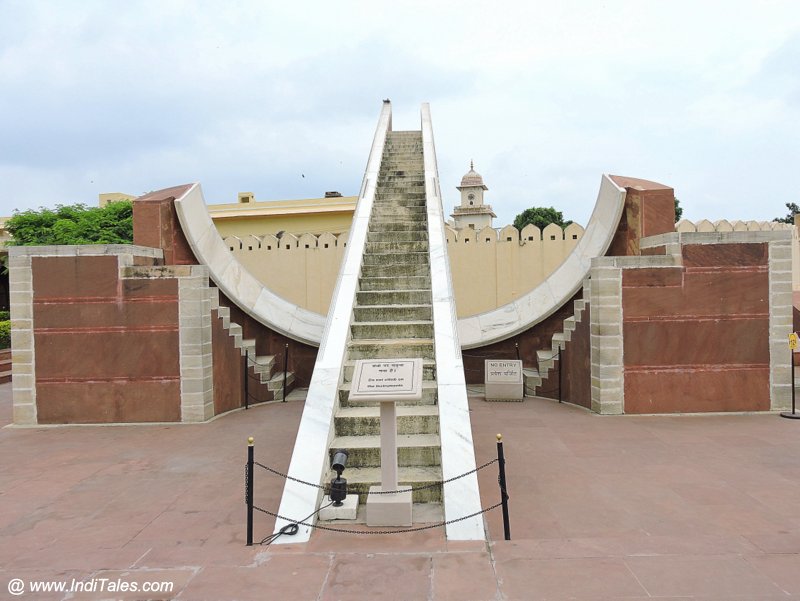
For this particular walk, I’d choose a clear weekday between 10 and 11 in the morning. A January visitor recalled a quiet weekday morning and a much busier weekend, and the shadow needs direct sun to register on the scale. Come to the observatory entrance beside the City Palace. Allow an hour for the pair of dials, including time to buy a walk-up ticket. An October 2026 price check put adult admission at ₹100 for Indian visitors and ₹600 for foreign visitors. Guides charge separately. A visitor who met guides just inside the entrance recommends agreeing on the fee before setting off. Ask yours to show you how to take a reading at the little dial, then let you try the second one yourself. [1][2][3][4]
The sloping edge on each triangle runs parallel to Earth’s axis. In the morning the Sun shines from the east and throws the edge’s shadow onto the western scale. Come back after local solar noon and you’ll need to change sides. Jaipur’s astronomers could mark equal intervals of time along those curves. By making the second instrument so large, they spread the same hour over a longer stretch of stone. The little dial reads to about twenty seconds. On the Vrihat Samrat Yantra, diagonally across the grounds, the finest marks stand just two seconds apart. [1][2][5]
At the big dial, look closely at what happens between sunlight and full shade. The shadow has a fuzzy margin that can cover six or seven of those fine divisions at once. How could anyone read a pair of seconds off that? Photographer Barry Perlus, who documented the instruments, describes an observer holding a thin twig just above the scale and sliding it sideways. The place where the twig’s own shadow disappears locates the middle of the blurred edge. From the visitor path, you can appreciate both parts of the achievement. The masons made room for the marks, and the observer had to know which mark to take. [2]
Now take out your phone. Even a perfect reading can disagree with the time on its screen. The phone keeps Indian Standard Time across the whole country. The stone keeps apparent solar time here in Jaipur, where noon comes when the Sun crosses the local meridian. Converting between the two takes a correction for longitude and another that varies with the date. If you have a guide beside you, ask for today’s correction. That gap between the two readings is something to bring home from Jaipur, right alongside the photograph of the stairs. [2]
Sources
- Anuradha Goyal, IndiTales, “Jantar Mantar Jaipur – Observatory of Sawai Jai Singh,” field account and photograph of the small sundial.
- Barry Perlus, “Samrat Yantra,” photographic observations of the morning and afternoon scales, shadow-reading technique and conversion to standard time.
- Tripadvisor, Jantar Mantar Jaipur, visitor accounts of weekday crowds, admission and hiring guides in 2026.
- Traveliac, Jantar Mantar visitor guide, including an October 2026 check of adult ticket prices.
- Rajasthan Tourism, “Jantar Mantar,” instrument descriptions and the precision of the two sundials.