Stand at the end of a row in the weave room at Lowell’s Boott Cotton Mills Museum and count off two looms. That was one weaver’s assignment when the Massachusetts mill opened in the late 1830s. Now count off twenty. By a century later, management could assign that many to one person. Seen from the doorway, the machines make a handsome repeating pattern. Seen from the spot where a weaver had to keep watch, the same row looks considerably longer. [1]
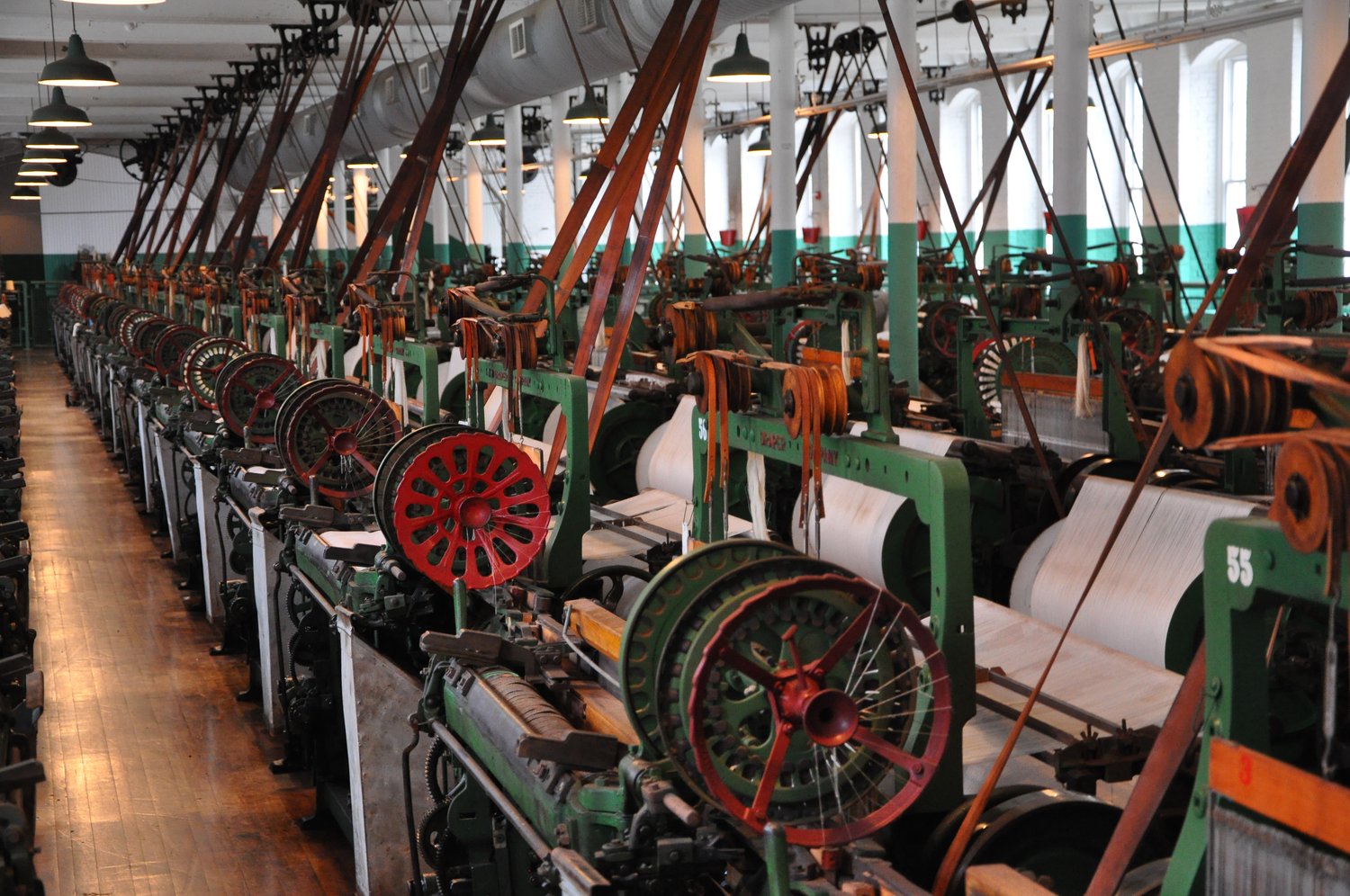
The cloth coming off the looms is toweling, the kind Boott made when it was in business. Pick one machine during the demonstration and watch for the moment a crosswise thread joins the cloth. The instructions for a hand weaver sound simple enough. Open a gap between two sets of lengthwise threads, pass the shuttle through, pack the new thread against the last one, then change the opening and pass the shuttle back. InsideLowell’s account of trying this by hand describes a separate program on the third floor. It is easy to head upstairs in search of the famous looms. For the powered version, stay on the ground floor and go just beyond the ticket desk. [1][2][3]
There is cotton to see even where nobody intended to weave it. When a photographer posted pictures of Boott to Lowell’s community forum, someone asked about the cobwebs on the machinery. Another reader recognized the wisps as cotton fiber. Look for that loose fluff after watching the orderly threads. The museum has restored 88 looms. A working room of the period might have held about 200, throwing enough lint into the air to turn it white. The wisps are a small trace of what a worker breathed through a shift. [4][1]
Aim for the 12:30 demonstration. It lasts about fifteen minutes and runs on both sides of the November 29, 2026 switch to winter hours. On winter weekdays, arrive around noon, when the museum opens. Through March 2027 the doors open at 9 on weekends, with a first demonstration at 10. Allow for the park’s holiday closures, including Thanksgiving. Individual visitors can walk up and buy a ticket at 115 John Street. Admission ranges from free for children five and under to $6 for an adult. [2][5][6]
If you are driving in for that quarter-hour of weaving, the two garages buy different things. The paid Joseph Downes garage at 75 John Street puts you a block from the door. Parking at the Hamilton Canal Innovation District garage on Dutton Street buys you a walk of about 10–15 minutes each way. Ask for its parking voucher at the museum desk while you have your ticket in hand. That makes the Dutton Street garage free for park visitors and saves a detour to the separate visitor center. [2]
Leave a little time after the machinery stops. Upstairs, former mill workers tell their stories in oral-history recordings, and the films have captions. Downstairs you can spend the whole demonstration following a single shuttle and call it a good visit. Upstairs is a chance to hear from the people whose job required them to keep an eye on the rest of the row. [1][6]
Sources
- National Park Service, Weave Room, hosted by UMass Lowell. Looms, toweling and the changing workload.
- Lowell National Historical Park, Boott Cotton Mills Museum. Weave room photograph, demonstration times, admission and parking.
- InsideLowell, “Weave Your Own Bit of Fabric at the Boott Mills Museum!” A participant visits the hand-loom workshop.
- Lowell community forum, “Boott Cotton Mill Museum.” Readers discuss cotton fibers in a photographer’s view of the machinery.
- Lowell National Historical Park, Operating Hours & Seasons. Winter 2026–27 schedule and holiday closures.
- National Park Service, Explore the Boott Cotton Mills Museum. Walk-up admission, oral histories and captioned films.