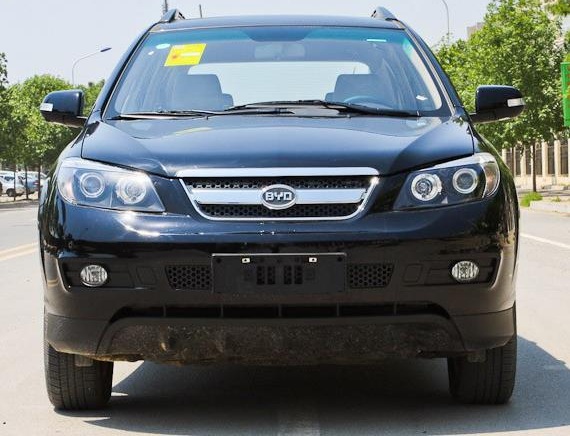
Two dark SUVs in the opening figure of the CompCars paper could pass for each other in profile. Both have a long roof, a rising window line and a little spoiler over the rear glass. Turn them to face the camera and the resemblance weakens. One grille pinches inward between the headlights. The other spreads across the nose in a stack of bright bars. For someone trying to name the model, a camera bolted above a lane has one surprising advantage. Every approaching car offers up roughly the same piece of evidence. [1]
What the camera gives away
A grille stays in one place on a car. It moves all over a photograph. In a three-quarter view one end recedes, and from the rear the grille disappears altogether. In 2013, Jonathan Krause and colleagues used the grille to explain why they wanted to locate distinctive parts on a three-dimensional car surface. CompCars, a collaboration involving the Chinese University of Hong Kong and the Chinese Academy of Sciences, offered another way to study that problem. Its web collection included cars photographed from several angles. Its roadside collection showed them from the front. The lab released the roadside images in September 2015. [2][1][3]
For their roadside test, the CompCars researchers used 44,481 photographs spanning 281 car models. They allocated 70% of the images to training and the rest to testing. Someone had already marked the car's position in each frame. Using that box, the researchers cropped out the car with a little room around it and resized the result. By the time the classifier saw the picture, the job of finding a vehicle in traffic was done. [1]
GoogLeNet, a network pretrained on ImageNet, put the correct model first on 98.4% of the test images. Even the lowest-scoring of the three networks reached 98.0%. The photographs included fog, rain and night scenes. The authors credited the consistent viewpoint with simplifying the task. Each network had learned from thousands of labeled roadside photographs. To repeat the experiment at a new camera site, somebody would have to supply those labels. [1]
Who labels the next lane?
Imagine having the camera and a catalog of labeled publicity shots, with nobody to identify each passing car. A 2020 study used CompCars to approximate that arrangement. Its researchers took labels from website photos and let their system see roadside images during training with the labels withheld. They even screened the web pictures for a visible front end. A clean shot of a trunk might be easy to label, but it offered little help with the view above the lane. [4]
The later study asked for the make. BYD, Honda and Volvo were three of its twenty possible answers. With an AlexNet-based classifier, the baseline got 35.1% right on the roadside task. A method that trained the network to make web and roadside features harder to tell apart and adjusted the classifier reached 50.7%. That 15.6 percentage-point gain is the comparison the experiment supports. Subtracting either score from 98.4% would mix up the effects of changing the labels, the training data and the network. [1][4]
The average also conceals an awkward result for anyone counting passing cars by make. For BYD the adapted classifier recognized about half the examples, up from roughly one in twelve. For Changan it went the other way, from about six in ten to one in three. A traffic survey could gain accuracy overall while getting worse at counting a particular manufacturer's cars. Before putting a figure on that survey, I'd want to see a hand-checked sample from the intended lane, broken down by make. A clear view of the grille settles where to look. The sample tells us how often the name attached to it is right. [4]
Sources
- Linjie Yang and colleagues, A Large-Scale Car Dataset for Fine-Grained Categorization and Verification, updated technical report, Figure 1 and section 6 (2015).
- Jonathan Krause and colleagues, 3D Object Representations for Fine-Grained Categorization, ICCV Workshops (2013).
- CUHK Multimedia Laboratory, CompCars dataset description and dated release notes.
- C²DAN: An Improved Deep Adaptation Network with Domain Confusion and Classifier Adaptation, vehicle experiments, Tables 3–5, Sensors (2020).