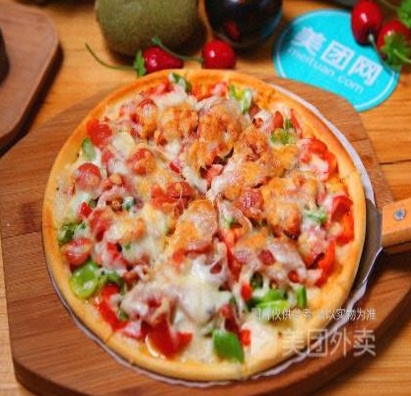
The crust is easy to see. The toppings take a second look. In a photograph from Food2K, a pizza sits on a wooden board, its surface crowded with cheese, green pepper and small pink pieces. The researchers filed it under shrimp pizza. Their model’s first guess was sausage pizza. It had found the right section of the menu and still earned zero credit for its first answer. [1]
Who writes the menu?
In 2014, ETH Zurich’s Food-101 gave researchers a collection of 101,000 images evenly divided among 101 foods. Pizza had one entry. A system that learned to spot the rim of a baked crust could put that clue to work across the whole category. For Food2K, a collaboration between Meituan and the Chinese Academy of Sciences’ Institute of Computing Technology, the researchers split pizza into several dishes. The crust could carry a model only so far. [2][3]
It took human judgment to decide which names deserved their own entries. Meituan had pictures from merchants and diners, along with the words people used for the food. Three names for seafood spaghetti alone included one that specified it was Italian and another that called it “Angel seafood spaghetti.” The team examined the pictures and pooled those names under seafood spaghetti. Shrimp and sausage pizzas stayed separate. Before a model saw a single plate, people had decided which differences in wording it should learn to ignore and which differences in appearance it should learn to preserve. [1]
The team also set a standard for what counted as a usable view. Annotators worked from reference pictures and discarded unclear images and examples in which the food was obscured. The resulting collection held just over a million photographs, each with one dish label. That last detail matters at a table where several people are sharing plates. Asking a camera to find and name everything in the frame introduces a second problem before it ever gets to the shrimp. [1][3]
One guess or five?
In the February 2023 version of the paper, the team reserved 30 percent of Food2K for testing. Its PRENet model with a ResNet-50 backbone saw a square crop from the center of each resized test image. Its first choice matched the assigned dish in 83.03 percent of cases. Allow five guesses and the figure rose to 97.21 percent. Both scores describe the same model looking at the same photographs. What changes is the job the reader imagines giving it. [1]
Suppose a restaurant uploads a photograph and an employee chooses from five suggested menu tags. The second score tells us how often the employee would find the assigned tag somewhere on that list under the study conditions. If the software prints its first guess straight onto the menu, the first score is the relevant one. Figure 8 gives the pizza’s winning prediction. It leaves open where shrimp pizza ranked among the alternatives. [1]
Even a correct first guess answers only the question the researchers posed. To see what it takes to ask a different one, consider Nutrition5k. Its researchers recorded the weight of each ingredient as well as the total weight and calories for individual cafeteria plates. Those measurements let them check a numerical estimate against the meal that was actually served. [4] Two cooks can use very different amounts of cheese and still send out a dish that earns full credit as shrimp pizza. Food2K’s answer key has room for both.
Sources
- Weiqing Min and colleagues, “Large Scale Visual Food Recognition,” February 2023 revision, especially sections 3 and 5 and figure 8.
- Lukas Bossard, Matthieu Guillaumin and Luc Van Gool, Food-101 dataset and evaluation split, ETH Zurich, 2014.
- Meituan Technical Team, research account of Food2K’s dish categories and visual recognition method, February 2023, in Chinese.
- Nutrition5k research team, dataset documentation and per-ingredient measurements.