A mason can measure a brick that is still in the wall. A brick that fell out long ago presents a different problem. Its neighbors may preserve the height of the course and the width of the gap. Where several courses have fallen together, even the height of the old wall becomes a matter of judgment. In 2018, a surveying team at Wuhan University took up that problem at Jiankou, a steep Ming-era stretch of the Great Wall in the hills north of Beijing. One of the things the researchers wanted from an aerial survey was surprisingly ordinary. They wanted a materials list. [1][2]
A tape measure on a mountainside
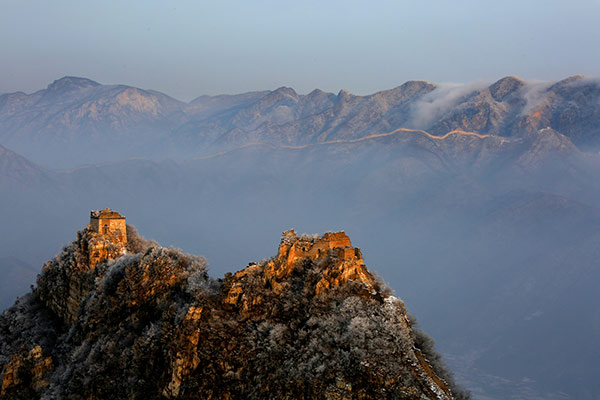
Reaching the face you need to measure is part of the cost of surveying Jiankou. The China Foundation for Cultural Heritage Conservation partnered with Intel to send a Falcon 8+ drone over masonry that was difficult or dangerous to approach on foot. Intel put the difference in field time at about a month for a conventional inspection, using eyes and tape measures, against three days for the drone survey. That was the equipment supplier’s comparison for inspection. The masons still had their work ahead of them. [2][3]
The camera looked sideways as well as down. Imagine flying directly over a parapet. Its top edge is easy to trace, but a gap halfway down the outer face can disappear under the lip. A view taken at a slant brings that face into the frame. Where views overlap, a surveyor can identify the same feature in several photographs and use its shifting position to work out where it sits in three dimensions. Huang Xianfeng’s team brought thousands of such images back to a workstation to reconstruct the surviving wall. [1]
How much masonry belongs in a gap?
That first reconstruction gave the researchers a surface they could inspect from the ground. Huang described a further step. His group used deep learning to locate cracks and brick loss, then simulated how the damaged masonry might once have looked. Comparing the surviving surface with a proposed reconstruction gave engineers a way to estimate the dimensions and quantities of materials for a repair. Each version of the wall answered a different question. A photograph could support a measurement of the surviving edge. Extending that edge across a breach required someone to decide how far the evidence carried. [1]
Consider what happens to the materials list if an engineer raises a reconstructed parapet by a single course. Across a long gap, that small choice adds a row of bricks to be made or found, carried up the ridge and laid. More camera angles might settle the question if a remnant of the course survives around a corner. If the whole course is gone, a sharper photograph of the void leaves the historical question open. A conservationist reviewing the estimate would want to be able to turn off the proposed additions and see the masonry that prompted them. [1][4]
At defensive tower No. 152, the foundation and a separate team from Peking University made a record that works in the other direction. They documented the repairs to the tower and the adjoining stretches of wall as the work proceeded, creating a three-dimensional archive of the intervention. The distinction matters most after the scaffolding comes down. A future surveyor could photograph a handsome, continuous course of brick and take it as evidence of how the tower was originally built. The repair record gives that surveyor a chance to see which part of the course the last crew laid. [4]
Sources
- Wuhan University, “Inheriting of the Great Wall miracle with AI Technology,” September 2018. Huang Xianfeng’s account of the survey and materials estimate.
- Intel, “Intel Technology Aids in Preserving the Great Wall of China,” July 2018. Field survey and inspection-time comparison.
- China Culture, “Intel and Chinese foundation to use AI, drone technology to help preserve Great Wall,” April 2018. Project announcement and Xinhua photograph of Jiankou.
- Historic England, Wall to Wall management seminar proceedings. The China Foundation for Cultural Heritage Conservation’s account of Jiankou and tower No. 152, pp. 149–150.