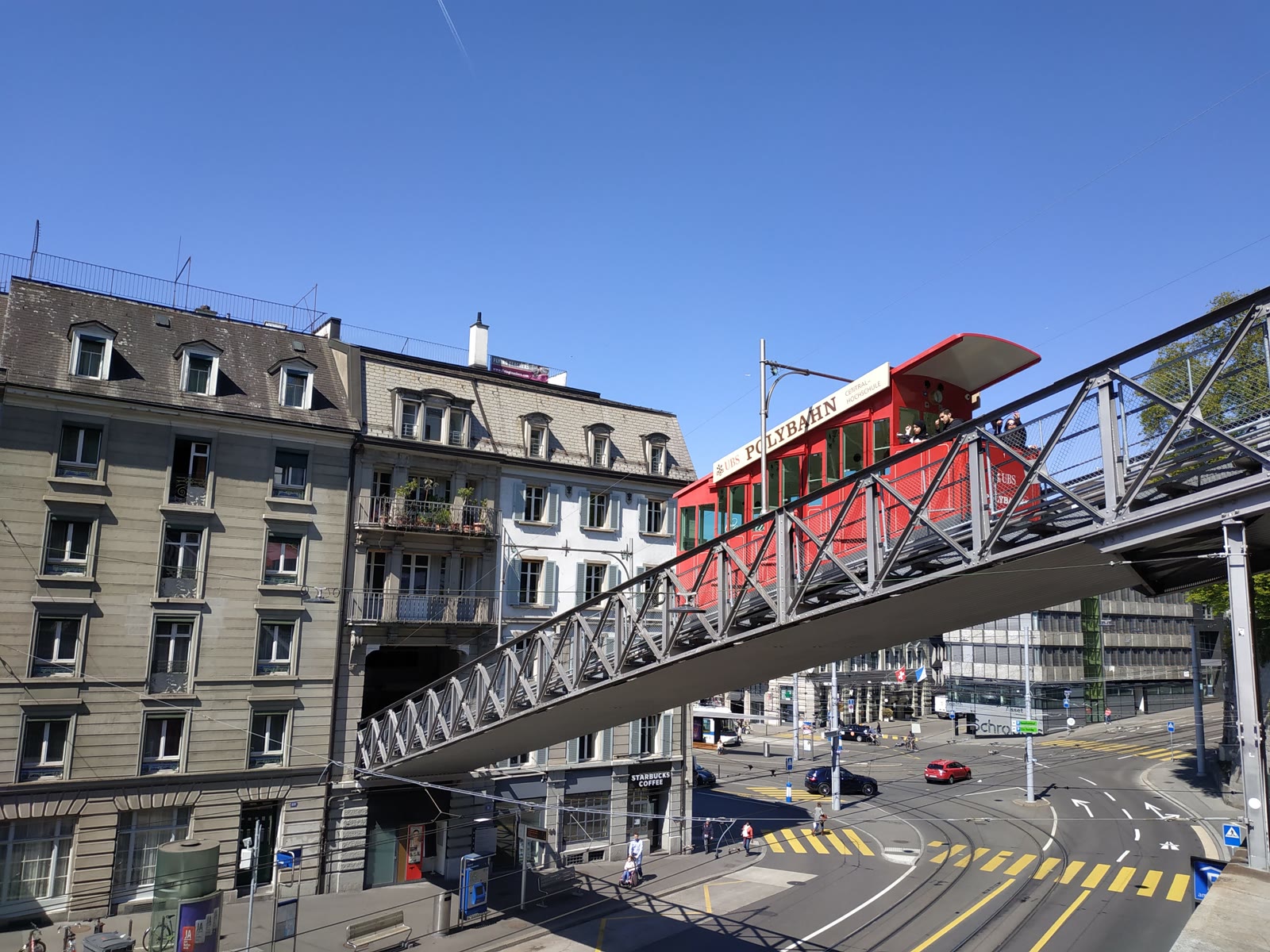
Zurich has bigger set pieces than this, but not many routes that explain the city so quickly. The useful move is compact: start at Central, take the Polybahn up to the Polyterrasse, then walk back down into the old town and finish at Lindenhof.[1][2][3] One anchor gives you Zurich's student-facing vertical logic; the other gives you the older hill where the city slows into benches, chessboards, and a view over the Limmat.[2][3]
That pairing works because the climb is real but tiny. The tourism board's Polybahn page calls it the shortest connection from Limmatquai to Zurich University and ETH, notes that the ride takes just 100 seconds, and says the train has been in service since 1889.[2] The operator's own page is even more practical: the little red car runs every 5 minutes, from 06:30-21:00 on weekdays, 07:30-21:00 on Saturday, and 09:00-21:00 on Sundays and public holidays.[1] Once you know that, Central stops being a transit blur and becomes the lower edge of one deliberate climb.
Lindenhof changes the feeling of the route. Zurich's official page describes it as a former Roman fort site and a historical square where the oath sealing the Helvetic Constitution was taken in 1798; today it is also a meeting point for chess players.[3] That is the detail that matters. Lindenhof is not only a viewpoint. It is one of those Zurich places where civic memory and everyday use still occupy the same paving stones.
Image context: the cover uses a real Wikimedia Commons documentary photograph of the Polybahn, because the carriage itself is the best recognition cue for this route. If the red car is not in the frame, the climb loses its identity.[7]
Why this Zurich sequence lands better than treating both stops as separate lookouts
The first advantage is compression. The Polybahn ride itself lasts 100 seconds.[2] Lindenhof sits only 533 m and about 7 minutes from Zurich Main Station according to the official page.[3] That scale keeps the route urban and repeatable. You are not building a half-day excursion. You are reading the old core through two short changes in elevation.
The second advantage is that each stop corrects the other. Polyterrasse can become too neat if you stop there alone: a clean terrace, a campus edge, a postcard view. Lindenhof by itself can become too passive: a bench, a photo, a square you pass through. Put them together and the city gets sharper. The Polybahn tells you Zurich still values exact, practical infrastructure. Lindenhof tells you the city also keeps room for old habits, slow sitting, and public play.[1][2][3][6]
The third advantage is behavioral. Google Maps still treats both the Polybahn and Lindenhof as living places with current review traffic rather than heritage shells.[4][5] Tsuri's Kreis 1 guide adds the right local texture for Lindenhof in warm weather: people use it for a casual round of boules rather than only for scenic hovering.[6] That is the route's real payoff. You move from a piece of functioning transit into a hill that still behaves like neighborhood public space.
Use the red car as the clock
The cleanest version begins at Central because the Polybahn gives the outing its first discipline. The operator posts not only the every-5-minute rhythm but also planned daytime closures for brake tests; on January 15, February 19, March 12, April 16, May 21, June 18, July 16, August 20, September 17, October 15, November 12, and December 17, 2026, the line is scheduled to be out until about 17:00.[1] That is exactly the kind of small operational fact visitors miss and locals respect.
Fare logic is similarly small but worth getting right. Polybahn's own site lists a CHF 1.20 single special ticket and a CHF 7.20 six-ride card, then adds the more useful detail: the funicular sits inside ZVV zone 110, so no extra ticket is needed if your city ticket already covers that zone.[1] Zurich.com's Polybahn page adds that the ride is also free with the Zurich Card.[2] The local move is not spending more money than the route requires.
After the climb, do not linger too long on the upper terrace if the light is shifting. Polyterrasse gives the broad read; Lindenhof gives the older, slower one. The route gets strongest when you keep the descent purposeful and arrive at Lindenhof while there is still enough light to see the river, the church towers, and the chess tables share the same square.[2][3]
8 local moves that make this two-level Zurich stop read correctly
First, start at Central instead of walking the hill cold. The whole point is to let Zurich's shortest useful climb do the opening work for you.[1][2]
Second, treat weekday blue hour as the sweet spot. With weekday service running until 21:00, you can still use the funicular late in the day without forcing the route into a rush.[1]
Third, check whether your fare already covers the ride. If you are already riding within ZVV zone 110, the Polybahn does not need a second purchase; if not, the special single ticket is just CHF 1.20.[1]
Fourth, keep Polyterrasse as a first pause, not the entire outing. One look over the old town and the lake is enough before you turn the route downhill.[2]
Fifth, walk to Lindenhof instead of swapping back into transit. The route gains force from continuity: one mechanical ascent, one human-scale descent, one older hill at the end.
Sixth, read Lindenhof as a lived square, not a scenic platform. The official page's chess-player note and Tsuri's boules reference are the clue that locals use the place for lingering, not only for photography.[3][6]
Seventh, sit on the edge, not in the middle churn. The better pause is on a bench or wall line facing the river side, where the old town roofscape stays in front of you and the square's social life stays audible beside you.[3][5]
Eighth, watch the maintenance calendar if you are doing this as an afternoon control move. A brake-test Thursday can turn the Polybahn from opening act into a closed gate until roughly 17:00.[1]
Non-local trapline: 4 common mistakes and the better move
Mistake 1: walking uphill from Central and missing the point of the route
Better alternative: use the Polybahn first. The ride is short, cheap, and structurally the reason this Zurich sequence feels precise.[1][2]
Mistake 2: buying an extra ticket without checking your zone coverage
Better alternative: remember that the line sits inside ZVV zone 110 and is also covered by the Zurich Card.[1][2]
Mistake 3: treating Lindenhof as a two-minute photo stop
Better alternative: stay long enough to let the square reveal its public habits: chess, sitting, quiet conversation, and the older-city pace that the Polyterrasse does not give you.[3][5][6]
Mistake 4: showing up on a listed brake-test day and assuming the car will be running anyway
Better alternative: use the operator's 2026 maintenance calendar and avoid the pre-17:00 dead zone on those named Thursdays.[1]
Concrete go details
- Best window: weekday late afternoon into blue hour, with the Polybahn still running until 21:00 and the downhill walk to Lindenhof done in the last good light.[1][3]
- Expected spend: CHF 0-1.20 for the core route if you are already covered in ZVV zone 110; otherwise buy the Polybahn single ticket at CHF 1.20.[1]
- Queue and reservation reality: no reservation layer; the real operational constraint is the every-5-minute rhythm and the few brake-test dates when service is interrupted until about 17:00.[1]
- Where to stand or sit: take the Polyterrasse railing for the first broad view, then keep your real pause for Lindenhof's river-facing edge or the benches near the chess side of the square.[2][3][5]
- Navigation cue:
Central -> Polybahn -> Polyterrasse -> downhill through the old-town side streets -> Lindenhof. - Numeric anchors worth keeping: 100 seconds, 5 minutes, 06:30, 07:30, 09:00, 21:00, CHF 1.20, CHF 7.20, 1889, 533 m, 7 minutes, 1798.[1][2][3]
Zurich can feel polished to the point of abstraction if you only collect its postcard edges. This route fixes that. The Polybahn gives the city one small act of exactness, Lindenhof gives it one older social room, and the walk between them is short enough that the two heights still feel like one place.
Sources
- UBS Polybahn, official site (current every-5-minute timetable, 2026 brake-test closure dates, CHF 1.20 single ticket, CHF 7.20 six-ride card, and zone 110 fare note).
- Zuerich.com, "Polybahn" (official tourism page covering the 100-second ride, 1889 opening, 50-person car, every 2-5 minute service, and Zurich Card note).
- Zuerich.com, "Lindenhof" (official tourism page covering Roman-fort history, the 1798 Helvetic Constitution oath, chess-player use, and the 533 m / 7 min proximity to Zurich Main Station).
- Google Maps search, "Polybahn Zurich" (current place-status and community-review surface).
- Google Maps search, "Lindenhof Zurich" (current place-status and community-review surface).
- Tsuri, "Chreis-Guide für den Kreis 1" (local Kreis 1 guide noting Lindenhof as a summer boules spot and a usable old-town pause rather than only a scenic overlook).
- Wikimedia Commons, "File:Polybahn, Zürich (2019) - 1.jpg" (documentary photograph used for the cover image).