Wanhua gets rushed into a checklist too easily. Visitors stack Longshan Temple, Herb Lane, Bopiliao, Huaxi Street, and a night-market meal into one anxious sweep, then wonder why Bangka feels like scenery instead of a district. The cleaner move is narrower: arrive at Longshan Temple for the late-afternoon turn, leave on the Herb Lane side, and walk about 5 minutes to Bopiliao Historic Block while the indoor rooms are still open and the outdoor arcades are about to take over.[1][3][4][5]
That sequence works because the two anchors do different jobs at different hours. Taipei Travel's official page keeps Longshan Temple simple on paper: 06:00-22:00 daily, with last admission at 21:45.[1] But the more useful operating signal comes from Bangka Stories: daily sutra chanting happens at around 6:00 a.m., 8:00 a.m., and 5:00 p.m., while volunteer tours run 90 minutes and start at 9:30 a.m., 1:30 p.m., and 7:00 p.m..[4] Bopiliao, by contrast, is structurally an early-evening place: its official information page lists outdoors 9 a.m.-9 p.m., indoors 9 a.m.-6 p.m., and Monday closed.[3] One anchor is a living religious room that stays active deep into the night; the other is a preserved street that becomes quieter and more legible once the daytime program starts winding down.
Bangka's older texture is what binds them. Bangka Stories calls Wanhua Taipei's oldest settlement, starts the neighborhood at Longshan Temple, and then turns directly to Herb Lane and Bopiliao as one historical seam.[4] Taipei Travel's September 2025 Wanhua faith itinerary is even more explicit: Bopiliao sits next to Longshan Temple and preserves a relatively complete old street of Qing-era and later shophouses.[5] A recent Smile Taiwan piece keeps the present tense alive by describing Guangzhou Street between Longshan and Bopiliao as an ordinary local starting line, not a dead heritage corridor.[6]
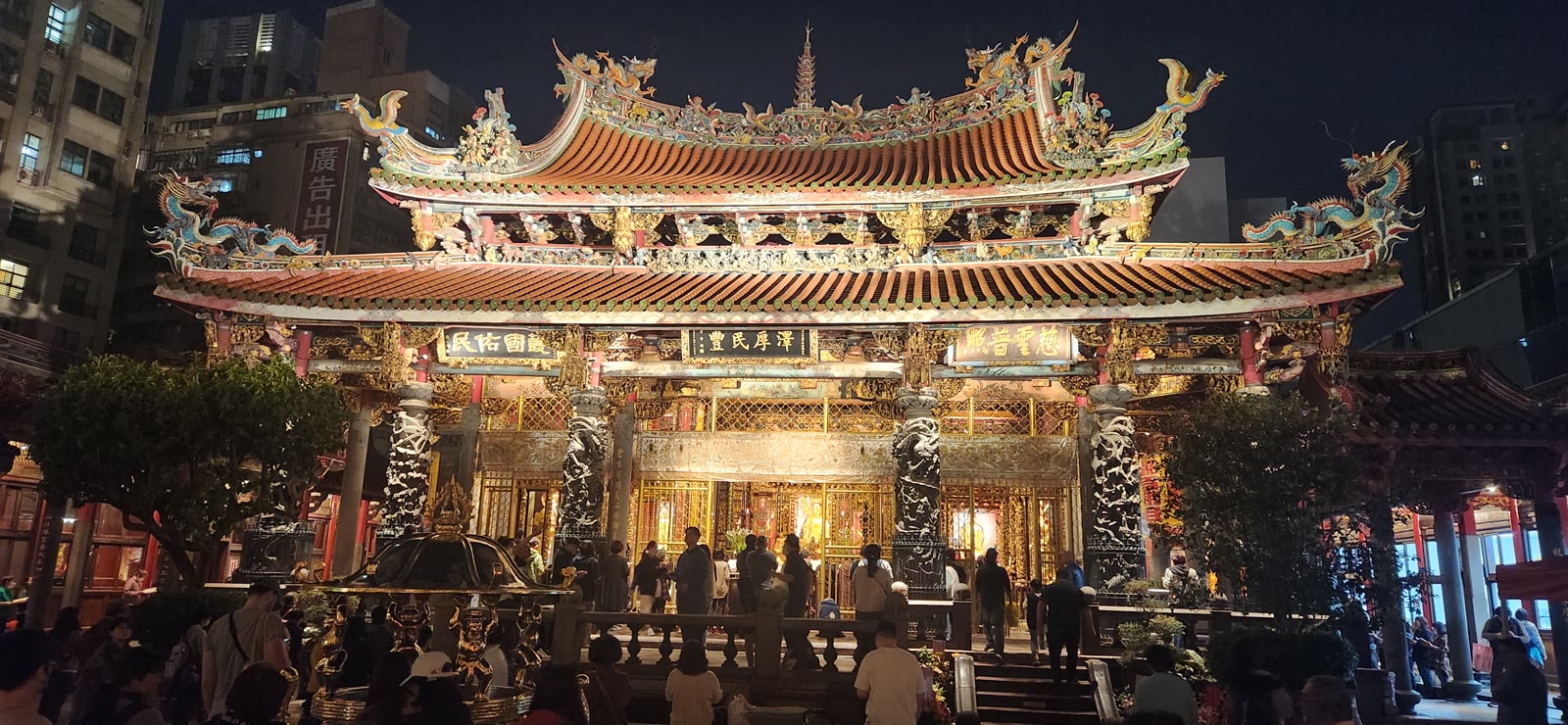
Image context: the cover uses a real 2025 Wikimedia Commons night photograph of Longshan Temple. That is the right image for this article because the route begins not with daytime monumentality but with temple light, bodies in the forecourt, and the hour when Bangka starts changing register.[9]
Why this 5 p.m. handoff works better than treating Wanhua as one long wander
The first reason is timing discipline. If you arrive around 4:45-5:00 p.m., Longshan gives you a real ritual turn instead of a generic drop-in.[1][4] You do not need to stay all evening. The point is to catch the temple while it is fully active, then let Bopiliao take the second half of the stop before its indoor spaces shut at 6:00 p.m..[3]
The second reason is spatial clarity. Longshan is dense, vertical, noisy, and layered with worship practice. Bopiliao slows that energy down into brick walls, arcades, and longer sightlines. The temple compresses attention; the old street releases it. If you try to do both in reverse, the route loses its shape.[3][4][5]
The third reason is local continuity. Bangka Stories explains that Herb Lane originally formed part of the route leading away from the temple toward what is now Bopiliao.[4] That historical relation still matters more than any modern "must-see" list. The useful move is not to collect two attractions. It is to read one old-city seam as it shifts from worship room to street room.
Anchor 1: use Longshan Temple as a working room, not a postcard
Longshan is easiest to misread when visitors treat it as a facade. The official attraction page already tells you enough to avoid that mistake: the site is open every day from 06:00 to 22:00, it sits right by BL Bannan Line Longshan Temple, and late entry stops at 21:45.[1] What changes the feel of the stop, though, is the 5 p.m. chanting window described in Bangka Stories.[4] That is the moment when the courtyard stops being merely photogenic and becomes a timed public room again.
There is also a small etiquette detail worth getting right. Longshan Temple's own art page explains that the 1922 "cloud-dragon imperial road" is a dedicated sacred path, associated in temple architecture with the route reserved for deities and, in one explanation, ancient imperial passage.[2] The practical consequence is simple: do not stage your grand entrance on the center stone strip. Use the side lanes, keep the middle legible, and let the building hold its own hierarchy.
If this is your first visit, skip the temptation to turn the temple into a full evening. Unless you are deliberately joining the 7:00 p.m. volunteer tour, a 20-30 minute stop is usually enough to catch the courtyard rhythm, read the roofline and dragon columns, and move on while the route still has a second act. That dwell suggestion is an operating inference from the official schedule, not a posted rule.[1][4]
Anchor 2: Bopiliao should take the blue-hour half of the route
Bopiliao matters here because it receives the energy Longshan sheds. The official site keeps the logistics exact: the block is closed on Monday; from Tuesday-Sunday, the outdoor area stays open until 9 p.m. while the indoor rooms close at 6 p.m..[3] Bangka Stories adds the route logic: Bopiliao sits about 5 minutes from the temple and preserves two rows of traditional brick houses and arcade-fronted streets.[4]
That means the best version is not "temple, then random street wandering." It is temple first, Bopiliao second, with enough daylight left to catch the interior threshold and enough evening left to let the exterior arcades take over after 6 p.m..[3][4] Taipei Travel's Wanhua faith itinerary is useful here because it frames Bopiliao not as a detached museum but as a preserved witness to Bangka's street development right beside Longshan Temple.[5]
Community-review surfaces matter because they confirm the route still behaves as a live place rather than a heritage shell. Google Maps activity around both Longshan and Bopiliao remains current and heavy, especially in the late afternoon and evening bands.[7][8] That helps explain why the two-anchor sequence still works in 2026: one anchor is still used for worship, the other is still used for walking, exhibitions, and local loitering.
8 local moves that materially improve this Bangka stop
First, arrive around 4:45-5:00 p.m.. That is the useful handoff window because the temple's 5:00 p.m. chanting is close and Bopiliao's indoor section still has time left before 6:00 p.m..[3][4]
Second, use the MRT and keep the route pedestrian. Longshan Temple sits right off the BL Bannan Line; adding a car or rideshare to this stop only creates friction in a district that reads best on foot.[1]
Third, keep off the center imperial road. Longshan's own art note on the 1922 sacred path is the clue that the middle strip should stay ceremonially legible, not be treated as a selfie runway.[2]
Fourth, let Herb Lane be connective tissue, not a shopping errand. Bangka Stories treats the lane as part of the historical route out of the temple, and that is still the best way to use it.[4]
Fifth, if you care about indoor Bopiliao, get there before 6:00 p.m. The route still works later, but after that hour you are relying on the outdoor arcades and facades alone.[3]
Sixth, after 6:00 p.m., hold the arcades rather than the entry gate. Bopiliao improves when you move under the covered walk and let the brick rhythm lengthen, not when you stop at the first obvious photo point.[3][8]
Seventh, keep Guangzhou Street in passing view, not as the main event. Smile Taiwan is useful because it reminds you that the Longshan-Bopiliao seam is still embedded in an ordinary neighborhood of long-running local businesses.[6]
Eighth, do not run this exact sequence on Monday. Once Bopiliao closes, the route collapses back into a single-anchor temple stop, which is a different outing altogether.[3]
Non-local trapline: 4 common misses and the cleaner alternative
Mistake 1: treating Longshan Temple as a two-minute facade stop
Better alternative: land in the late-afternoon window and let the 5:00 p.m. chanting band give the first anchor an actual rhythm.[1][4]
Mistake 2: walking the center imperial road as if it were the obvious visitor lane
Better alternative: keep to the sides and leave the 1922 sacred route visually intact.[2]
Mistake 3: reaching Bopiliao after 6:00 p.m. and assuming the indoor rooms will still be open
Better alternative: preserve the sequence and get to Bopiliao before the indoor cutoff if that part matters to you; otherwise accept that the outdoor arcades are the whole second act.[3]
Mistake 4: turning the corridor between Longshan and Bopiliao into a food crawl before the second anchor is secured
Better alternative: finish the two-anchor ritual first. Guangzhou Street and the surrounding stalls can come later, once the route has already done its architectural and temporal work.[5][6]
Concrete go details
- Best window: 4:45-6:45 p.m. is the cleanest operating band. Hit Longshan near the 5:00 p.m. turn, reach Bopiliao before 6:00 p.m., and let the outdoor arcades carry the rest of the stop.[3][4]
- Expected spend: NT$0 for the core two-anchor walk once you are already in Wanhua; add only MRT fare and any food or drink you decide to pick up after the route is complete.[1][3]
- Queue and reservation reality: ordinary visits do not need reservations; the only real schedule layer is Longshan's volunteer tour grid at 9:30 a.m., 1:30 p.m., and 7:00 p.m. if you want a structured temple read.[4]
- Where to stand: in Longshan, stay along the side lanes or courtyard edge rather than the center strip; in Bopiliao, move under the arcades instead of stopping at the first gate-facing opening.[2][3]
- Navigation cue:
MRT Longshan Temple -> Longshan Temple -> Herb Lane side -> about 5 minutes on foot -> Bopiliao Historic Block.[1][4][5] - Numeric anchors worth keeping: 1738, 1922, 06:00, 17:00, 18:00, 21:00, 21:45, 9:30, 1:30, 7:00, 90 minutes, 5 minutes.[1][2][3][4]
Taipei's old south side does not need to be conquered in one pass. Bangka reads more clearly when you let one temple hour hand the district over to one preserved street. Longshan gives the route its pulse. Bopiliao gives it its aftersound.
Sources
- Taipei Travel, "Lungshan Temple" (official attraction page with daily 06:00-22:00 hours, 21:45 last admission, address, and MRT access).
- 艋舺龍山寺, "御路" (official art note on the 1922 cloud-dragon imperial road and its sacred-path meaning inside the temple complex).
- Bopiliao Historic Block, "Visit Information" (official page with Tuesday-Sunday hours, outdoor 9 a.m.-9 p.m., indoor 9 a.m.-6 p.m., Monday closure, and free outdoor entry).
- Taipei Travel, "Bangka Stories" (TAIPEI Quarterly 2024 Winter Vol.38; 1738 founding context, 5 p.m. chanting, 90-minute volunteer tours, Herb Lane, and the 5-minute link to Bopiliao).
- Taipei Travel, "Faith (Wanhua District): A Tour through Faith and Architectural Splendor in Bangka" (published 2025-09-03; official itinerary placing Bopiliao next to Longshan Temple and describing its preserved Qing-era street fabric).
- 微笑台灣, "台北萬華一日遊|從龍山寺出發逛艋舺鬧熱街市,尋覓華西街、廣州街巷仔內的老滋味" (published 2025-12-06; recent local-native read of Guangzhou Street and the Longshan-Bopiliao seam as a living neighborhood corridor).
- Google Maps search, "Longshan Temple Taipei" (current community-review and live place-status surface; accessed 2026-04-07).
- Google Maps search, "Bopiliao Historic Block Taipei" (current community-review and live place-status surface; accessed 2026-04-07).
- Wikimedia Commons, "File:Lungshan temple Taipei.jpg" (2025 documentary night photograph used for the cover image).