Dublin has grander set pieces than Sandycove, but very few places where literature and daily habit still touch so directly. The clean move is small: come out at Sandycove & Glasthule, walk down to the James Joyce Tower, then carry that line to Forty Foot. One anchor gives you sentence and memory; the other gives you behavior.[1][2][3][4]
That pairing matters because Forty Foot is not a decorative bay stop. Dublin.ie describes it as a year-round swimmers' ground near Dún Laoghaire, long tied to local camaraderie, Christmas Day plunges, and the harsh pleasure of cold water.[1] The Tower beside it is equally specific. The museum frames Sandycove's Martello Tower as the setting for the opening of Ulysses; the institution opened in 1962, and the local community rallied in 2012 to keep it alive.[2][3] Put together, the place reads less like "coastal Dublin" in the abstract and more like one repeated civic rite with a literary afterlife.
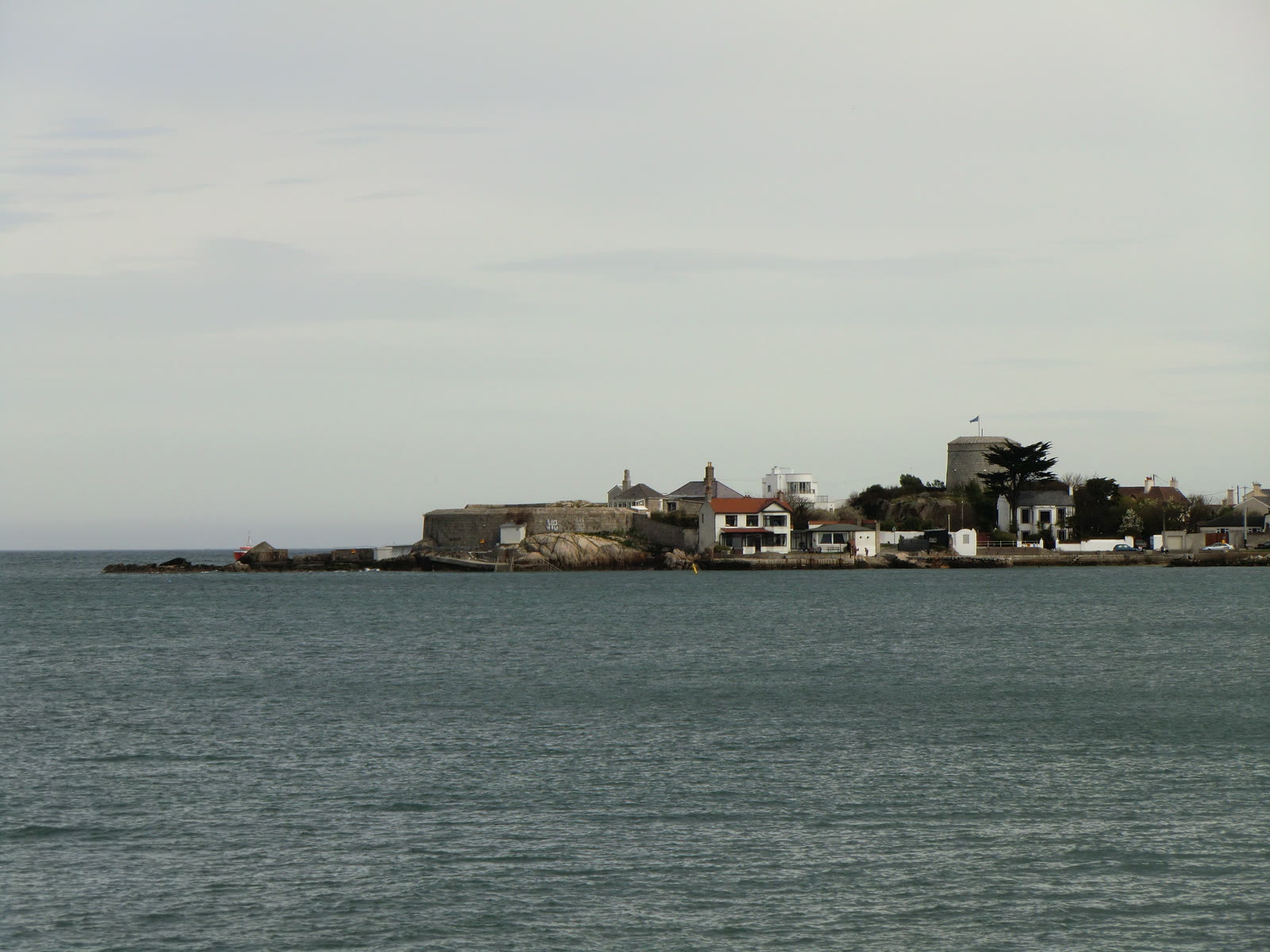
Image context: the cover uses a real Wikimedia Commons photograph of Sandycove with the James Joyce Tower visible above the water. That is the right recognition cue for this route because the tower and the swimming place need to stay in the same frame.[7]
Why this ritual works better than treating Sandycove as a quick seaside detour
The first advantage is scale. The Tower's visit page says the site sits 14 km from Dublin city centre, 2 km from Dún Laoghaire, and about a 10-minute walk from Sandycove & Glasthule DART station.[2] That is the right amount of effort for a city-travel move: enough to feel earned, short enough that the route stays compact and precise.
The second advantage is that the two anchors explain each other. Dublin.ie notes that Forty Foot has been popular with Dubliners for around 250 years, that women only forced their way properly into the ritual about 50 years ago, and that the place still pulls people back for year-round swims.[1] The Tower's official material keeps the literary side equally grounded: this is the Martello setting at the start of Ulysses, not an abstract monument detached from use.[2][3] One side gives Sandycove its text; the other gives it its temperature.
The third advantage is behavioral clarity. Forty Foot is a watched place even when you do not swim. Dublin.ie is explicit that if the water feels too severe, the better move is to sit back, stay with the company, and take the view across Dublin Bay.[1] Google Maps surfaces for both Forty Foot and the Tower still function as current community signals rather than dead heritage listings, which is another clue that Sandycove works because people keep using it.[5][6]
Use the tower as the clock
The local sequence gets cleaner once you let the museum hours set the day. The Tower is open Tuesday-Sunday, 10:00-16:00, closed on Monday, and entry is free for walk-ins; only groups of 15+ need to book ahead.[2] That makes the tower the practical opening move whenever it is open. You arrive, take the literary frame first, and only then let the coast take over.
This order changes the feeling of Forty Foot. If you go straight to the water, Sandycove can flatten into a scenic stop. If you begin with the Tower, Buck Mulligan's sea and the actual bathing place stay connected.[1][2][3] The swim spot stops feeling like generic shoreline and starts feeling like a public habit that Joyce borrowed because it was already there.
There is a second practical reason to keep the sequence tight. The Tower is not wheelchair accessible.[2] That means the literary half needs honest planning, and it also means the exterior-only version should be treated as a real fallback rather than an afterthought. Sandycove rewards accuracy. A small route with clear boundaries works better here than trying to force a universal all-access stop out of uneven coastal infrastructure.
8 local moves that make this Sandycove ritual read correctly
First, use the DART and walk in from Sandycove & Glasthule. The official Tower guidance treats the station as the natural rail entry, and that scale keeps the route local rather than chauffeur-driven.[2][4]
Second, put the Tower first whenever it is open. Free walk-in access, the 10:00-16:00 window, and the short coastal walk afterward make the literary frame the right opening chamber.[2]
Third, carry the Ulysses connection only as far as it still helps the outing. The useful fact is that the action opens here and Buck Mulligan heads toward the sea; the route gets stronger when that knowledge sharpens the place instead of turning the whole stop into quotation-hunting.[1][2][3]
Fourth, treat Forty Foot as steps, railings, rock, and open water, not as a casual beach. Dublin.ie includes a rough-day account vivid enough to make the point: swell, railings, and awkward exits are part of the reality here.[1][5]
Fifth, if you are not swimming, still keep the second anchor. Dublin.ie gives explicit permission for the spectator version: sit, watch, absorb the company, and use the bay view as part of the experience.[1]
Sixth, keep the budget in civic-space mode. Tower admission is free, walk-ins are welcome, and the core route costs EUR0 once you are on site.[2]
Seventh, if you are coming as a group, plan the museum part properly. The Tower welcomes groups of 15+, but asks them to book in advance so access stays orderly.[2]
Eighth, hold the route to one descent and one linger. The place gains force from compression: station, tower, bathing wall, one long look across the bay. Sandycove gets weaker when you spread it into an all-afternoon blur.
Non-local trapline: 4 common mistakes and the better move
Mistake 1: treating Forty Foot like a normal beach stop
Better alternative: read the site for what it is, a cold-water bathing point with steps and railings, and let rough conditions push you into the spectator version instead of the heroic version.[1][5]
Mistake 2: arriving on Monday expecting the full museum half of the route
Better alternative: remember the official clock. Monday is closed; Tuesday-Sunday, 10:00-16:00 is the full Tower window.[2][3]
Mistake 3: separating the Tower from Forty Foot into two unrelated checkboxes
Better alternative: keep the order intact so the literary frame lands first and the water follows as lived behavior.[1][2][3]
Mistake 4: assuming the Tower works for every body and every group without planning
Better alternative: note the access boundary. The Tower is not wheelchair accessible, and groups of 15+ should book ahead.[2]
Concrete go details
- Best window: Tuesday-Sunday from 10:00 onward, while the Tower is open and the whole Sandycove sequence can still be done as one connected ritual.[2][3]
- Expected spend: EUR0 for the core route on site; transport is the only necessary extra.[2][4]
- Queue and reservation reality: Tower walk-ins are welcome; 15+ groups should book; Forty Foot itself has no ticketing layer.[2]
- Where to stand or sit: the most useful pause is above the Forty Foot steps, where the company and the bay stay in view even if you never enter the water.[1][5]
- Navigation cue:
Sandycove & Glasthule station -> Marine Parade / coastal walk -> James Joyce Tower -> Forty Foot.[2][4] - Numeric anchors worth keeping: 250 years, 50 years, 1962, 2012, 10:00-16:00, 2 km, 14 km, 10 minutes.[1][2][3]
Dublin often reveals itself through talk, weather, and repeated habits rather than through one monumental object. Sandycove distills that tendency. The Tower gives the ritual a sentence, Forty Foot gives it a body, and the walk between them is short enough that the two still feel like one local act.
Sources
- Dublin.ie, "The Forty Foot" (local feature on year-round swimmers, the site's roughly 250-year local life, the 50-year shift in women's access, Christmas swims, rough-day risk, and the spectator version of the stop).
- James Joyce Tower, "Visit" (official access page covering free walk-in entry, Tuesday-Sunday 10:00-16:00 hours, group-booking threshold, station approach, distance markers, and accessibility note).
- James Joyce Tower, home page (official museum history covering the 1962 opening, the 2012 community rescue, and Sandycove's Joyce framing).
- Iarnród Éireann / Irish Rail, "Sandycove & Glasthule, Co. Dublin" (official current station page for the DART entry point).
- Google Maps community listing, "The Forty Foot, Sandycove" (current place-status and community-review surface).
- Google Maps community listing, "James Joyce Tower and Museum, Dublin" (current place-status and community-review surface).
- Wikimedia Commons, "File:Sandycove with James Joyce Tower.JPG" (documentary photograph used for the cover image).