Zagreb can look almost too well-behaved in daylight: Austro-Hungarian facades, a hill, a square, a funicular so short it feels like a joke, then another church corner. The city gets sharper once you give it one dusk sequence instead of a whole day's grazing. Go up to Strossmayer Promenade just before dark, let Upper Town's gas-lit edge do its work, then come down through the Grič Tunnel instead of reversing your steps.[1][2][3]
That order matters because the two anchors do different jobs. Strossmayer Promenade gives you the suspended room above the city. Visit Zagreb calls it the best panoramic walk in town, one of Zagreb's most romantic promenades, and the edge where the old defensive wall turns into a long lookout under chestnut trees.[1] Grič Tunnel gives you the release. The same tourism board describes it as the only public piece of Zagreb's tunnel network, built in 1943, running 350 metres, and taking about five minutes end to end when no event is occupying it.[3]
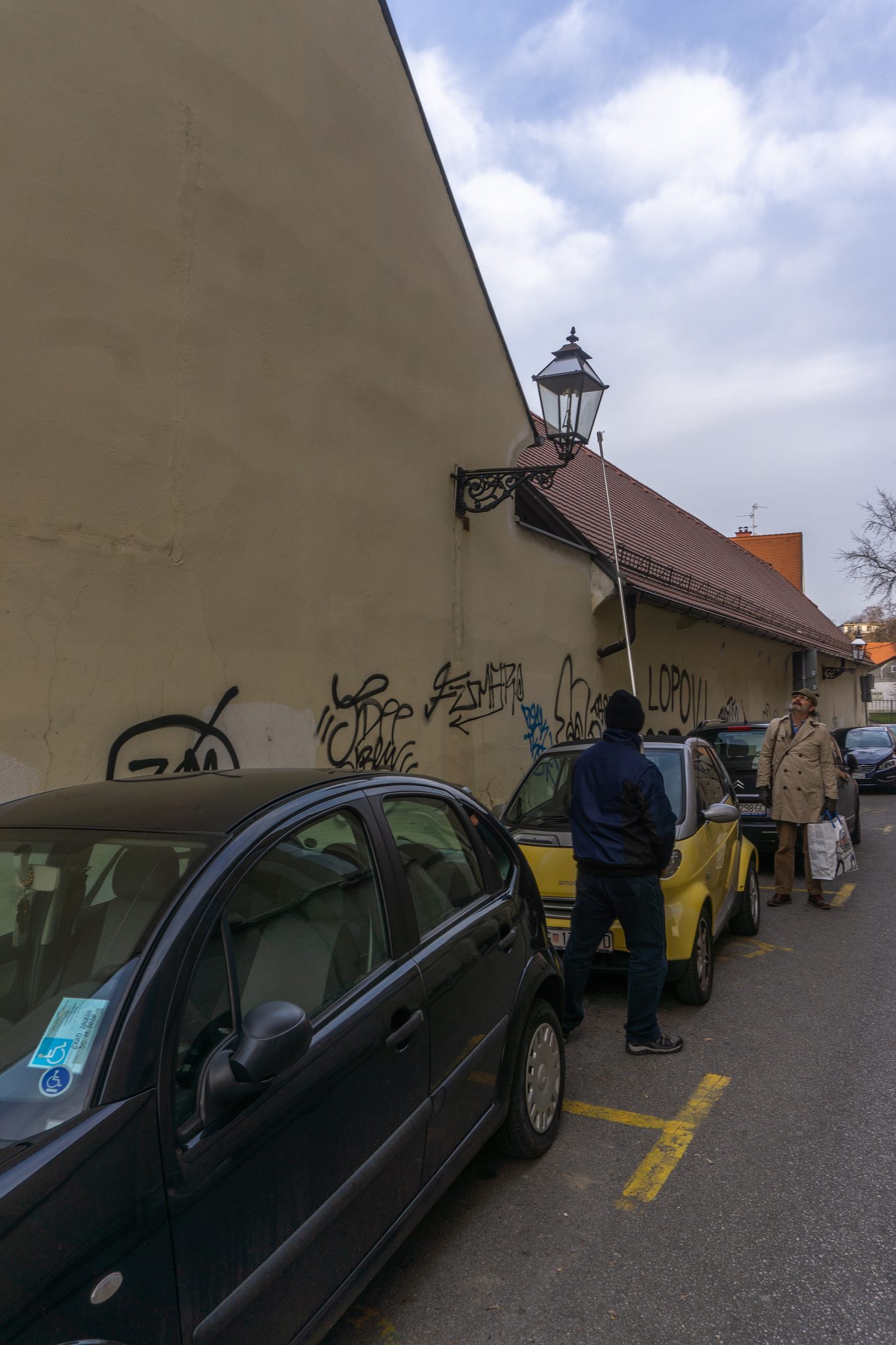
The city-specific texture sits between those two points. Visit Zagreb's Upper Town page says Zagreb is still one of the last cities keeping a daily gas-lighting tradition, with 214 gas lanterns in Upper Town and Opatovina lit by hand just before dark, a job that takes the lamplighters around three hours.[2] This is not decorative nostalgia pasted onto a tourist zone. It changes the timing logic of the neighborhood. Upper Town in late afternoon is a hill with views; Upper Town after the lamps begin to catch is a proper night room.
Local guides and local discussion treat the promenade the same way. In Your Pocket's current 2026 event listing still uses Strossmayer Promenade as a live venue, not a dead heritage shelf.[5] A recent r/zagreb itinerary post folds the funicular and Stross into a compact city walk because the view pays off quickly.[6] Another local reply to a first-time visitor gives the cleaner version: go to Strossmayerovo šetalište for the view, then walk through Tunnel Grič, and do the Upper Town on foot because it is narrow, hilly, and better read at walking speed than on wheels.[7]
Image context: the cover uses a real documentary photograph of a Zagreb lamplighter at work in the Old Town. That is the right recognition cue here because the whole article depends on one timing shift that non-locals often miss: the evening does not begin when the sky gets darker, but when the hand-lit gas lamps start turning the ridge into a slower, older city.[8]
Why the dusk window changes everything
This route is better in the 30 to 45 minutes before sunset than in the middle of the afternoon. If you arrive too early, Stross reads as a pleasant lookout and no more. If you arrive too late, you miss the transition that makes the place feel local rather than scenic.
The official pages make that transition unusually legible. Stross is open all day and free.[1] Upper Town's gas lamps are lit manually just before dark every day.[2] Grič Tunnel is open 09:00-21:00, also free, which gives you a hard lower bound for the return.[3][4] That is enough to build a clean clock around: reach Lotrščak and the promenade before the lamplighters have finished their first stretch, stay until the lower town starts flattening into lights, then drop through the tunnel before the 21:00 shutoff.[2][3][4]
There is also a social reason to do it this way. Visit Zagreb says Stross hosts concerts, events, and performances through most of the year.[1] In Your Pocket's 2026 calendar confirms it is still active enough to serve as a programmed public room this summer.[5] You do not need an event night to enjoy the route. The point is that the promenade still behaves like part of the city's evening circulation, not like a viewpoint people visit once and abandon.
8 local moves that make this night room land properly
- Climb before the lamps, not after them. The route works on transition, not on full darkness.[2]
- Use Ban Jelačić Square as the lower-town reset, then go up with purpose. Whether you walk or use the short funicular access, do not scatter your attention across extra stops first.[1][2]
- On Stross, keep moving past the first railing. The better pause is farther along, where the promenade stops feeling like a lookout platform and starts feeling like a room under trees and wall fragments.[1]
- Take one deliberate stop near the Matoš bench zone. Visit Zagreb treats the poet on the bench as part of the promenade's character, and it is a better pause point than hovering at the entrance.[1]
- Stay long enough to see the lamps outrun the remaining daylight. That overlap is the payoff; once the ridge is fully dark, you are already late.[2][8]
- Exit toward Mesnička, not back toward the square. The route is stronger when it resolves downward through Grič instead of repeating the same climb in reverse.[2][3]
- Use the tunnel as a real shortcut, but not a rushed one. It is only about five minutes across, yet the drop in temperature and sound is part of the sequence, not dead transfer time.[3][4]
- Do the Upper Town on foot. Local advice is clear that this part of Zagreb is narrow and hilly, and the whole point is to feel the grade change rather than erase it.[7]
Non-local trapline: 4 common mistakes and the cleaner alternative
Mistake 1: doing Stross at noon because "a view is a view"
Cleaner alternative: go in the evening shoulder. The city keeps a manual gas-lighting ritual for a reason, and this promenade reads differently once that process begins.[1][2]
Mistake 2: riding up, taking one panorama photo, and riding straight back down
Cleaner alternative: let the descent be different from the ascent. The Grič Tunnel gives the route a second chamber and keeps the outing from collapsing into a single overlook.[2][3]
Mistake 3: arriving at the tunnel after it has effectively stopped being usable
Cleaner alternative: remember the 09:00-21:00 operating window and use the tunnel before late-evening drift takes over.[3][4]
Mistake 4: treating Upper Town as bike or scooter territory
Cleaner alternative: walk it. Local commentary frames this part of central Zagreb as stair-heavy, narrow, and better understood on foot.[7]
Concrete go details
- Best window: arrive on Stross roughly 30-45 minutes before sunset, then leave enough margin to enter Grič Tunnel before its 21:00 close.[2][3][4]
- Expected spend: EUR0 if you walk the whole sequence; add only a small transit cost if you decide to use the funicular or tram for access.[1][3]
- Queue and reservation reality: none for the core route; the only real constraint is the tunnel clock, not ticketing.[1][3]
- Where to stand: first on the promenade farther in from the entrance near the Matoš-bench stretch, then at the Mesnička-side tunnel entrance where the route turns downward.[1][3]
- Navigation cue:
Ban Jelačić Square -> Upper Town climb -> Strossmayer Promenade -> Mesnička edge -> Grič Tunnel -> Radićeva 19 -> back to the center.[2][3] - Numeric anchors worth keeping: 214 gas lamps, 3 hours, 1943, 350 metres, 5 minutes, 09:00-21:00, 30-45 minutes before sunset.[2][3][4]
Zagreb does not need a giant night itinerary to explain itself. One ridge, one hand-lit evening tradition, one short underground return: that is enough to make the city stop posing and start breathing.
Sources
- Visit Zagreb, "Strossmayer promenade (Zagreb Stross)" (official page describing the promenade as Zagreb's best panoramic walk, its medieval-wall edge, the Matoš bench, event life, open-all-day access, and free admission).
- Visit Zagreb, "Zagreb Upper Town (Gornji grad) - Oldest part of Zagreb" (official page on Upper Town's manually lit gas-lamp tradition,
214lanterns, the3-hourlighting routine, and the Stross-to-Grič sequencing). - Visit Zagreb, "Grič Tunnel - Zagreb Underground" (official page covering the tunnel's
1943wartime origin,350-metrelength,09:00-21:00hours,5-minutecrossing time, and Mesnička/Radićeva entrances). - In Your Pocket Zagreb, "Grič Tunnel" (local city guide confirming the tunnel's
350-metrescale and current09:00-21:00opening window). - In Your Pocket Zagreb, "Zagreb promenade" (2026 event listing showing Strossmayer Promenade still functioning as a live public-event venue, with a
June 27, 2026date on the calendar). - Reddit
r/zagreb, "Zagreb Travels (Friday afternoon to Monday Early Morning)" (community post from March 2026 using the funicular and Strossmayer Promenade as a compact Upper Town walk segment). - Reddit
r/zagreb, "french travelling to zagreb for few days" (community thread recommending Strossmayerovo šetalište plus Tunnel Grič, and noting that Upper Town is narrow and hilly enough to prefer on foot). - Wikimedia Commons, "File:Zagreb - Lamplighter.jpg" (documentary cover photograph showing a lamplighter lighting a gas lamp in Zagreb's Old Town).