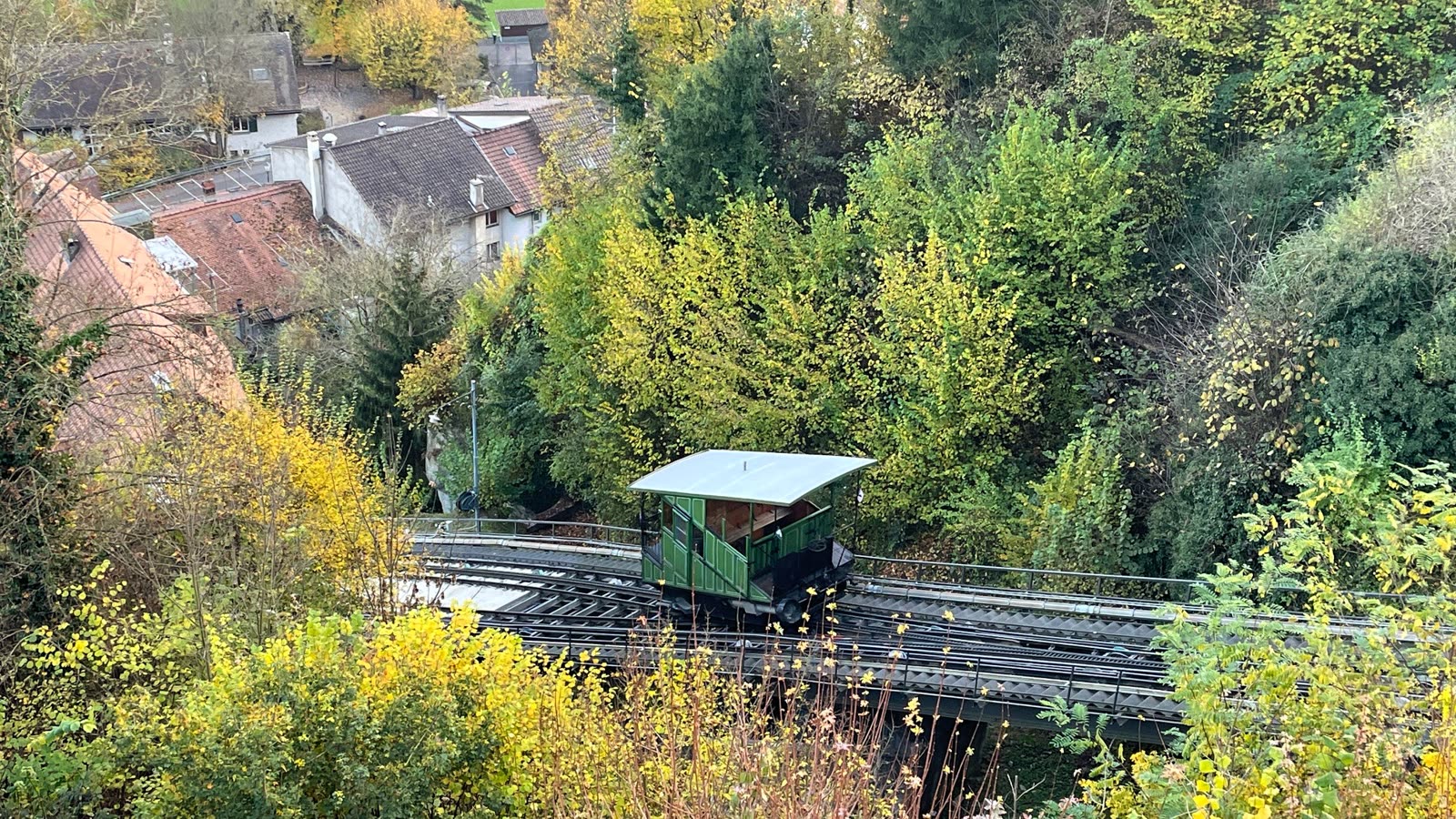
Fribourg gets sold too vaguely. Visitors hear "medieval old town," notice the cliffs, maybe wander the upper streets for a while, and treat the lower town as an optional extra if energy remains. The cleaner local move is more exact. Use the wastewater-powered funicular early, ride down from St-Pierre into Neuveville, and let the Basse-Ville do the long work of explanation instead of treating the line as a novelty ride that begins and ends at the station.[1][2][3]
The numbers make the case. The current TPF timetable says the Fribourg funicular, in service since 4 February 1899, runs on demand roughly every 6 minutes, with a journey time of 2 minutes.[1] From 1 September 2025 to 31 May 2026, the posted hours are 07:00-19:00 Monday through Saturday and 09:30-19:00 on Sundays; from 1 June to 31 August 2026, Monday-Saturday service extends to 20:00.[1][2] The tourism page adds the fare logic that matters to an actual walk: zone 10 ticket, valid 1 hour, current full-fare price CHF 3, half-fare CHF 2.30, and free travel with the Fribourg City Card.[2] None of that describes a grand excursion. It describes a tiny piece of working city machinery that is most useful when you let it reposition your whole read of Fribourg.
The lower town page supplies the cultural texture that keeps this from collapsing into transit trivia. Basse-Ville is where the Sarine winds past bridges, churches, convents, and fountains, and where Bolze culture took shape as a mixed French-German local language and habitus.[3] The same page notes the mechanical oddity that made the funicular famous: before each journey, 3,000 litres of city wastewater are pumped into the system as ballast.[3] Fribourg's own inspiration page makes the local attitude even plainer. The line sits in Switzerland's cultural-heritage inventory, still runs on water ballast, and carries a "sometimes funky odour" that locals accept as part of the bargain rather than as a reason to avoid it.[4]
Image context: the cover uses a real Wikimedia Commons photograph of the Fribourg funicular. That is the right lead image because the article is about a precise grade-change tool, not a generic skyline or cathedral shot. The city becomes readable at the moment that small car drops you from the upper centre into the lower river bend.[9]
Why the downhill-first sequence is stronger
Many visitors reach Fribourg from the station or upper centre and postpone the lower town until later, which usually means never. The downhill-first sequence fixes that. Instead of burning your legs on the grade or circling the top until the day gets diffuse, you spend 2 minutes solving the cliff and arrive in a different city room almost immediately.[1][2] The object itself is the point. Fribourg is not only beautiful; it is vertically organized, and the funicular is the shortest proof.
The local/community layer backs up that reading in a useful way. In a recent Reddit thread about what Fribourg means to people who know it, one commenter kept returning to the city's defining split: "the upper city and lower city."[7] Another community thread about winter views and traffic makes the pedestrian point more bluntly: the higher viewpoints are gorgeous, the car layer is a nuisance, and the old city works better when you treat it as a place to walk rather than to manage from behind a windshield.[8] That is exactly why the funicular belongs near the beginning of the route. It lets you stop thinking about the climb as a problem to solve.
There is also one very Fribourg detail worth handling correctly. Because the ballast comes from wastewater, the top-side loading moment can smell exactly like what it is.[4][6] This is not a moral test and not a joke you need to overplay. It is simply local infrastructure. If you are sensitive to odours, stand a little back from the upper entrance and board when the doors open. Do not let 20 seconds of honesty at the station trick you into skipping the city's best short transition.[4][6]
Why Basse-Ville is the second anchor, not a bonus round
The Basse-Ville should not be treated as the afterthought at the bottom of the track. It is the actual payoff. The official description is unusually dense for a tourism page: bridges in wood and stone, river bend, churches and convents, and a neighborhood identity distinct enough to produce Bolze as its own hybrid local language.[3] That means the right post-funicular move is not to glance around and immediately ride back. It is to stay low for 20-45 minutes, walk enough of the river edge to feel the scale change, and let the upper city recede into wall line and tower silhouettes.
This is also where the recent city-maintenance source helps. Fribourg's urbanism department explained in late 2025 that the covered stair-and-rampart link by the funicular required structural renovation work after signs of serious deterioration.[5] The route lesson is broader than the works themselves. Do not assume every steep shortcut around the line is the elegant local version. In Fribourg, grade change is real infrastructure. The smarter move is to take the system seriously, use the funicular for the hard vertical shift, and then choose your walking return only if you actually want the climb.[2][5]
That approach keeps the article inside a tight, non-generic city-travel frame. One object, one landing, one river bend. Fribourg does not need a huge itinerary to explain itself. It needs you to notice that the city centre and the Basse-Ville are not two attractions sitting side by side. They are one settlement split by level and reconnected by an almost absurdly short ride.
8 local moves that make this object lens work
- Ride down first if you start in the centre. The best first use of the funicular is to spend 2 minutes solving the grade and begin your real walk in the lower town.[1][2]
- Use the fare window intelligently. A zone 10 ticket lasts 1 hour, which is enough time for one ride and a measured lower-town drift without turning the stop into a rushed novelty pass.[2]
- Treat the smell as a station detail, not a verdict. The ballast system really does have an odour at moments; stand back, board, and keep moving.[4][6]
- Do not overbuild the walk. The Basse-Ville payoff is compact. Give it 20-45 minutes, not a fake half-day mission.
- Stay near the river long enough to feel the level change. The bridges, walls, and waterline are what make the upper/lower split physically legible.[3]
- Use the funicular before the old town gets crowded or your legs get impatient. Weekday morning into late morning is the cleanest band; Sunday starts later at 09:30.[1][2]
- Do not assume the stair connection is the elegant default. Recent city work on the covered stair-and-rampart link is a reminder that this edge is infrastructure, not scenery alone.[5]
- If you want to go back up without forcing a climb, simply ride again. Departures every 6 minutes mean the line works better as a tool than as a once-only ritual.[1]
Non-local trapline
Mistake 1: treating the funicular as a cute extra after you have already "done" the old town
Better move: use it near the start. The whole point is to let Fribourg's vertical split organize the day early.[1][2][6]
Mistake 2: arriving on Sunday before the line is running
Better move: remember the posted Sunday and holiday start time is 09:30, not the weekday 07:00 rhythm.[1][2]
Mistake 3: deciding the lower town is optional because the ride itself is so short
Better move: understand that the 2-minute descent is only the transfer mechanism. The Basse-Ville is the actual second act.[1][3]
Mistake 4: insisting on a car for this part of Fribourg
Better move: keep the route pedestrian and transit-first. Community commentary about traffic and the city's car-light core points the same way.[8]
Concrete go details
- Best window: 09:15-11:30 on weekdays or 09:45-12:00 on Sundays, when the line is already running and the lower town still feels calm.[1][2]
- Expected spend: CHF 3 full fare, CHF 2.30 with half-fare, or free with the Fribourg City Card.[2]
- Queue and reservation reality: no reservation layer; departures are on demand roughly every 6 minutes.[1][2]
- Where to stand: board at the upper station near St-Pierre, then make your real pause after the descent in Neuveville rather than lingering beside the machinery.[2][3]
- Navigation cue:
St-Pierre upper station -> 2-minute descent -> Neuveville landing -> lower-town river and bridge drift -> decide between a walking climb or one more funicular ride. - Numeric anchors worth remembering: 1899, 3,000 litres, 2 minutes, 6 minutes, 07:00, 09:30, 19:00, 20:00, 1 hour, CHF 3.[1][2][3]
Fribourg is one of those cities that looks picturesque before it looks intelligible. The funicular fixes that. One short descent, one lower-town pause, one return decision: that is enough to make the place click.
Sources
- TPF, "Consultez l'horaire du funiculaire de la ville de Fribourg" (official timetable page covering the 4 February 1899 opening, on-demand departures roughly every 6 minutes, the 2-minute ride, and current seasonal operating hours).
- Region of Fribourg, "Funicular of Fribourg" (official tourism page covering the zone 10 ticket valid for 1 hour, CHF 3 / CHF 2.30 pricing, City Card validity, and the current posted opening-hour bands).
- Region of Fribourg, "Basse-Ville" (official page covering the lower town's bridges, churches, convents, fountains, Bolze culture, and the 3,000-litre wastewater ballast detail).
- Region of Fribourg, "Funicular" (official inspiration page noting the line's national cultural-heritage status, water-ballast system, and the sometimes funky odour).
- Ville de Fribourg, "Assainissement et rénovation des escaliers du funiculaire" (city project page, updated within the last year, documenting the structural renovation context for the stair-and-rampart link beside the line).
- Reddit
r/Switzerland, discussion of Fribourg's wastewater-powered funicular (community thread used here for the top-station smell cue and local reaction to the line's very literal ballast system). - Reddit
r/Switzerland, "What is Fribourg to the rest of Switzerland?" (community thread used here for the upper-city/lower-city framing and the city's small-scale local feeling). - Reddit
r/Switzerland, "Snowy Fribourg" (community thread used here for the pedestrian reading, higher-place views, and anti-car local perspective). - Wikimedia Commons, "File:Fribourg funicular 2024-11-09.jpg" (documentary photographic source page for the lead image used in this article).