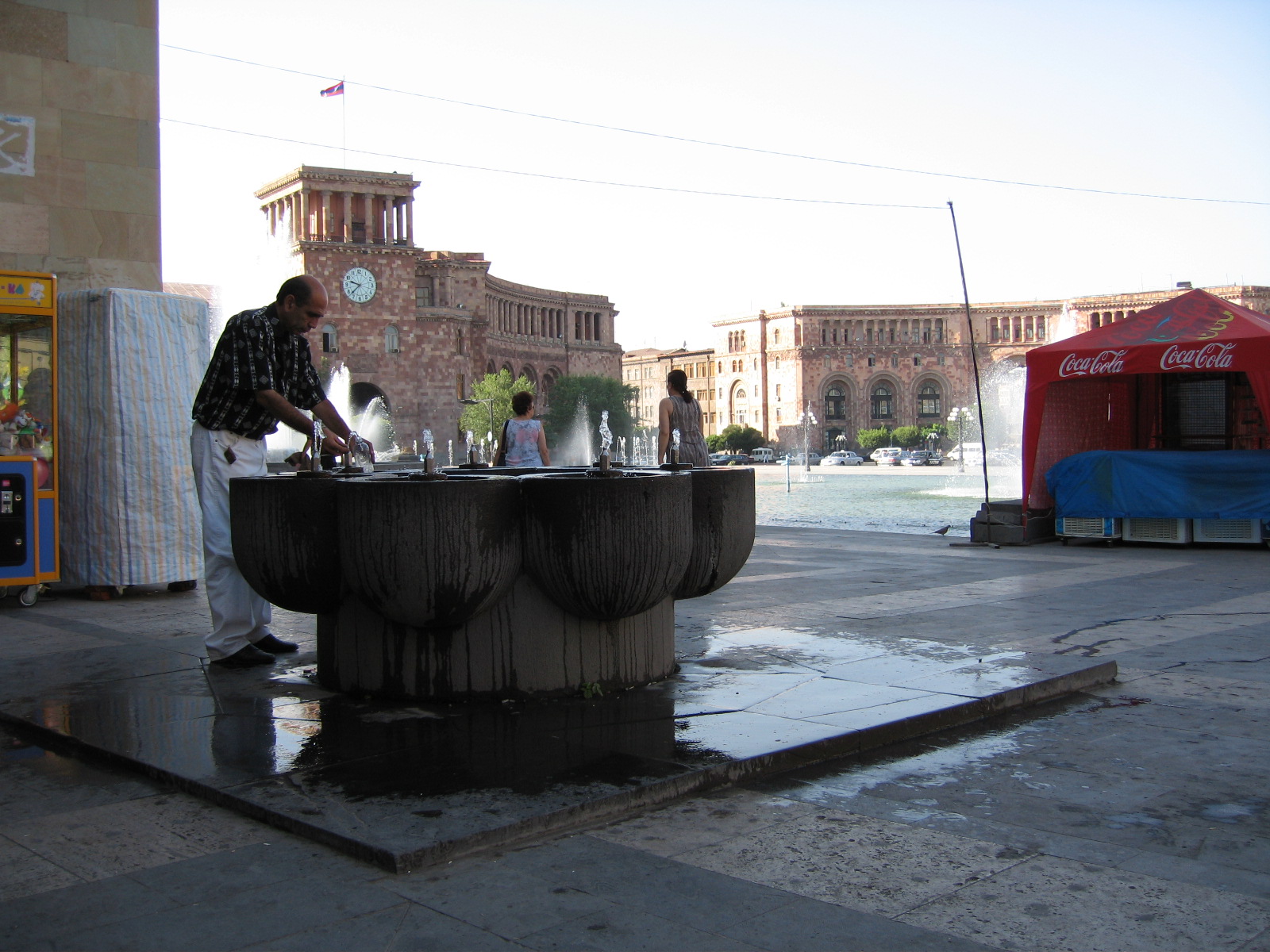
Republic Square is built to pull the eye upward and outward: pink-tuff facades, an oval of paving, a clock tower and the broad basin of the singing fountains. The object that best explains Yerevan is lower. Beside the museum buildings, seven dark stone cups hold seven small jets of drinking water. This is Yotnaghbyur—Seven Springs—a pulpulak made for bending, drinking and moving on [2][3][4].
Give it 10–15 minutes, preferably between 08:00 and 10:00 on a warm morning. From the Republic Square metro exit, allow 3–5 minutes to cross the square without cutting through traffic. The fountain costs AMD0 and requires no reservation or formal queue: wait outside the ring until one of its seven spouts is clearly free. Those modest mechanics are the point. Seven Springs is not another attraction competing with the square; it is a working public object that briefly changes a pedestrian into a participant.
As of August 16, 2026, the evidence for using pulpulaks is strong but conditional. Armenia's official tourism site presents them as flowing drinking fountains found throughout Yerevan, and a 2025 local host guide independently identifies street pulpulaks as clean, drinkable water [1][7]. That guide's separate ask-a-local caveat concerns tap water, not a recognized street fountain [7]. A Yerevan guide published in July 2026 draws the useful boundary for the fountain itself: use it only when the water is flowing normally, the outlet looks maintained and no warning is posted [4]. A community fountain project makes the same point from below by treating location maps and maintenance reports as necessary parts of keeping pulpulaks useful [5]. The map can bring you here; live flow is the final signal.
Find the small fountain inside the big square
The first local move is to save the exact Seven Springs pin, then keep a physical recognition cue: the low cluster on the museum and National Gallery side of Republic Square. The municipality's description naturally emphasizes the plaza's monumental basin and singing fountains [3]. Seven Springs is not part of that show. If you are standing at the large pool waiting for music, you have found water meant to be watched, not the water meant to be drunk.
Use the Republic Square metro station as the approach, but do not follow a straight phone-screen line across the carriageways. The current place layer lists the square as a 24-hour public landmark and shows the station on Aram Street [9]. Follow the pedestrian route into the square, orient toward the museum buildings and look for seven waist-high stone cylinders rather than spray, colored light or seating. That 3–5-minute allowance is intentionally generous: the square is easy to see and surprisingly easy to cross badly.
The second move is to come while the object is still ordinary. Between 08:00 and 10:00, the square is cooler and Seven Springs reads as street furniture rather than a prelude to the evening performance. A second good window is 17:00–19:00, before the musical basin becomes the dominant event. These are editorial windows, not official operating hours; the pulpulak has no ticket desk or posted daily session. If it is dry, fenced or marked, do not wait for an imagined opening time.
Stand half a step back until a spout is free. Seven outlets distribute a small crowd, so there is no useful queue to form across the ring. The third move is to let the person drinking finish, then approach one basin from the outside and leave the center visually open. A community account describes the pulpulak as a natural pause on an ordinary walk and a piece of shared public life [5]. Treating the working outlet as a portrait set reverses that social rhythm.
Drink from the arc, not the metal
Before leaning in, watch the stream for a few seconds. A real pulpulak is a drinking fountain, but not every pipe, decorative jet or basin in the city is one. The July 2026 local guide advises checking for normal flow, a clean maintained outlet and the absence of a warning; it explicitly separates drinking fountains from ornamental water and damaged fixtures [4]. That is the fourth move: identify, observe, then drink.
The technique is simple. Bend toward the rising arc, keep your lips off the nozzle and take a short drink without gripping the metal tip. The current local guide describes this no-contact posture [4]. The fountain's height makes the bow unavoidable; do not turn that physical fact into a grand ritual before noticing its practical virtue. It lets one person drink directly from moving water without sharing a cup or mouthpiece.
The fifth move is to yield as soon as you are done. A small reusable bottle can be filled when the arc and bottle neck make that easy, but Seven Springs is better shaped for a direct sip than for organizing several large containers [4]. Keep bags off the wet rim, do not wash hands or food at the outlet, and step away before checking the photo you just took. If a child or an older person is waiting, make the pause shorter still.
Do not over-romanticize the source. Tourism language often calls Armenia's pulpulak water mountain-spring water [1], but today's supply is also an engineered public system. Veolia describes a network of springs, reservoirs, treatment facilities, transmission lines and city distribution pipes; Yerevan's first centralized supply began in 1911 [8]. Seven Springs feels ancient because shared water is culturally legible here. The water reaching a functioning urban fountain is nevertheless infrastructure, not magic.
That distinction supplies the sixth move: carry a small backup bottle even in a city famous for free water. A local Armenian tourism feature describes the annual spring restart after the street fountains' winter sleep, while a community fountain project treats maintenance reporting as part of keeping the network useful [5][6]. A dry spout is not an invitation to drink from the neighboring performance basin. It is a reason to use the backup, ask nearby or move to another confirmed drinking fountain.
Read south after you drink
Only after the practical act should you inspect the object. YerevanCards dates the composition to the 1960s and credits architect Spartak Knteghtsyan. Its original fortress-tower-shaped bronze outlets disappeared during the 1990s; in 2008, jeweler-designer Nur restored the tips and turned them into a field of small signs. Armenian letters appear inside the fountains, the nozzles were conceived to work as sundials, and a phrase above the letter A wishes the drinker sweetness [2].
The seventh move is to walk one slow circuit rather than trying to decode everything while somebody waits for water. Find the four-language dedication—“To Yerevan from Yerevan”—and look for the Armenian face. According to the local design account, that inscription faces south [2]. The fountain therefore gives two kinds of orientation: water tells you how the city cares for a passerby; script tells you which way the city is facing.
Do not use the spouts as precision clocks. Shadows shift, bodies interrupt them and a phone will tell time better. Their value is conceptual. A public utility has been allowed to remain an artwork without ceasing to be useful. The eighth move is to test the south-facing clue against your map, then put the phone away for the walk out of the square. That tiny verification makes the design memorable without reducing it to a scavenger hunt.
Seven Springs also corrects a common reading of Republic Square. The municipality describes a composition assembled across the Soviet decades and reconstructed in the early 2000s [3]. The pulpulak belongs to that civic scale, yet it refuses monumentality at the moment of use: one person bends, drinks and makes room for another. Its lettering and bronze details reward attention, but the work succeeds even when the drinker never learns the designer's name.
Three visitor mistakes, and the better move
Mistake one: confusing the singing fountains with Seven Springs. The large basin is the square's spectacle; the low seven-part cluster beside the museum buildings is the drinking fountain [2][3][4]. Better: navigate by the museum-side stone cylinders, not by the sound of water or the evening crowd.
Mistake two: assuming a famous fountain must be flowing—or that any flowing public water is potable. Local guidance and community mapping both insist on the operational boundary [4][5]. Better: check the structure, stream, outlet and any notice; use backup water when uncertain [4].
Mistake three: turning a shared spout into a long photo or bottle-filling station. The outlet is a shared public good, and the no-contact drinking arc is part of what keeps it workable [4][5]. Better: wait outside the ring, drink without touching the nozzle, step away, then circle back to read the details.
The go details
- Primary anchor: Seven Springs, or Yotnaghbyur, beside the museum buildings on Republic Square. No second attraction is needed.
- Best window: 08:00–10:00 for a cooler, quieter read; 17:00–19:00 is the evening alternative before the performance basin takes over.
- Time needed: 10–15 minutes, plus a 3–5-minute walk from the Republic Square metro exit using the pedestrian route [9].
- Expected spend: AMD0 at the fountain. There is no admission, purchase or reservation.
- Queue reality: there is no formal line; wait outside the seven-spout ring and take the next clearly free outlet.
- How to use it: confirm normal clean flow and no warning, drink from the arc without touching the nozzle, then yield [4][7].
- Recognition cue: seven low dark-stone basins on the museum side—not the large singing-fountain pool [2][3][4].
- Seasonal boundary: do not build a winter or heat-wave hydration plan around one fountain. If Seven Springs is off, use backup water or another locally confirmed pulpulak [5][6].
The smallest useful object in Republic Square offers water, a compass clue and a lesson in scale. Find the low fountain, let its condition decide whether you drink, and read the bronze only after you have made room for the next person. Yerevan's gift is not merely that the water is free. It is that a piece of civic art still knows it has a job.
Sources
- Armenia Travel, “Practical Information” — official national-tourism guidance on Yerevan's flowing public drinking fountains and their summer use.
- YerevanCards, “A Distinctive Urban Feature — Yerevan's Pulpulaks” — local account of Seven Springs, Spartak Knteghtsyan's 1960s design, Nur's 2008 restoration, inscriptions, Armenian letters and south-facing orientation clue.
- Yerevan Municipality, “Squares” — official description of Republic Square's layout, museum-side buildings, architectural sequence and separate singing-fountain basin.
- Yerevan Info, “Why Yerevan Has Free Drinking Fountains Everywhere” (July 10, 2026) — recent local guide to Seven Springs, no-contact drinking, bottle limits and the live-flow/maintenance boundary.
- Pulpulak, “Pulpulaks and Public Life: How a Simple Fountain Shapes Armenian Communities” (May 5, 2025) — community-fountain account of shared use, free access, location mapping and maintenance reporting.
- Armenia Tourism, “A Sip of Life From Stone” (April 24, 2018; Russian) — local account of Yerevan's winter shutdown and annual spring restart, Seven Springs and the city's drinking-fountain customs.
- Wikimedia CEE Youth Group, Guide for the CEE Youth Group Meeting Yerevan 2025 — recent locally prepared visitor guidance identifying street pulpulaks as clean and drinkable, with a separate caution about tap water.
- Veolia Armenia, “Drinking Water” — operator account of Yerevan's centralized supply history and the contemporary spring-to-reservoir-to-distribution system.
- Google Maps, “Seven Springs, Republic Square, Yerevan” — current local place layer for the square, metro approach and museum-side orientation.
- Wikimedia Commons, “File:Yerevan Republic Square pulpulak.jpg” — Eve d's 2005 documentary photograph used as the article image.