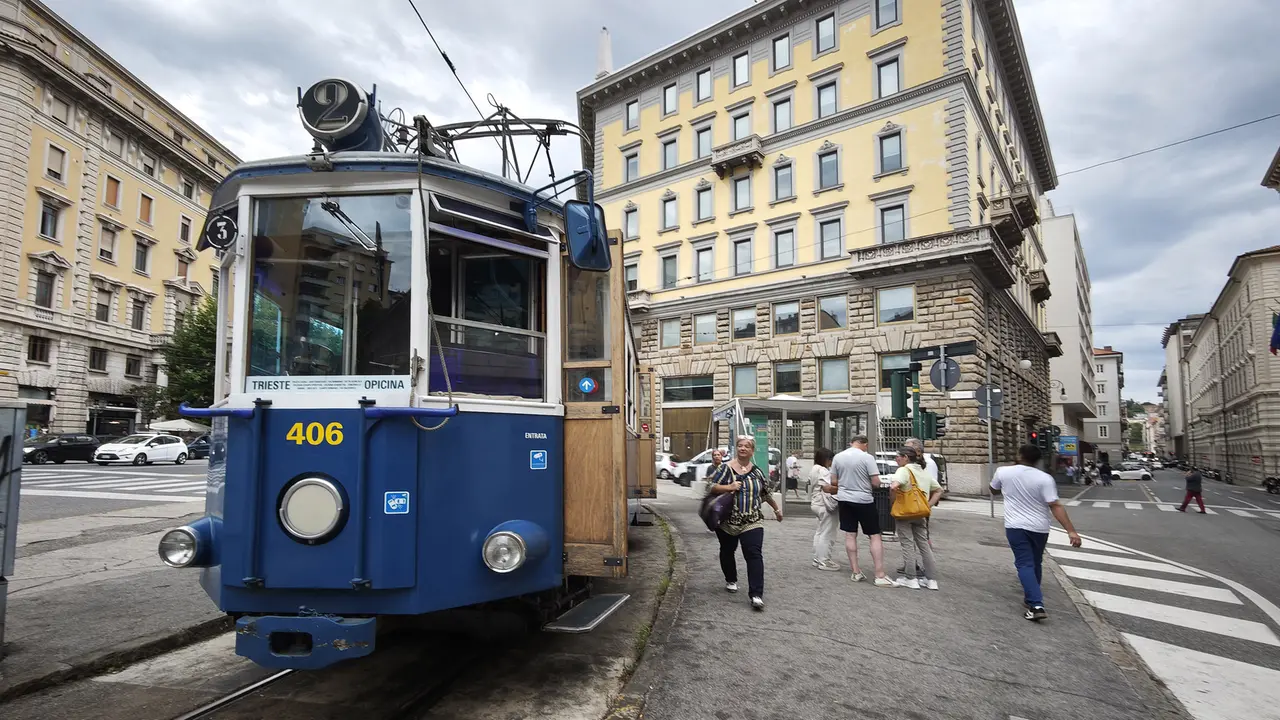
At Piazza Dalmazia, Trieste's blue Line 2 looks like an old tram temporarily caught in ordinary traffic. That reading lasts only a few minutes. The car leaves the square under its own power, meets a cable-driven carro-scudo on the steep section, lets that shield car push or restrain it, then separates and continues toward the Karst plateau as a tram again. One vehicle crosses three kinds of street without asking its passengers to change seats [2][8].
The best first encounter is equally compact: take a mid-morning car from Piazza Dalmazia, leave at Obelisco, spend 25–35 minutes on the opening stretch of the Strada Napoleonica, then return to the same stop. Do not turn it into a race to the Opicina terminus or a full 4-kilometre hike. In roughly 2–2.5 hours, this small sequence shows why the line is not simply picturesque transport. It is Trieste's working negotiation between a port at sea level and a limestone plateau immediately behind it.
As of August 16, 2026, that negotiation comes with unusually specific operating rules. The tram returned on July 20 after a roughly nine-month interruption and a multi-stage work program [3]. From August 12, capacity is restricted to seated passengers, boarding is through the door on the Trieste side, and the central doors are for exiting [4]. The first local move is therefore not “find the prettiest seat.” It is check Trieste Trasporti's alerts and the dated Line 2 PDF on the morning you ride. On this line, a saved timetable is evidence of a plan, not proof that the car is moving today.
Begin at the terminal that looks temporary
The current city terminus is Piazza Dalmazia, not Piazza Oberdan. Trieste Trasporti expects the historic final section to remain out of use while Piazza Oberdan is rebuilt, with completion estimated for June 2027 [3]. The move has given a small, previously hurried square an odd new gravity: local reporting reads it through Casa Nussa, Villa Ermione and Palazzo Arrigoni, with the tram now holding the foreground [9]. That is the first piece of place-specific texture. The railway has not merely shifted one stop; it has made Trieste look again at a room it used to pass through.
The second local move is to save the Piazza Dalmazia pin, then navigate by the rails and the blue car rather than by a search result that still says “Piazza Oberdan.” The current place layer shows the terminal in the square [6]. If you reach the old terminal, do not wait beside an inactive platform and hope the tram will complete the missing block. Walk to Piazza Dalmazia.
Use the published 09:42 departure as a clean target on a calm morning. The current Line 2 table runs daily, with departures from Piazza Dalmazia every 28 minutes from 07:22 until 20:26; the full scheduled run to Opicina takes about 31 minutes [1]. Arrive around 09:20–09:25. There is no ordinary-seat reservation step on the official Line 2 page, and the current seated-only restriction makes the available chairs the real capacity limit [2][4]. Fifteen or twenty minutes is useful waiting time here: enough to identify the boarding side, not so much that the tram becomes the whole morning.
The third move is to solve payment before joining that wait. Line 2 is part of Trieste's urban network. In 2026, a 60-minute ticket costs €1.50, a 75-minute ticket €1.85, and an urban day ticket €3.35 [2][5]. On ordinary weekdays, budget €3 for two 60-minute tickets. On Sundays and public holidays, timed urban tickets last 240 minutes, so one €1.50 ticket can cover this 2–2.5-hour loop. The €3.35 day ticket remains the flexible all-day choice [5]. Buy in the app or from an authorized outlet, and validate as soon as you board. The dedicated tram page also says every car has a contactless purchase device [2]; carrying a prepared ticket is still the calmer choice when only one door is taking passengers.
When the car arrives, let the center doors finish their work. Then use the Trieste-side entrance, take an open seat and keep the aisle clear. This is the fourth move, and it overrides older photos and advice that celebrate standing behind the driver. Since August 12, passengers may not stand either in the saloon corridor or on the platform behind the driver's position; that space now contains four bicycle racks [4]. The restriction changes the social shape of the car. Boarding is a short compression, then everybody has a fixed place while the machinery changes around them.
Let the street change the tram
Line 2 is only 5.175 kilometres long, but its central problem is concentrated into about 800 metres with a gradient of up to 26 percent [2]. The tram cannot treat that incline like an ordinary rail street. On the climb, the cable-bound shield car meets the passenger car and pushes it; on the descent, it holds the tram back. Above the cable section, the tram resumes adhesion running toward Obelisco and Opicina [2][8].
The fifth move is to stay seated and listen before reaching for the phone. Ordinary wheel noise acquires the dull mechanical undertone of cable guidance; the city's facades begin to fall away; retaining walls and vegetation replace the square's shopfront scale. The engineering is easiest to understand as sequence, not spectacle: street tram, assisted climb, tram again. A continuous video through the window tends to flatten those three states into one shaky ascent.
This strange machine has been part of Trieste's self-description almost from birth. The line opened on September 9, 1902. A brake failure and derailment followed one month later, inspiring the dialect song whose title says the Opicina tram was “born unlucky” [8]. The joke endured because the tram endured. Its early rack assistance gave way in 1928 to the cable-driven shield cars, and the surviving line became difficult to classify neatly: tramway, light railway and funicular occupy the same short journey [8].
That history gives today's alert-checking a local resonance. Reliability is not a side note to be hidden from visitors, and neither is affection. The July reopening followed work on the cable section, track, overhead line, substations, vehicles and staff certification [3]. Ride it with curiosity, but do not make a timed airport or rail connection depend on it.
Obelisco is the useful exit
Obelisco arrives near the crest, before the Opicina terminus. Tell the onboard staff that it is your stop if you are unsure, and prepare to leave through the center doors without blocking the boarding side. The sixth move is to get off here rather than staying aboard merely to complete the line.
The monument marks an older solution to the same hill. In 1830, the new road to Opicina opened a broader connection between Trieste's free port and the Habsburg interior. The obelisk commemorates that road; the panoramic path beginning beside it is officially the Strada Vicentina, after engineer Vicentini, although Trieste commonly calls it the Napoleonica [7][10]. Road, monument and tram are not three disconnected sights. They are successive answers to the question the slope keeps asking.
The seventh move is to follow the current platform exit and on-site pedestrian signs toward the obelisk and the broad gravel entrance to the Napoleonica. Do not import directions written for nearby substitute-bus stops into the tram platform. The official route includes Obelisco as an intermediate stop [2], while local route sources place the panoramic path beside the monument [7][10]. If the signs feel less obvious than the panorama, slow down and ask the onboard staff before improvising a road crossing.
Once on the path, keep the walk deliberately small. The full route toward Prosecco is about 3.7–4 kilometres one way and takes roughly one hour at an easy pace; it has no reliable bar, fountain or toilet along the way and is a poor choice in strong Bora [7]. For this street microcosm, walk 10–15 minutes out, stop where the gulf opens, then retrace your steps. Bring water, keep the gravel lane shared, and do not mistake a flat profile for shelter from sun or wind.
That is the eighth move: turn while Line 2 still organizes the outing. At the stop, consult the posted departure rather than assuming the 28-minute endpoint rhythm produces an exact Obelisco minute [1]. Build in at least one full service interval, and allow more if a same-day notice or the stop display shows a revised pattern. If an alert has suspended the tram, use the operator's journey planner for the current bus alternative instead of waiting through another empty slot [2][3].
Three mistakes that make the line harder than it is
Mistake one: going to Piazza Oberdan because every old photo begins there. Current operator material and the live place layer put the ordinary terminal at Piazza Dalmazia, while local reporting shows how the tram has physically remade that square [3][6][9]. Better: save Piazza Dalmazia, look for the blue car on street track, and arrive before the published departure.
Mistake two: trusting any undated “the tram is running” or “the tram is replaced by a bus” page. A local Napoleonica guide published after the July 20 restart still described substitute-bus access [3][7]. Better: use local guides for the character of the walk, but let the same-day operator alert decide whether steel wheels are actually climbing.
Mistake three: chasing the view by standing behind the driver. Current rules allow seated passengers only and reserve the former standing platform for bicycle racks [4]. Better: take the view from your seat, keep the aisle clear and let the change in sound tell you when the cable section begins.
The go details
- Primary anchor: ordinary Line 2 from Piazza Dalmazia to Obelisco; the first 10–15 minutes of the Strada Napoleonica are the only secondary anchor.
- Best window: arrive 09:20–09:25 for the published 09:42 departure on a calm day. Check the dated timetable and live alerts that morning [1][3].
- Time needed: about 2–2.5 hours, including the ride and a 25–35-minute path out-and-back. Budget at least one 28-minute service interval on the return, with extra slack if the operator posts a revised pattern [1][3][7].
- Expected spend: on weekdays, €3 for two 60-minute urban tickets; on Sundays and public holidays, one €1.50 timed ticket lasts 240 minutes and can cover the loop. The flexible day ticket is €3.35 [5].
- Queue and reservation reality: Line 2 uses urban tickets, while the current restriction limits capacity to seated passengers. Arrive 15–20 minutes early rather than assuming you can stand [2][4].
- Navigation cue: the blue tram and street rails in Piazza Dalmazia [6][9]. At Obelisco, follow the current platform exit and on-site pedestrian signs toward the obelisk and Napoleonica [2][7][10].
- Where to sit: any available seat. The current rule matters more than a supposed “best side”; do not occupy the aisle or rear platform [4].
- Access boundary: the historic cars and stops cannot safely board or carry wheelchair users, and open strollers are not permitted. Check the TPL journey planner for an accessible alternative before setting out [2].
- What to bring: water, shoes comfortable on gravel and a wind layer. The Napoleonica has no dependable services along its full one-way hour [7].
Trieste's great trick is not that the tram conquers the hill. It concedes the hardest 800 metres to another machine, then carries on. Begin in the square the line has newly made visible, stay seated while street becomes cableway, and leave at the monument to the road that came before it. At Obelisco, the city below and the Karst behind finally belong to the same short ride.
Sources
- Trieste Trasporti, Linea 2 — servizio tranviario (timetable in force from July 20, updated July 31, 2026) — daily Piazza Dalmazia and Opicina departures, 28-minute service pattern and scheduled end-to-end times.
- TPL FVG, “Tram di Opicina” — official route, 5.175-kilometre length, 800-metre cable section, 26-percent maximum gradient, urban-ticket and contactless rules, stop list, stroller rules and wheelchair-access boundary.
- Trieste Trasporti, “Linea tranviaria Trieste-Opicina, riattivazione del servizio” (July 18, 2026) — official restart notice, completed works, initial capacity prescription and temporary Piazza Dalmazia terminal timeline.
- Trieste Trasporti, “Linea tranviaria Trieste-Opicina, riduzione del numero di passeggeri a bordo e nuovi portabiciclette” (August 11, 2026) — current seated-only capacity, one-door boarding flow and four-rack arrangement effective August 12.
- TPL FVG, Tariffe per i servizi di linea di trasporto pubblico locale — servizio urbano (fares effective January 1, 2026) — €1.50 60-minute, €1.85 75-minute and €3.35 day-ticket prices, plus the 240-minute validity of timed tickets on Sundays and public holidays.
- Google Maps, “Tram di Opicina, Piazza Dalmazia” — live local place layer for the current terminal pin, approach and recent user photographs.
- InformaTrieste, “La Strada Napoleonica (o Vicentina), passeggiata panoramica più celebre e amata di Trieste” (July 24, 2026) — recent local account of the path's resident uses, double name, 3.7–4-kilometre length, one-hour duration, exposure and lack of services.
- Davide Damiani, “El tran de Opcina xe nato disgrazià.” TPL FVG reproduction of the 1981 history — opening, early accident and song, cable-section evolution, shield-car mechanics and the line's relationship to the Karst plateau.
- Zeno Saracino, “Piazza Dalmazia, quello spazio di Trieste svelato dall'arrivo del Tram.” Il Piccolo, August 3, 2025 — local portrait of the temporary terminal's architectural room and source page for Andrea Lasorte's documentary hero photograph.
- TRIESTEMETRO, “Obelisco — Opicina, Strada napoleonica” — local cultural-route account of the 1830 road, its connection between the free port and Habsburg interior, the commemorative obelisk and the path toward Prosecco.