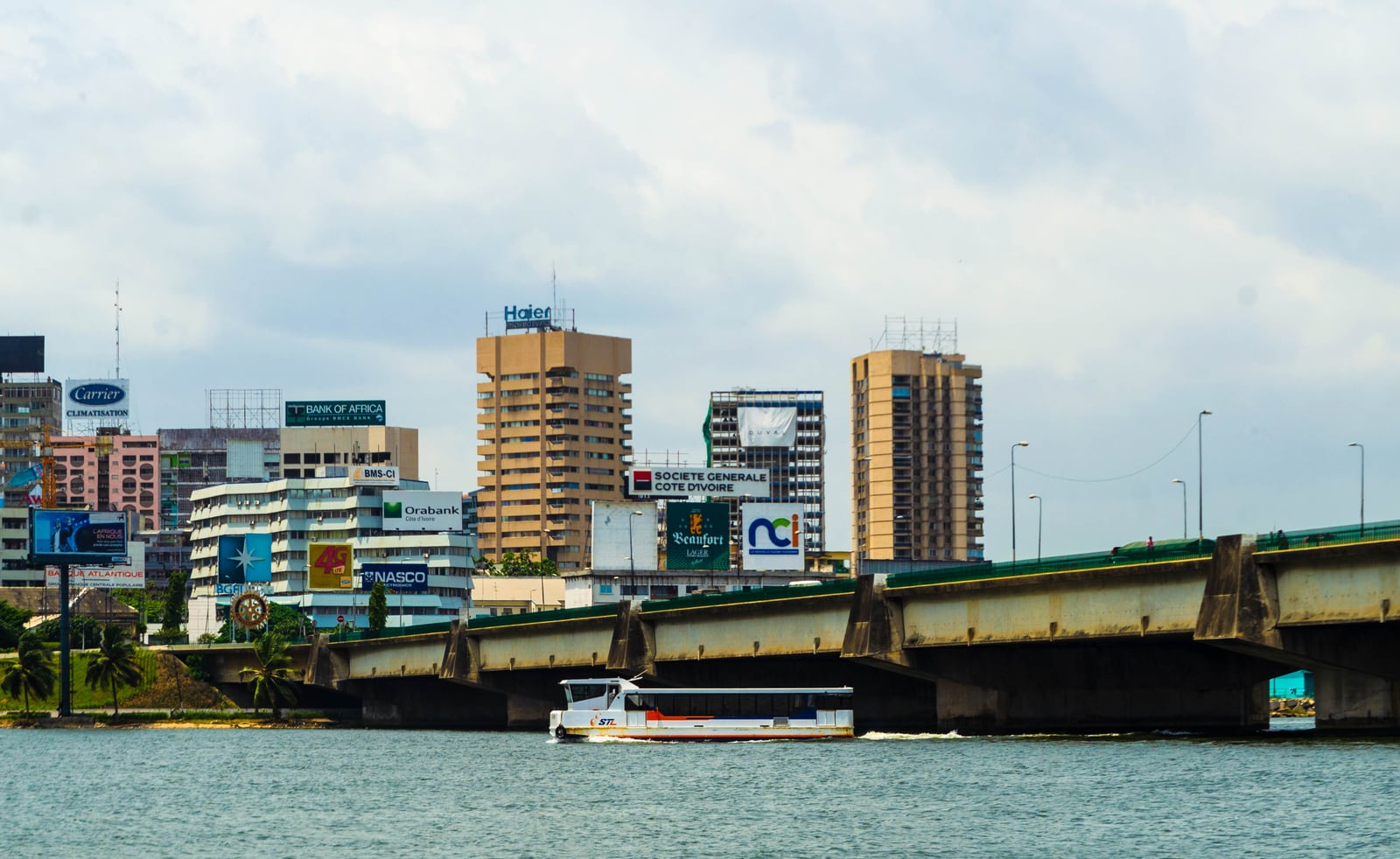
At 17:00 on a weekday, Abidjan's Plateau begins to empty toward the same water that defines its edge. Office light flattens against the Ébrié Lagoon. At the terminal, the useful question is not where the best view is. It is simpler: Which operator, which queue, which destination? Get those three answers right and the city's evening commute becomes a room in motion.
Make this one short, deliberate crossing on an STL bateau-bus from Plateau to Treichville. The current 2026 guide price is 300 FCFA one way, and the route is listed as a weekday service [2]. Allow 45–60 minutes for the whole exercise even though the two banks face each other. The buffer belongs to the dock, not the distance: comments under STL's own ticket instructions describe long waits on another corridor, while one Abidjan writer's lagoon loop treats unhurried movement as part of the experience [4][5]. Neither is a live timetable. That is why the app check governs.
This is not a promise that a boat leaves at 17:00. It is a recommendation to arrive while the commuter room is forming and daylight still gives you a margin. As of August 16, 2026, STLGO offers live departure and arrival information, station listings, e-tickets and Mobile Money payment [3]. Use that live layer. A directory's opening hours, an old screenshot or a generic “ferry” pin cannot tell you whether your particular boat is running now.
Choose the service before the scenery
The first local move is to choose one operator before walking downhill. Abidjan's lagoon transport is not a single interchangeable fleet. The mobility authority lists SOTRA, STL and CITRANS as distinct formal services, alongside a much larger informal pinasse network [6]. Plateau also has operator-specific landing points close enough to confuse a visitor. “The lagoon station” is therefore an incomplete destination.
Set your map to Gare Lagunaire STL Plateau, on Boulevard du Général de Gaulle near Gare-Sud, then look for STL branding rather than the first hull you see [7]. The official parent-company route page places Plateau and Treichville on several STL corridors [1]. Your anchor is only the short Plateau–Treichville leg. Do not let a longer route name persuade you that every boat touching one terminal will touch the other next.
The second move is to open STLGO before you descend to the waterfront. Confirm three things on the same screen: Plateau origin, Treichville destination, and a live departure. The app's 2026 update added real-time schedule information and a station list precisely because static route knowledge is not enough [3]. If the trip is missing, delayed beyond your margin or unclear, do not improvise with another operator or an informal boat. Keep the evening on land.
Buy the 300 FCFA STL e-ticket in the app when the departure is confirmed, and keep the confirmation easy to reopen [2][3][4]. That is the third move. STL's own instructions say the e-ticket avoids the ticket-purchase line; they do not say it reserves a seat or eliminates the boarding line [4]. The useful distinction is small: you have paid for passage, not purchased punctuality.
Let the queue tell you how the room works
Reach the STL terminal 30–45 minutes before the departure you actually intend to take. That is the fourth move, and it is why 16:30–17:00 is a better arrival window than a dash toward the last light. The Plateau listing places the terminal on Boulevard du Général de Gaulle, beside the Gare-Sud transport cluster [7]. The crowd is operational information: it shows which part of the room is moving and which part is still waiting.
Do not join the longest line on instinct. Show the e-ticket to an attendant and say “Treichville” before settling into a waiting area. Ask again when boarding begins. This fifth move matters because a local writer who planned a multi-stop lagoon day discovered that her chosen company did not call at one expected stop [5]. A skyline can orient you to the city; it cannot confirm a ferry's next call.
Wait beside the destination group rather than at the lip of the pontoon. Keep the gangway clear, let disembarking passengers finish, and board in the order staff opens. A commuter ferry is not improved by racing for the first photograph. It works when bodies move through a narrow transfer without turning it into a contest.
There is no reservation ritual to master. Queue reality is the ritual. The official service picture is substantial—AMUGA describes an STL fleet of 20 vessels carrying about 17,000 passengers a day—but a large network can still produce a long wait at one pontoon [6]. The local lesson is not “the boat is always faster.” It is that the lagoon can bypass a road bottleneck while creating its own small bottleneck at the water's edge.
Take a seat, then watch the banks change roles
Once aboard, take the seat the crew directs. If there is a genuine choice after regular commuters have settled, choose a window-side place without blocking an aisle, doorway or sightline. That is the sixth move. One Abidjan writer described sitting at the back “like school” and noticing passengers who were couples, families, friends and solo riders [5]. The useful atmosphere comes from accepting that ordinary frame.
The boat's orange-and-blue livery is a better recognition cue than its size; STL operates multiple vessel types [6][8]. Put bags on your lap or under control, keep the gangway free and stay seated while the boat is moving. There is no need to lean toward a doorway for a cleaner photograph. The Plateau towers will still be there through glass or weather curtain, and the image that matters is the relationship between the banks.
Plateau reads from the water as a wall of administration and commerce. Treichville reads as the south-bank handoff into a different urban rhythm. Formal boat-bus service began at Plateau in 1980; STL joined the private formal network in 2017 [9]. That history is visible less as nostalgia than as geometry. Bridges concentrate road traffic. Terminals let commuters cut across the same lagoon instead of following its edge.
This is what makes the crossing a night room rather than a miniature cruise. Around you, passengers are completing a workday. Phones replace guidebooks; seats face the practical direction; the city darkens while the cabin stays briefly shared. The water does not remove you from Abidjan. It shows how much of Abidjan is organized around crossing it.
The seventh move is to remain aboard until crew, app and terminal agree on Treichville. Do not step off merely because a new bank looks close or a large building seems familiar. The local account's failed Blokhauss plan is a useful warning that an imagined route and an operator's actual calls can differ [5]. Name beats resemblance; confirmation beats confidence.
Make the return decision before the first boat moves
Decide the onward plan while you are still at Plateau. That is the eighth move. If this is an out-and-back, check the live Treichville return before boarding the first leg and leave at least one full service interval between your intended boat and the final option shown. If Treichville is your destination, arrange the next walk or ride before the cabin reaches the south bank.
Do not build the outing around a listed closing time. One current local directory shows broad terminal hours, while rider reporting says service can thin or stop earlier than a visitor expects [5][7]. A terminal being open is not the same thing as your route having another departure. The live STLGO listing is the governing signal [3].
That boundary also keeps the article's romance honest. The formal bateau-bus and an informal pinasse are not interchangeable backups. AMUGA treats them as different service categories, and a recent sector account describes different boarding, equipment and operating logics [6][9]. If STL is unavailable, leave by land. Do not turn a failed timetable into an unresearched night crossing.
Three visitor mistakes, and the better move
Mistake one: following a generic ferry pin. Plateau has neighboring operator facilities, and tickets do not transfer by visual similarity [6][7]. Better: navigate to the STL terminal, then match operator, origin and destination before paying.
Mistake two: treating an e-ticket as a reservation. STL says STLGO removes the purchase-line step, while community accounts still document boarding waits [4][5]. Better: buy in advance, then preserve a 30–45-minute dock buffer.
Mistake three: saving the return question for Treichville. Service hours and route frequency are not the same, especially toward the end of the operating day [3][5][7]. Better: check both directions before the first boarding and keep a land exit available.
The go details
- Primary anchor: the weekday STL bateau-bus from Gare Lagunaire STL Plateau to Treichville; no second attraction is needed.
- Best window: arrive 16:30–17:00, after verifying a live departure in STLGO. Treat the time as a light-and-buffer window, not a timetable [3].
- Time needed: budget 45–60 minutes from terminal arrival to the Treichville bank; the padding is editorial insurance against a boarding wait, not a claimed live frequency [3][4].
- Expected spend: 300 FCFA one way or 600 FCFA for a same-fare out-and-back, subject to the live fare shown before purchase [2][4].
- Service pattern: the 2026 guide lists Plateau–Treichville on weekdays [2]. Verify the actual date and departure in STLGO [3].
- Queue reality: an e-ticket can skip the sales line, not the destination queue or boarding order [4][5].
- Where to wait: in the area staff identifies for Treichville, away from the pontoon edge and disembarkation path [5].
- Recognition cue: STL's orange-and-blue boat livery plus the operator name; do not rely on “lagoon station” alone [7][8].
- On board: take the directed seat, keep aisles and doors clear, and confirm Treichville before stepping off.
- Fallback: if the live departure is absent or the return margin collapses, leave by land rather than substituting an unfamiliar boat.
The reward is not a secret viewpoint. It is a change in the city's grammar. Plateau stops being a skyline seen from a road and becomes one bank of a working water system. For a few minutes, Abidjan's evening belongs to the queue, the cabin, the motor and the two shores trading places. Choose the right service first; the night room will assemble around you.
Sources
- SNEDAI Groupe, “Lignes de Transports Publics & Navigation de plaisance” — operator-parent route list placing Plateau and Treichville on STL's public corridors.
- Petit Futé, “Bateaux STL” (2026) — current guide confirmation of the weekday M'Pouto–Treichville–Plateau service and the 300 FCFA Plateau–Treichville fare.
- Startup Medias, “Innovation: STL lance l'application STLGO pour digitaliser le transport lagunaire” (April 20, 2026) — recent local report on live schedules, station listings, e-tickets and Mobile Money payment.
- STL Abidjan, “Si tu ne sais pas comment te déplacer facilement, nous on sait !” — operator instructions for buying a 300 or 700 FCFA STLGO e-ticket before reaching the terminal, plus rider comments that preserve the boundary between sales and boarding queues.
- Les vadrouilles d'Alleki, “Balade Lagunaire” — an Abidjan-based first-person account of planning a multi-stop lagoon ride, discovering an operator did not serve an expected stop, choosing a rear seat and reading the city from the water.
- Autorité de la Mobilité Urbaine dans le Grand Abidjan, “Services de transport” — official distinction among SOTRA, STL, CITRANS and informal pinasses, with STL fleet and ridership context.
- Go Africa Online Côte d'Ivoire, “Gare Lagunaire STL Plateau” — current local directory entry for the operator-specific terminal on Boulevard du Général de Gaulle and its posted facility hours.
- Wikimedia Commons, “File:Transport lagunaire à Abidjan.jpg” — source page for Pierrekonan's real March 2020 photograph of an STL boat on the Ébrié Lagoon.
- Jan van der Vorm, “Transport Lagunaire par Bateaux Bus ou pinasse à Abidjan, secteur Formel et Informel” (October 16, 2025) — recent locally grounded sector account of formal-service history, operator distinctions, typical evening bounds and the commuter role of the lagoon.