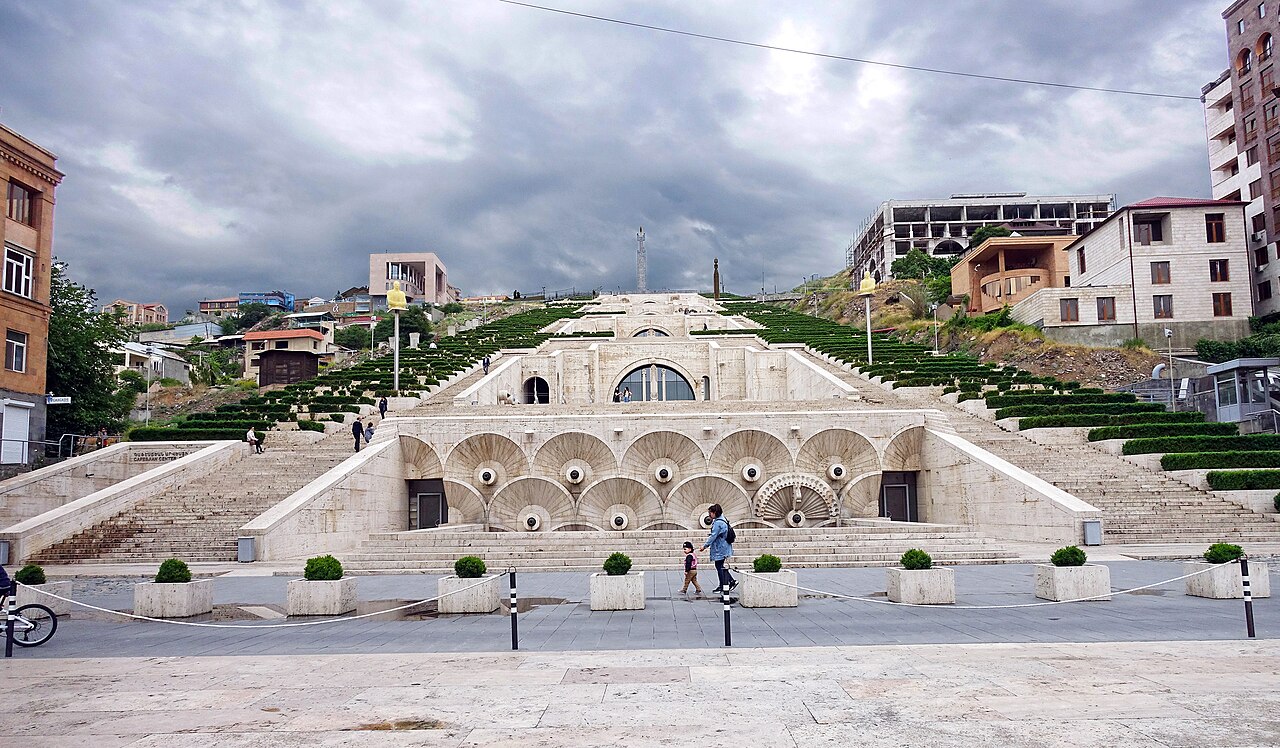
Most first-time Yerevan routes make the Cascade too small. They turn it into a backdrop, take the sculpture-garden photo, climb until the legs complain, and leave before the place has explained anything. The better move is narrower and slower: arrive from Tamanyan Street in the evening, read the sculptures from the bottom, then use the Cascade as one civic rise rather than as a checklist viewpoint.[1][2][3]
This is a ritual lens, not a monument audit. The Cascade works because it is both formal and everyday. Yerevan's municipality places it inside the city's long attempt to bind center, slope, view, and public culture into one urban gesture, beginning with Alexander Tamanyan's 1924 master-plan idea and continuing through the later Soviet and post-Soviet building phases.[3] TourPoint's current guide gives the simpler visitor translation: the Cascade is both Yerevan's most recognizable Soviet-Armenian architectural monument and an open-air contemporary-art setting.[2]
That sounds grand, but the useful travel version is more ordinary. AskYerevan calls the Cascade a place where people gather, exercise, stroll, watch sunset, sit on steps, hear music, and let the city lights come on.[5] That is the key. The Cascade is not best understood at the top. It is best understood while the city is actively using it.
Image context: the cover uses a real Wikimedia Commons photograph of the Yerevan Cascade from Tamanyan Street. It is the right image because this piece depends on the full stair-and-terrace recognition cue, not on an isolated sculpture detail.[8]
Start At The Bottom On Purpose
Begin at 10 Tamanyan Street, the Cafesjian Center address, and resist the urge to sprint upward.[1] The outdoor sequence is already doing part of the work. The TourPoint guide treats the lower approach, sculpture garden, terraces, and fountains as one open-air museum sequence rather than separate attractions.[2] That matters because the bottom is where the Cascade is most public. People wait for friends, children move around the sculptures, visitors look up, and the slope turns into a stage before it becomes a climb.
The complex has hard numbers, and they help calibrate the visit. TourPoint lists 572 steps, 302 meters of vertical route, and a 50-meter width, while the municipality records the broader story of the old cascade, later redevelopment, and unfinished upper area.[2][3] Those figures are not trivia. They explain why a rushed visit feels wrong. This is too large to be a quick staircase and too urban to be a hike. Treat it as a vertical street.
The indoor schedule also changes the route. Cafesjian's current visitor page says gallery admission is free, the Sculpture Garden is always open, the Escalator Gallery runs 8:00-20:00 every day, and the exhibition galleries, museum store, and visitor center currently open Friday-Sunday 10:00-20:00, with the center closed on state holidays.[1] That makes 18:30-19:45 the cleanest default window: late enough for evening use and slanting light, early enough to keep the escalator gallery as a real option if your knees, heat tolerance, or time budget need it.[1][5]
The Useful Sequence
Use the route in three short acts. First, stay low for five to ten minutes. Walk the sculpture garden rather than treating it as a queue to the stairs. Visit Yerevan identifies works by Lynn Chadwick, Jaume Plensa, Barry Flanagan, Fernando Botero, and others in the complex, which is why the first layer reads as an open-air art room before it reads as exercise.[4]
Second, climb only after you have looked up from the base. The upward view matters because the Cascade is still partly an unfinished city argument. The municipality notes the interruption after the 1988 earthquake, the later 2002 reconstruction phase, the 2009 opening, and the unfinished upper section.[3] You do not need to enter that debate deeply as a visitor, but you should notice that the Cascade is not frozen heritage. It is active urban pressure.
Third, choose your descent before you reach the top. If the day is hot, if the Escalator Gallery is still open, or if someone in your group is tiring, do not make the stairs a test of seriousness. Recent review/community roundups keep repeating the practical pattern: the view is strongest around sunset and clear weather, and the inside escalators are the obvious way to spare your legs while still reading the art landings.[7] The best visitor is not the one who suffers most. It is the one who keeps enough attention for the view back over the city.
8 Local Moves That Make The Route Work
- Arrive from Tamanyan Street, not by taxi at the upper edge. The bottom-up sequence gives you the sculpture garden, the social forecourt, and the full white stair mass in one read.[1][4]
- Aim for 18:30-19:45 in warm months. You get evening use without losing the 20:00 indoor-escalator cutoff.[1]
- Check the sky before promising Ararat. Visitors keep noting the Ararat payoff, but it depends on clear conditions; haze can erase the mountain and leave you with a city view instead.[7]
- Treat the escalator as infrastructure, not defeat. The official complex was designed with an indoor escalator shaft, and the current Escalator Gallery is open daily 8:00-20:00.[1][2]
- Sit once before climbing. The lower steps and sculpture garden tell you more about Yerevan's evening social rhythm than a rushed summit photo.[5]
- Keep the whole route free unless you choose extras. Gallery admission is free, and the outdoor garden is always open; your basic spend can be AMD0 before coffee, taxi, or museum-store detours.[1]
- Make sunset a return, not a scramble. A recent local-style walking guide explicitly brings the route back to Cascade for sunset, which is the right instinct: let the day end here instead of arriving exhausted at the last minute.[6]
- Leave through the city, not just down the same stairs. After the descent, drift toward Opera or Abovyan if you still have legs; the Yerevan Info route treats Cascade as part of a center-city walking sequence, not a sealed monument.[6]
Non-Local Trapline
Mistake 1: using the Cascade as a photo stop before dinner.
Better alternative: hold the lower garden, climb or ride slowly, then sit at least once. The point is the public room, not only the panorama.[1][5]
Mistake 2: assuming the top is always the goal.
Better alternative: decide based on heat, haze, and the 20:00 escalator cutoff. A clear lower-evening read beats a tired full ascent in bad light.[1][6]
Mistake 3: treating the unfinished upper condition as ugliness to ignore.
Better alternative: notice it as part of Yerevan's living urban story. The municipality still identifies the upper part as unfinished, which is one reason the Cascade feels less like a closed monument than an argument still attached to the hillside.[3]
Mistake 4: stacking too many heavy institutions before the climb.
Better alternative: give the Cascade its own evening slot after a lighter afternoon. It is only 302 meters from bottom to top of the main complex, but the attention cost is larger than the distance suggests.[2]
Go Details
Best window: 18:30-19:45, especially when sunset light and the 8:00-20:00 Escalator Gallery window overlap.[1]
Expected spend: AMD0 for the core outdoor route and free gallery admission when open; budget separately for transport, drinks, or paid special programming if you add it.[1]
Queue and access reality: the Sculpture Garden is always open, the Escalator Gallery is daily 8:00-20:00, and exhibition galleries are currently Friday-Sunday 10:00-20:00; state holidays can close the center.[1]
Where to sit or stand: start with a low bench or step in the sculpture garden, take the first long backward look after one or two terraces, and save the top for clear weather rather than forcing it every time.[4][6]
Navigation cue: Tamanyan Street -> Cafesjian Sculpture Garden -> lower terraces -> stairs or Escalator Gallery -> upper view if clear -> slow descent toward Opera or Abovyan.[1][4][6]
Yerevan's Cascade is strongest when it is allowed to remain both planned and unfinished, monumental and casual, civic and personal. Come from the bottom, rise slowly, and let the city keep interrupting the architecture. That interruption is the point.
Sources
- Cafesjian Center for the Arts, official homepage - current "Visit CCA" admission-and-hours section covering free gallery admission, Sculpture Garden access, Escalator Gallery hours, exhibition-gallery hours, state-holiday closure, and the 10 Tamanyan Street address.
- TourPoint.am, "Cascade Complex" - current local visitor guide covering the Cascade as Soviet-Armenian architecture and open-air contemporary-art museum, with 572 steps, 302 meters of vertical route, terraces, fountains, sculptures, and the Cafesjian Center inside.
- Yerevan Municipality, "Yerevan museums: Cafesjian museum-foundation" - city page on the Cascade's place in the 1924 master plan, 1970s development, 1988 interruption, 2002 reconstruction, 2009 opening, Ararat view, and unfinished upper area.
- Geomerid, "Cascade architectural complex" - visitor guide with location, terraces, sculpture-garden context, evening-walk framing, 302-meter/572-step scale, and Ararat-view note.
- AskYerevan, "Cascade" - local city guide describing the Cascade as a gathering, exercise, sunset, steps, music, city-lights, and sculpture-garden place.
- Yerevan Info, "One Day in Yerevan: A Local-Style Walking Route with Food, Views and Real Atmosphere" - recent local-style guide that returns to Cascade at sunset and places it inside a walkable center-city sequence.
- Wanderlog, "Cascade Complex, Yerevan" - review/community aggregation covering visitor emphasis on sunset, clear-day Ararat views, stairs, escalators, sculpture levels, and practical top-access choices.
- Wikimedia Commons, "File:Yerevan Cascade 2018.jpg" - documentary photograph by Tiia Monto used as the article image.