Nicosia is easy to mishandle if you arrive looking for a border stunt. The better old-city move is smaller and more respectful: start at Eleftheria Square, walk Ledra Street slowly, pause before the Green Line crossing, and decide whether to cross only after the street has already done its work. The point is not to collect two sides in one bragging sentence. It is to feel how a normal shopping street becomes a civic threshold in the middle of daily life.[1][3][4]
Ledra Street works as a street microcosm because it compresses three versions of Nicosia into one walk. It is commercial, with cafes, shops, shade, delivery carts, and the tired middle-of-day rhythm of a Mediterranean capital. It is historical, named on official tourism material as one of the old city's pedestrian streets and linked to the walled-city core.[4] And it is political, because the UN buffer-zone system still cuts through the island, with Ledra Street listed by UNFICYP as one of the Nicosia crossing points opened after April 2003.[1]
That combination is why the route should stay tight. Give yourself 60 to 90 minutes, not a whole capital-in-one-day mission. Walk from Eleftheria Square toward the old street grid, let Ledra's ordinary retail energy narrow around you, and stop before the crossing long enough to notice the change in street behavior: more people checking pockets, more signs, more hesitation, and a sudden awareness that paperwork is part of the pavement here.[1][6][7]
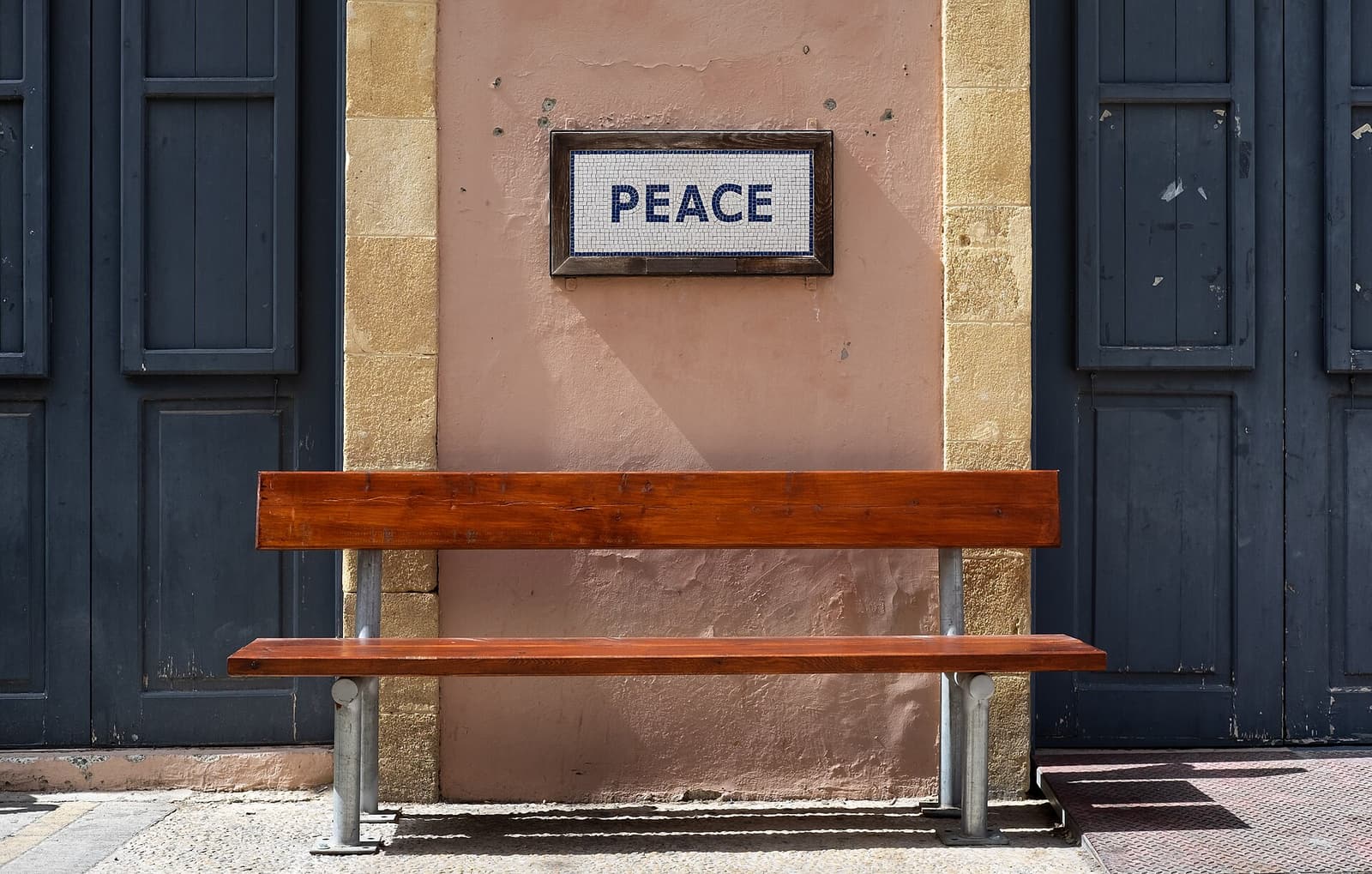
The cover image uses a 2018 Wikimedia Commons photograph by Jules Verne Times Two showing a peace sign near the Ledra Street buffer-zone crossing. It is not used as generic optimism. It fits because this route is about what the street asks a visitor to hold together: benches and barriers, a public sign and a controlled passage, a city trying to behave normally around an unresolved line.[8]
The Street Before The Checkpoint
Begin on the south side, near Eleftheria Square, because that approach lets Ledra appear first as city fabric rather than as a border apparatus.[4] The official Nicosia tourism map folds Ledra into a wider old-city walk with museums, gates, historic streets, and the Venetian-wall frame; that matters because the crossing is not floating in isolation.[4] You are inside a working center before you are inside a geopolitical symbol.
The first local move is to keep your pace normal. Do not sprint to the checkpoint as if the rest of the street were a queue. Ledra is useful because it still behaves like a pedestrian retail spine: people drift between side streets, pause under awnings, and use it to get somewhere ordinary. A local Cyprus Mail report from July 18, 2025 noted that calls for another old-town crossing had grown partly because Ledra Street itself can become overcrowded with tourist movement, especially in summer.[5] That is the warning hidden in plain sight. If you arrive as another person rushing toward the same pinch point, you help create the blur you came to understand.
The second move is to read the crossing as a hinge, not as the whole story. PRIO's account of the April 3, 2008 Ledra/Lokmaci opening emphasizes why this crossing felt different: it connected residential and commercial areas of the same municipality across the cease-fire line, rather than only moving people through a peripheral checkpoint.[3] That is what you can still feel on foot. The street does not end and restart as scenery. It tightens, filters, and resumes.
Cross Only If The Mechanics Are Clean
If you plan to cross, make the decision practical before you reach the desk. Bring a valid passport or EU ID card; a current Nicosia crossing explainer published in March 2026 describes those as the normal documents visitors use at the Ledra Street checkpoint.[6] Community travel advice says the pedestrian crossing is usually the easiest Nicosia option on foot, but still treats wait time as variable rather than guaranteed: one recent Cyprus thread described crossing as often taking roughly 5 to 20 minutes.[7]
That range is enough to change the route. If you have a museum ticket, dinner booking, bus departure, or heat limit pressing on you, do not treat the crossing as frictionless. The European Commission's 2025 Green Line update says authorized crossings across Cyprus reached 7.18 million in 2024, a historic high.[2] That island-wide number does not tell you the exact queue at Ledra at 11:20 on your visit, but it does explain why the crossing should be handled as live infrastructure, not a symbolic doorway that always behaves the same way.[2][5]
The third move is to cross lightly. Do not photograph guards, desks, documents, or anyone else's face in the checkpoint flow. Keep your bag easy to open, your passport in hand, and your plan simple: cross, orient, walk a short north-side segment, then either continue deliberately or return. The non-local mistake is trying to make the passage dramatic. The local intelligence is the opposite. People use this crossing because it works.
8 Local Moves That Keep The Walk Legible
- Start at Eleftheria Square and walk north. It keeps Ledra in the old-city sequence before the crossing takes over the story.[4]
- Give the route 60 to 90 minutes. Anything shorter turns the street into a document errand; anything much longer tends to sprawl into unfocused old-town collecting.
- Carry the right ID before you enter the street. Passport or EU ID is the practical baseline in current visitor guidance; do not discover the rule at the desk.[6]
- Treat summer and midday as crowd multipliers. Local reporting links the old-town crossing pressure partly to tourist volume, especially during summer.[5]
- Use the crossing as a hinge, not a trophy. The important fact is that Ledra/Lokmaci joins commercial and residential pieces of the same city fabric.[3]
- Keep photos away from control points. Photograph street texture, signs, shopfronts, and civic furniture instead of making staff or other crossers part of your image.
- Check same-day local surfaces if crossing is essential. Queues, temporary works, and political events can change the feel of a short walk.[5][7]
- Exit by a side-street pause, not an immediate U-turn selfie. After the crossing zone, step aside, regain the street rhythm, and decide whether to keep walking or return.
Non-Local Trapline
Mistake 1: treating Ledra Street as only "the border street." Better move: read the south-side approach first as pedestrian city life. The crossing lands harder when ordinary cafes, shops, and old-city navigation come before the checkpoint.[4]
Mistake 2: assuming the crossing is always instant. Better move: budget a 5-to-20-minute variable wait even if many crossings are smooth, and keep a larger buffer when the old town is busy.[5][7]
Mistake 3: chasing political spectacle. Better move: let the controlled passage stay controlled. The strongest experience is the quiet contrast between normal walking and the sudden need for documents.[1][3][6]
Mistake 4: trying to "do both sides" with no actual route. Better move: choose one compact north-side or return-side continuation before crossing. Otherwise the walk becomes a vague claim rather than local knowledge.
Concrete Go Details
- Best window: late morning before lunch heat or late afternoon before the shopping street thins too much; avoid treating the highest summer tourist period as neutral.[5]
- Expected spend: EUR 0 for the walk and the pedestrian crossing itself; spend only if you stop for coffee, museums, or transport.
- Queue and document reality: bring a valid passport or EU ID card, and leave a practical wait buffer rather than assuming an instant pass.[6][7]
- Navigation cue:
Eleftheria Square -> Ledra Street pedestrian spine -> checkpoint pause -> optional crossing -> short north-side orientation -> return or continue deliberately. - Where to stand: pause before the crossing zone without blocking the pedestrian stream; after crossing, move aside before checking maps.
- Numeric anchors worth keeping: April 2003 for the wider crossing-point opening period, April 3, 2008 for Ledra/Lokmaci, 7.18 million authorized Green Line crossings in 2024, July 18, 2025 for the recent overcrowding report, March 2026 for current visitor crossing guidance, and 60-90 minutes for the clean route frame.[1][2][3][5][6]
The best Nicosia walk does not need you to exaggerate it. Ledra Street is powerful because it keeps refusing to be only one thing. It is a shopping street, a memory line, a crossing point, a place locals use, and a place visitors often over-symbolize. Slow down before the checkpoint, cross only when the mechanics are clean, and the city becomes clearer than any divided-capital slogan can make it.
Sources
- UNFICYP, "About the buffer zone" (updated November 22, 2025; official UN context for the buffer zone and the Nicosia crossing points including Ledra Street).
- European Commission Representation in Cyprus, "Cyprus Green Line crossings reached historic high in 2024" (July 1, 2025; 7.18 million authorized crossings).
- PRIO Cyprus Centre, "The Opening of Ledra Street/Lockmaci Crossing in April 2008: Reactions from Citizens and Shopkeepers" (opening date and same-municipality commercial/residential significance).
- Cyprus Deputy Ministry of Tourism, "Nicosia Map" PDF (official tourism map for the old-city frame, Ledra Street, and pedestrian-street context).
- Cyprus Mail, "Greek Cypriots 'suggested crossing point in Nicosia's old town'" (July 18, 2025; local reporting on calls for another old-town crossing and Ledra Street overcrowding pressure).
- Tom Henty's Travel, "Crossing the Ledra Street Border in Nicosia" (March 21, 2026; current visitor guidance on documents, queues, Eleftheria Square approach, and the pedestrian crossing experience).
- Reddit / r/cyprus, "Visiting Cyprus in November" (2025 community thread used for practical traveler/local advice that Ledra Street is the easiest on-foot Nicosia crossing and that wait times can vary).
- Wikimedia Commons, "File:Peace sign near the Ledra Street buffer zone crossing, Nicosia, Cyprus (PPL1-Corrected) julesvernex2.jpg" (documentary photograph by Jules Verne Times Two, taken March 8, 2018).