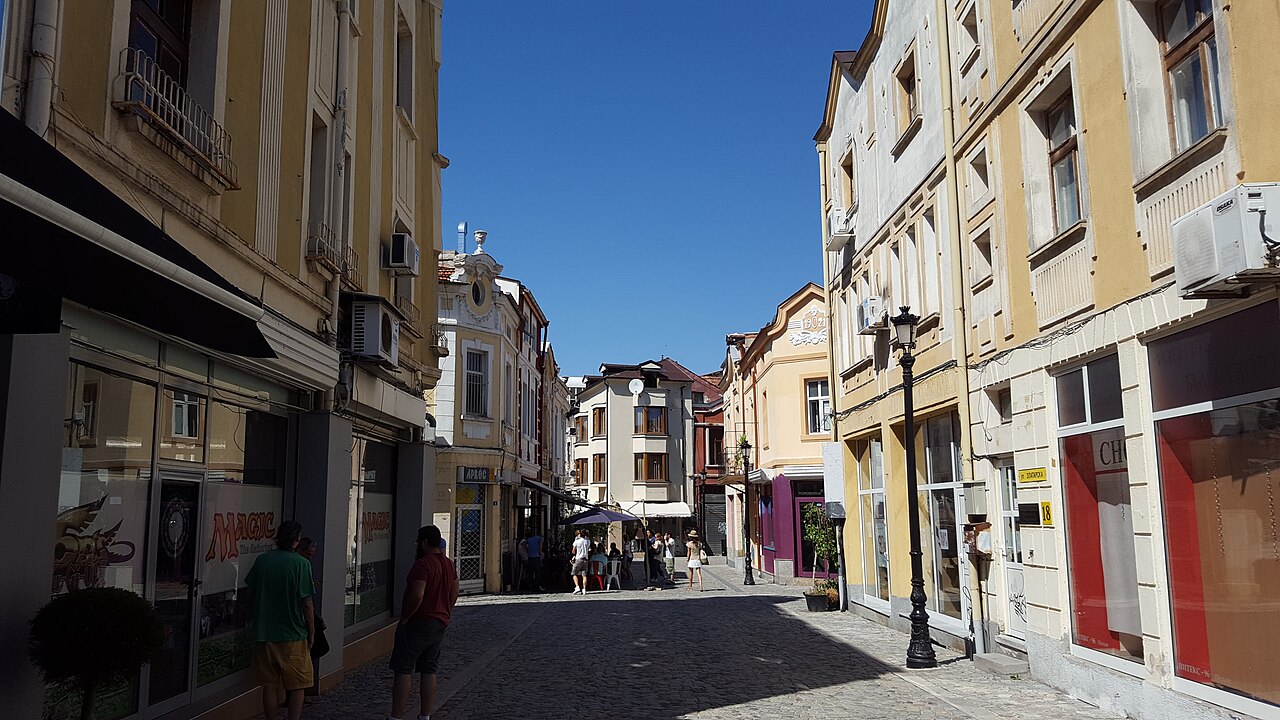
Plovdiv is easy to oversell as a list of eras: Roman theatre, Revival houses, Ottoman mosque, 2019 creative-city afterglow. The better first read is smaller. Start with the Ancient Theatre while it is still a monument, then drop toward Kapana and let the city shrink to lane width. The move works because the two places explain each other: one is stone, slope, and public spectacle; the other is the everyday afterlife of a center that still prefers walking, sitting outside, and drifting between small streets.[1][2][4]
This is a street microcosm, not a one-day Plovdiv itinerary. Keep the anchor tight: Ancient Theatre to Kapana, with the Old Town descent as the connector. Visit Plovdiv places Kapana directly off the central pedestrian area and describes it as a former craft quarter around Kurshum Han, with street names still carrying old trades such as ironwork, fur work, wool clothing, and goldsmithing.[1] That is the detail most visitors miss. The district is not only "creative" because it has murals, bars, and cafes. Its creative mood sits on top of an older street grammar built for small trades.
The Ancient Theatre gives the route its first scale correction. Visit Plovdiv dates the building to the 90s of the first century AD, notes its 28 marble seating rows and roughly 6,000-person capacity, and points out that it is still used for opera, drama, and music rather than being sealed as a ruin.[2] The 2026 Opera Open schedule makes that living-stage status concrete: summer performances at the Ancient Theatre begin around 20:00-21:00, which means the site changes personality after normal sightseeing hours.[3]
Image context: the cover uses a real Wikimedia Commons photograph of Kapana. It fits this article because the route depends on Plovdiv's close street texture rather than on a panoramic hill view or a food-table image.[7]
Start With Stone, Leave By Foot
Do the theatre first, but do not overstuff it. Current visitor information on Visit Plovdiv lists summer hours as 9:30-18:00, winter hours as 9:00-17:30, and a 12:30-13:00 lunch break.[2] That makes late afternoon the practical sweet spot: you can see the theatre before closing, avoid the hardest midday heat, and still descend into Kapana while the district is waking into its evening rhythm.
The trap is to exit the theatre and keep chasing views. Plovdiv has plenty of them, and Nebet Tepe will tempt you. For this route, resist. Free Plovdiv Tour's local navigation note is more useful than another scenic detour: from the Old Town core, the way to Kapana can be as short as 3-4 minutes if you use the lanes toward Konstantin Stoilov and Pernik Street.[5] The point is not efficiency for its own sake. It is continuity. You want to feel the city contract from amphitheatre scale to human conversation scale without turning the middle into a taxi transfer.
The descent also fixes a common orientation error. Kapana is not a separate nightlife bubble. Visit Plovdiv's pedestrian-area page ties it to Knyaz Aleksandar I Street, the Roman Stadium zone, Dzhumaya Mosque, Small Main Street, and the covered pedestrian bridge toward the Maritsa.[1] A recent Old Town guide makes the same practical point from the other side: the historic district is a sloped walking reserve, so its Roman and Revival layers are best understood as approaches into the center, not sealed sights to finish before the "real" city begins.[6] In practical terms, that means Kapana is the hinge between the formal old-city walk and the living center. Arrive through that hinge and the district feels obvious. Drop in by ride-hail at a random bar pin and it can feel like any compact European cafe quarter.
8 Local Moves That Make The Microcosm Work
- Enter Kapana on foot from Old Town, not from a car door. The short 3-4 minute pedestrian connection is part of the read: walls, slope, underpass, then the lower creative grid.[5]
- Use late afternoon as the default. The Ancient Theatre's regular visitor hours close before evening, while Opera Open shows demonstrate that the site has a second life after 20:00 on performance nights.[2][3]
- Let the trade-name streets slow you down. Zhelezarska, Kozhuharska, Abadzhiyska, and Zlatarska are not decorative names; they preserve the older craft logic under the current cafe-and-gallery layer.[1]
- Sit outside if weather allows. Tours Bulgaria's 2026 cafe guide describes Plovdiv's local
ayliakmood as refusing to rush a coffee and says residents often prefer outdoor seating even in cooler months.[4] - Aim for a weekday coffee window if you want texture without crowd compression. The same guide calls 10:00-14:00 on weekdays the calmer Kapana cafe-hopping window, while weekend afternoons can feel like a pedestrian festival.[4]
- Keep one eye on the theatre calendar. A 21:00 Ancient Theatre performance changes the whole route: Kapana becomes a pre-show pause, not the end of the night.[3]
- Do not make dinner the primary anchor. Food and drink are useful here, but the better payload is the street behavior: outdoor tables, small shops, wall art, short blocks, and people using the quarter without sightseeing urgency.[1][4]
- Leave through the main pedestrian spine. After Kapana, drift toward the Roman Stadium and Dzhumaya Mosque rather than backtracking uphill; that keeps the route in Plovdiv's walking center.[1]
Non-Local Trapline
Mistake 1: treating Kapana as only a cafe district.
Better alternative: read the craft-street names and street scale before choosing a table. The cafes make more sense when you understand that the district's "creative" identity grew inside an older maze of workshops and trades.[1][4]
Mistake 2: trying to cover every hill before sitting down.
Better alternative: let this route be compact. Theatre, descent, Kapana, pedestrian spine. Plovdiv rewards wandering, but the first visit gets sharper when one short route teaches the city's scale.[1][5]
Mistake 3: arriving in Kapana at peak weekend crush and blaming the district.
Better alternative: use a weekday late afternoon or the 10:00-14:00 cafe window if you want the lanes to breathe; save weekend evening for atmosphere, not precision.[4]
Mistake 4: assuming the Ancient Theatre is just daytime archaeology.
Better alternative: check whether a performance is running. The official Opera Open 2026 calendar shows why the theatre still matters as a civic stage, not just as a preserved Roman object.[2][3]
Go Details
Best window: 16:30-19:30 for the normal route. That leaves time for the Ancient Theatre before the regular summer 18:00 close, then gives Kapana the first part of evening without turning it into a late-night bar crawl.[2][4]
Expected spend: keep the core walk free except for Ancient Theatre admission or a cafe stop. For a low-commitment Kapana pause, budget one coffee or lemonade rather than a full meal; the local rhythm is slow sitting, not table turnover.[4]
Queue and access reality: the theatre has a lunch break listed at 12:30-13:00, free admission for students and retired people on the first Thursday of the month, and separate event access when the stage is in performance mode.[2][3]
Where to sit or stand: in the theatre, sit high enough to see the rows as a public machine; in Kapana, choose an outdoor table on a narrow lane where walkers still pass close enough to keep the street alive.[2][4]
Navigation cue: Ancient Theatre -> Old Town descent -> Konstantin Stoilov / Pernik approach -> Kapana lanes -> Roman Stadium / Dzhumaya Mosque -> Knyaz Aleksandar I pedestrian spine.[1][5]
Plovdiv's strongest first impression is not that it is ancient. Plenty of cities are ancient. Its stronger trick is that the old public city and the present walking city sit only a few minutes apart. Let the Roman stone set the scale, then let Kapana reduce it to tables, shopfronts, and lane turns. That is when Plovdiv stops being a chronology and starts behaving like a place.
Sources
- Visit Plovdiv, "Central Trade and Pedestrian Area" - official city tourism page on Knyaz Aleksandar I Street, Kapana's location, craft-quarter history, street-name meanings, pedestrian links, and central sights.
- Visit Plovdiv, "Ancient Theatre" - official tourism page on the theatre's first-century date, 28 rows, 6,000-person capacity, current stage use, address, admission note, and visitor hours.
- Opera Plovdiv, "Opera Open 2026" - official 2026 performance calendar showing the Ancient Theatre's current summer stage use and evening performance times.
- Tours Bulgaria, "12 Best Cafes in Plovdiv: A Local's Coffee Guide (2026)" - recent local guide to Kapana cafe culture,
ayliak, outdoor seating, and weekday/weekend timing. - Free Plovdiv Tour, "How to navigate in the city center if you are staying in the Old Town of Plovdiv" - local guide to Old Town exits, the route toward Kapana, and the 3-4 minute connection.
- Tours Bulgaria, "Plovdiv Old Town Guide: Architecture, History, and Travel Tips" (updated May 9, 2026) - recent local guide to Old Town slope, Revival architecture, Roman ruins, tickets, hours, and practical walking context.
- Wikimedia Commons, "File:Plovdiv119.jpg" - documentary photograph of Kapana used as the article image.