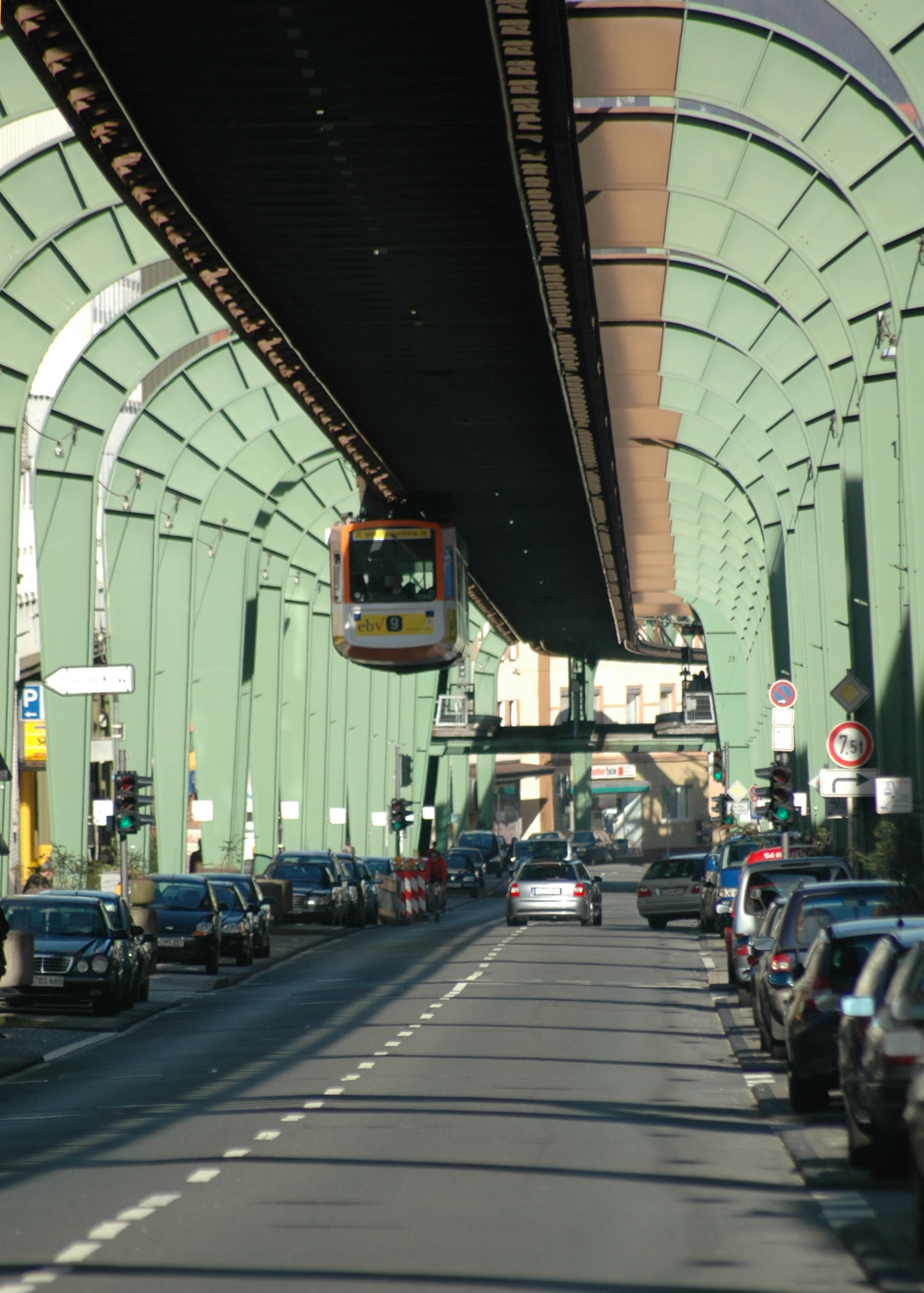
Wuppertal gets flattened too easily into a bucket-list ride. Visitors board somewhere central, film one stretch above the Wupper, and leave with the sense that the city's signature transport is a clever stunt. The cleaner local move starts farther west. Board at Vohwinkel, take the panorama window at the very end of the train if it is free, and let the first minutes over Kaiserstraße show you why the Schwebebahn works as city fabric before it works as spectacle.[1][2][3][5]
The official Schwebebahn homepage gives the scale, and the scale matters. Since passenger service began in March 1901, the Schwebebahn has become Wuppertal's east-west spine: more than 80,000 people a day, roughly 13 kilometres through the city, 20 stations, and about 30 minutes from Vohwinkel to Oberbarmen.[1] The most useful detail for a first ride is more specific than any of those numbers. The homepage notes that only 4 stations are on the land route, while the Vohwinkel station page makes clear what that means at ground level: the western end opens straight into the tight Kaiserstraße segment.[1][2] That western segment is where the whole system stops reading like an attraction and starts reading like an answer to a narrow valley city.
Vohwinkel is the right anchor because the station itself already explains the point. The official station page says the terminal has larger dimensions than the other stops because it carries the depot and workshop hall, and then it names the real visual payoff directly: from the platform, you look into the narrow Kaiserstraße, with the railway structure forced into the street wall almost uncomfortably tightly.[2] The same page adds one of those Wuppertal details that make the city feel cheerfully over-specific: the Solingen trolleybus stops right outside the station, giving you a second transport rarity at the same doorway.[2]
Image context: the cover uses a real Wikimedia Commons photograph of the Schwebebahn over Kaiserstraße in Vohwinkel. That is the right lead image because this piece is about the west-end street squeeze, not about a generic river view or a full-line souvenir lap.[7]
Why the west end explains the city better than a generic full-line lap
The common outsider move is to board near the middle, stay too short, and come away with a river clip rather than a city read. An official page about the newer cars spells out one practical detail that matters more than it sounds: the panoramic window sits on the rear side of the train.[5] Vohwinkel is the cleaner choice for a first run because the railway opens straight into the street-running section. You do not begin with the line already behaving nobly above water. You begin where it still has to squeeze through an ordinary commercial street.
The operating pattern supports that use. The current tickets page says the Schwebebahn comes every 3 minutes on weekdays, every 4 minutes on Saturday, and every 6 minutes on Sundays and holidays.[3] The same page lists the current 24-HourTicket at 7.60 euros, with a Germany ticket also valid on the line.[3] That makes the west-end ride easy to use as an urban tool rather than as a one-shot ceremony. Ride the first segment, get off if the structure or the street catches your eye, and reboard while the whole system is still behaving like normal transport.
Why Kaiserstraße is the part you should not rush through
A January 2026 enthusiast guide for public-transport spotters, while written for photographers, explains the spatial logic unusually well. It names Vohwinkel as one of the best Schwebebahn photo points, says morning to midday is strongest there, and then points readers toward Landgericht when they want the structure in a light urban curve rather than the straight squeeze through houses.[4] Read as city-travel advice rather than pure spotting, that produces a useful route shape: start at Vohwinkel for the narrow-street compression, stay on through Bruch and at least to Sonnborner Straße, and only then decide whether you want the whole 30-minute traverse or a shorter stop-off farther east.[1][2][4]
The live place layer around Vohwinkel backs up the practical side of that plan. Recent user photos and current navigation cues on Google Maps make the terminal easy to identify once you reach the district, and they confirm that the visual payoff starts before you even board: steel above roadway, shops compressed beneath the structure, and a platform that already points your eye down Kaiserstraße.[6] Wuppertal has greener slopes and grander museum detours. Very little else explains the city's transport intelligence faster.
8 local moves that make this object lens land
- Start at Vohwinkel instead of boarding in the middle of the line. The terminal gives you the clearest first contact with the street-running segment and the easiest shot at the panorama window seat.[2][5]
- Take the very end of the train if you can. The rear panoramic window changes the ride from sideways sightseeing into a forward-moving urban read.[5]
- Stay on at least until Sonnborner Straße. That is the point at which the Schwebebahn has shown both faces of itself: the tight Kaiserstraße squeeze and the valley line above the river.[1][2]
- If you care about light and photography, use the west end in the morning band. The January 2026 guide recommends Vohwinkel from morning into midday and saves Landgericht for later in the day.[4]
- Use the platform before you board. The official station page is right to emphasize the view into Kaiserstraße; the west-end payoff begins on foot, not only once the car moves.[2]
- Treat the Solingen trolleybus outside the station as part of the same transport scene. It is a small detail, but it sharpens the sense that Vohwinkel is a junction of unusual systems rather than a decorative terminal.[2]
- Buy a 24-hour ticket if you want to hop off once or twice. At 7.60 euros, it is the cleanest way to turn the ride into a short Wuppertal reading instead of one sealed pass.[3]
- Check operations on weekends before you go. The January guide notes that engineering works or replacement services can appear on weekends, so same-day verification matters.[4]
Non-local trapline: 4 common mistakes and the better alternative
Mistake 1: boarding near Wuppertal Hbf because it feels central and therefore efficient
Better alternative: start at Vohwinkel and let the line earn the river section by first showing how it fits through Kaiserstraße.[1][2]
Mistake 2: taking a middle seat and turning the ride into a sideways phone video
Better alternative: wait for the end window. The local-community advice about the panorama seat exists because the ride reads differently when you see the line opening in front of you.[5]
Mistake 3: getting off after one station and thinking you have already understood the west end
Better alternative: stay on at least to Sonnborner Straße so the system can shift from street-running compression back into valley infrastructure.[1][2]
Mistake 4: treating the Schwebebahn as a one-time novelty and never reboarding
Better alternative: use the short headways and the day ticket to make one stop-off part of the plan, especially if you want a second view at Landgericht or farther east.[3][4]
Concrete go details
- Best window: 08:00-12:30 if you want the Vohwinkel platform view and the Kaiserstraße run in the strongest light, with room to continue toward Landgericht around midday.[4]
- Expected spend: 0-7.60 euros depending on whether you already hold a Germany ticket or buy the current 24-HourTicket.[3]
- Queue and reservation reality: no reservation layer; service runs every 3 minutes on weekdays, 4 minutes on Saturday, and 6 minutes on Sundays and holidays.[3]
- Where to stand or sit: first on the Vohwinkel platform looking into Kaiserstraße, then at the very end of the train for the rear panorama window.[2][5]
- Navigation cue:
Vohwinkel terminal -> end-window seat -> ride through Bruch and the Kaiserstraße stretch -> stay on to at least Sonnborner Straße -> decide between a full eastbound traverse or one shorter stop-off farther east.[1][2][4] - Numeric anchors worth keeping: 1901, 80,000+, 13 kilometres, 20 stations, 4 land-route stations, 30 minutes, 3/4/6 minutes, 7.60 euros, and the 08:00-12:30 light window.[1][3][4]
Wuppertal has bigger cultural claims than this train and greener routes above the valley. The Schwebebahn still carries the city's clearest sentence. Start at the west end, watch it squeeze through a normal street, and the whole place settles into focus.
Sources
- Schwebebahn.de, "The suspension monorail" (official homepage covering the March 1901 start, the 13-kilometre route through the city, 20 stations, the 30-minute end-to-end ride, more than 80,000 daily users, and the small number of land-route stations).
- Schwebebahn.de, "Vohwinkel" (official station page covering the terminal's depot and workshop hall, the platform view into narrow Kaiserstraße, the Solingen trolleybus outside, and the station sequence eastward).
- Schwebebahn.de, "Tickets & Pricing" (official page covering current service frequencies, the 2026 24-hour ticket price, and Germany-ticket validity).
- Traintrack, "ÖPNV Spotter Wuppertal: Die besten Fotospots an Schwebebahn, S-Bahn und Bussen" (published 2026-01-13; enthusiast guide used here for the Vohwinkel morning-to-midday light window, the Landgericht timing, and the weekend-works caution).
- Schwebebahn.de, "Start neue Schwebebahn – Wuppertal im 7. Himmel" (official page on the newer cars, cited here for the rear panoramic window).
- Google Maps search, "Vohwinkel Schwebebahn Wuppertal" (live local place layer useful for current terminal orientation, recent user photos, and same-day access cues).
- Wikimedia Commons, "File:Wuppertal-Vohwinkel-Schwebebahn-Kaiserstr.jpg" (documentary photographic source for the lead image used in this article).