Prague is full of evening mistakes that still look good in photos. People squeeze onto Charles Bridge, drift around Old Town until the facades become repetition, and leave with the sense that the city is beautiful but over-handled. The cleaner local move is to climb out of the tourist current altogether. Take the red metro up to Vyšehrad, enter through the Brick Gate, and keep walking until the south-west ramparts and the ruined lookout called Libuše's Bath finally turn the city into one long, quiet river-height room.[1][2][3][4][5]
That sequence works because Vyšehrad is not just "Prague's other castle." Prague City Tourism describes it as a settlement established in the mid-10th century on a rocky promontory above the Vltava, with the Brick Gate itself added in 1841 as part of a new road through the fortress.[1] The official parks page adds the civic texture that matters for an evening walk: the grounds cover about 8 hectares, the tree-lined parks and lawns are accessible year-round without restrictions, and the city asks visitors to respect the old stairs and not climb or sit on the ramparts.[2] This is already enough to understand the route's character. Vyšehrad is not a single viewpoint. It is a long, elevated public edge with rules, memory, and enough distance from central Prague to reset your breathing.
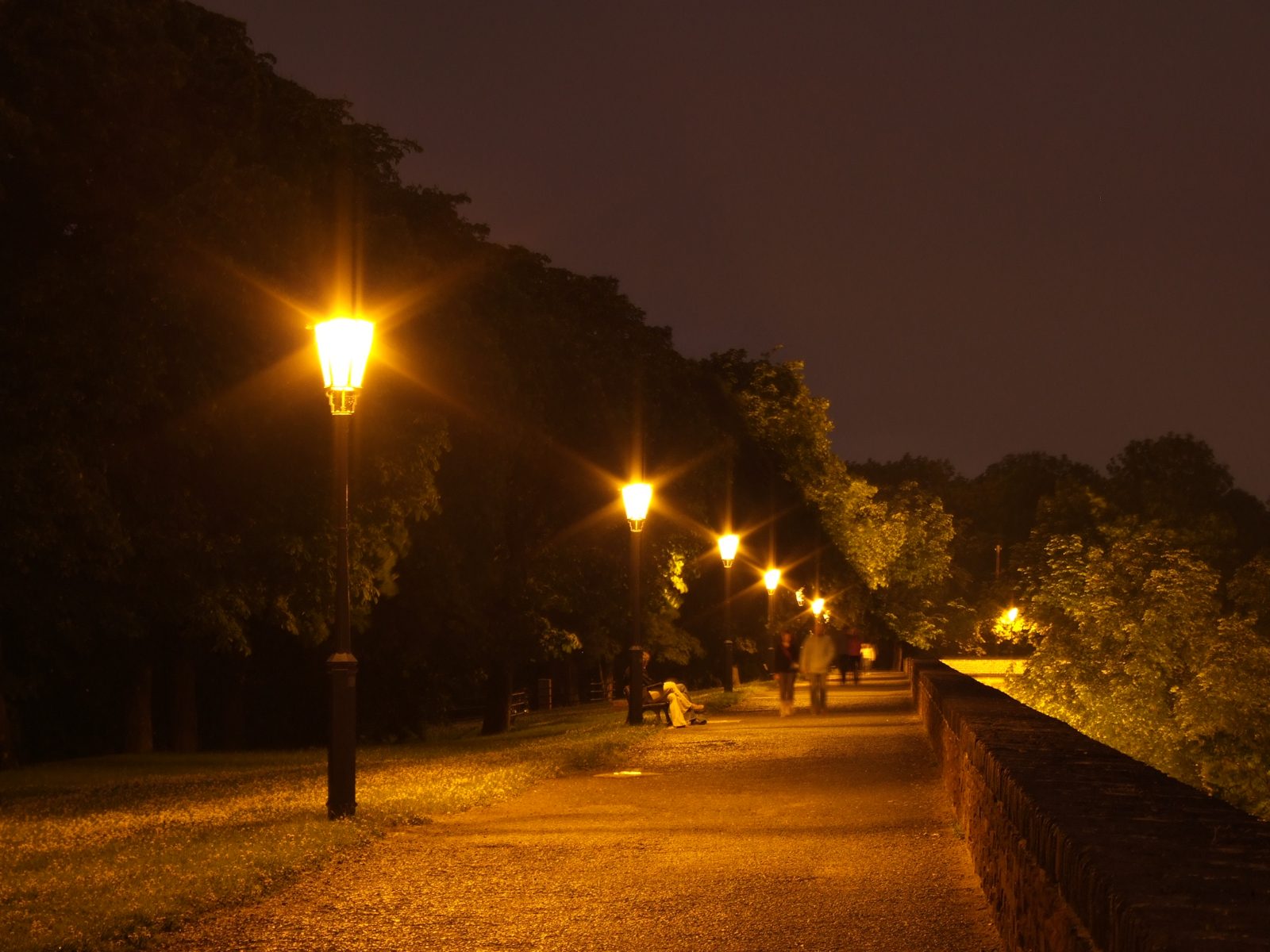
Image context: the cover uses a real Wikimedia Commons photograph of Vyšehrad's ramparts at night. That is the right lead image because this article is about the fortress walls as an evening instrument, not about a checklist of interiors or a generic Prague skyline.[6]
Why this works better as a night room than as a sightseeing stop
The key is to let Vyšehrad behave as a sequence instead of a monument cluster. Loudavym krokem's recent local guide says the baroque ramparts form an easy 2.5-kilometre circuit, calls the south-western bastion the strongest river view, and bluntly recommends sunset in the warm months if you want the place at its most atmospheric.[3] The same guide also makes the basic access logic very plain: the easiest arrival is metro line C to Vyšehrad station and then a 10-minute flat walk to Tábor Gate, while the tram option to Výtoň is more romantic but comes with a real uphill climb.[3]
That metro-up logic shows up in community advice too. In r/Prague's recommendations thread, one commenter says Vyšehrad is a relaxed stroll with great views, explicitly recommends taking the red metro up to the Vyšehrad stop, and then walking down afterward toward the river rather than forcing the route both ways.[4] A separate travel thread puts the emotional version of the same point more simply: Vyšehrad feels quieter than the postcard core because it gives you huge views and old stone walls without the same crowd pressure.[5] That is the whole night-room argument. Prague does not need more evening spectacle. It needs a place where the spectacle thins out and the city starts reading as topography again.
The Brick Gate is the right first anchor, and Libuše's Bath is the right last one
Start with the Brick Gate on purpose. Prague City Tourism identifies it as the fortress's main entrance and notes that it was built in 1841 in Empire style as part of the new road through Vyšehrad.[1] That matters because the route gets cleaner when you enter formally instead of slipping in from a random side street and spending your first minutes recovering orientation. Once inside, keep the basilica and cemetery in peripheral view and stay moving. The walk becomes stronger only when the inner court loosens and the edge starts doing the work.
The official parks page and the local guide point to the same payoff from different angles. The parks page highlights lookout points from Prachárna and from a place called Šemík's Jump on the ramparts, while Loudavym krokem says the most beautiful river-facing vista is from the south-western bastion and notes the Gothic cliff ruin known as Libuše's Bath below the walls.[2][3] Together those details produce the real evening line: old gate first, long wall second, ruined edge last. That line also solves the common over-planning problem. If you care about the cemetery, do it earlier; the same local guide notes that it shuts at 6 p.m. in summer and 4 p.m. in winter.[3] The night room starts after that logic ends.
There is also a specifically Prague kind of texture here that the center cannot fake. Vyšehrad is wrapped in myths of Princess Libuše and Czech beginnings, but the local guide is more useful when it drops back to the ground: the embedded cannonball on the Rotunda of St Martin, the slow river views toward Podolí and Zlíchov, the sense that the place becomes softer once you stop asking it to prove itself as a major sight.[3] That is why the route lands. It is not anti-historical. It just lets history stay in the wall and the outline instead of dragging the whole evening indoors.
8 local moves that make this Prague night room actually land
- Take metro line C up and save the downhill walk for later. The flat 10-minute approach from Vyšehrad station is the cleanest way to begin without burning energy on the wrong slope.[3][4]
- Enter through the Brick Gate instead of improvising a side arrival. The gate is the formal front door, and starting there keeps the route legible from the first minute.[1]
- Keep the first fifteen minutes moving. Do not let the basilica forecourt turn into your final stop before the ramparts have even started working.
- Treat the cemetery as a separate early add-on, not as the evening's core. If you want it, remember the 6 p.m. summer and 4 p.m. winter closing rhythm.[3]
- Make the south-west ramparts your long pause. That is where the fortress stops feeling enclosed and starts opening toward the river, Podolí, and the far bank.[3]
- Respect the park etiquette literally. The official site says the grounds are open year-round, but it also says not to climb or sit on the ramparts and to watch your footing on the old stairs.[2]
- Use Libuše's Bath as the last visual anchor, not the first. The ruin reads better once the city has already thinned out behind you.[3]
- If you still have energy, walk down toward Výtoň or Náplavka instead of retracing the whole route uphill. This is the most useful community move because it turns the fortress into a height-to-river release rather than a closed loop.[4]
Non-local trapline: 4 common mistakes and the better alternative
Mistake 1: treating Vyšehrad as a lesser substitute for Prague Castle
Better alternative: treat it as a different tool. The point is not to compare grandeur. The point is to use a quieter elevated edge that lets Prague breathe again.[3][5]
Mistake 2: arriving from Výtoň first because the river looks more cinematic
Better alternative: go up by metro and walk down later. The night-room logic works when the slope releases gradually rather than demanding effort at the start.[3][4]
Mistake 3: spending too long in the central monument cluster and reaching the ramparts only after the light is gone
Better alternative: keep interiors and cemetery visits surgical. The walls and river drop are the real evening event here.[1][3]
Mistake 4: treating the ramparts like seating furniture
Better alternative: keep your long pause beside the walls, not on top of them. The official rules are explicit: do not climb or sit on the ramparts.[2]
Concrete go details
- Best window: shoulder-season late afternoon into sunset is strongest, and in July and August the local guide specifically recommends waiting for sunset rather than turning up in the brightest part of the day.[3]
- Expected spend: 0 CZK if you keep the route fully outside; transit is the only real cost, with the recent local guide pegging a basic 30-minute ticket at about EUR 1.20 and a day pass at about EUR 6.[3]
- Queue and reservation reality: the grounds and parks are accessible year-round without restrictions, while specific buildings and tours are a separate decision layer.[1][2]
- Where to stand: first long pause on the south-west ramparts, last one near the Libuše's Bath edge where the Vltava drop finally takes over.[3]
- Navigation cue:
Metro C Vyšehrad -> Tábor Gate / Brick Gate -> keep moving past the inner monuments -> south-west ramparts -> Libuše's Bath -> optional descent toward Výtoň / Náplavka.[1][3][4] - Numeric anchors worth remembering: mid-10th century, 1841, 8 hectares, 2.5 kilometres, 10 minutes, 6 p.m., 4 p.m., 30 minutes, and EUR 6.[1][2][3]
Prague has louder night views than this and more famous ones. Very few are better calibrated. One metro ride up, one old gate, one long wall, one ruined lookout over the river, and one downhill exit are enough to make the city feel spacious again.
Sources
- Prague City Tourism, "Vyšehrad" (official page, updated 2026-04-13, covering the mid-10th-century settlement, the Brick Gate's 1841 date, the main entrance role, and the fortress's key landmarks).
- Národní kulturní památka Vyšehrad, "Parks" (official page on the 8-hectare park grounds, year-round accessibility, lookout points, and visitor rules such as not climbing or sitting on the ramparts).
- Loudavym krokem, "Vyšehrad Prague: Complete Guide to Prague's Second Castle (Basilica, Cemetery, Ramparts)" (published last week; local guide with the 2.5-kilometre rampart circuit, sunset timing, 10-minute metro walk, tram alternatives, cemetery closing times, and Libuše's Bath context).
- Reddit
r/Prague, "Visiting Prague? This is the monthly recommendations post (May 2025)" (community advice recommending the red metro up to Vyšehrad and the downhill walk afterward). - Reddit
r/travel, "Prague, Czech Republic" (community post describing Vyšehrad as a quieter fortress above the river with huge views and old stone walls). - Wikimedia Commons, "File:Praha, Vyšehrad, večer na hradbách.JPG" (documentary photographic source for the lead image used in this article).