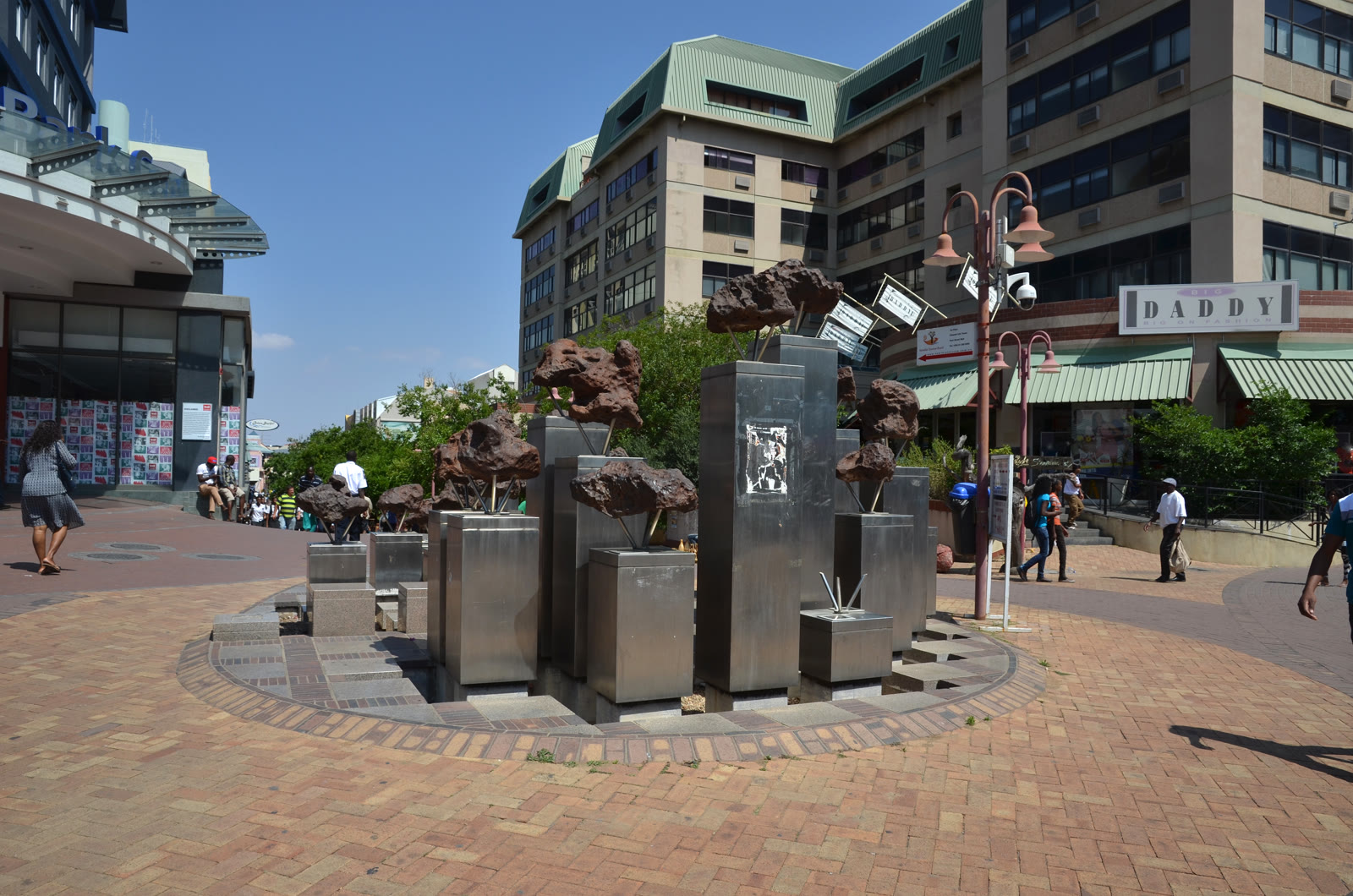
Windhoek has put pieces of an iron meteorite where a capital usually puts a fountain: in the middle of a pedestrian shopping passage, between errands, craft sellers, shopfronts, and people cutting through town. The Gibeon fragments in Post Street Mall do not ask for a ticket or a darkened gallery. They rise on steel plinths at roughly conversational height, rough brown masses held above brick paving while the city keeps moving around them.[1][2][9]
That ordinary setting is the reason to give the object more than a photograph. Use one anchor only: the Gibeon Meteorite Fountain and its immediate ring of Post Street Mall. Enter from Independence Avenue, make a full circuit of the plinths, and leave by the same pedestrian passage. Allow 35–50 minutes. A useful editorial window is 09:15–10:45 on a weekday—after the adjoining Wernhil shops begin trading at 09:00, while the mall has active foot traffic and long before evening makes a casual camera stop unwise.[2][4][6][7]
Image context: the cover is a real 2014 photograph of the Gibeon display in Post Street Mall. It shows the recognition cue that matters: irregular iron fragments, silver plinths, brick paving, nearby shops, and pedestrians occupying the same frame. This is a civic object in use, not a generated meteorite fantasy or a diagram.[9]
The object is a scatter, not one rock
Do not begin by trying to find the “main” meteorite. There is no single hero piece here. Namibia's Ministry of Mines and Energy describes Gibeon as the most extensive known meteorite shower on Earth and records about 120 specimens with a combined mass of roughly 25 tonnes. The fragments are iron meteorites made principally of taenite and kamacite, with an average of about 8% nickel and 0.5% cobalt.[3] Their torn-looking cavities and folded surfaces are not sculptural imitation; the metal itself survived atmospheric entry and a long terrestrial afterlife.
The street display makes that scale intimate, but its exact count is less tidy than guidebook copy suggests. The City of Windhoek currently says 31 pieces are visible in Post Street Mall and gives an estimated total shower mass of 26 tonnes.[10] Travel Namibia also describes 31 displayed fragments, while Rough Guides reconstructs a sequence in which 33 fragments went into storage in 1975, three later disappeared, and 30 remained on their plinths.[1][8] Those figures do not align cleanly, so resist converting the visit into a specimen audit. The more revealing move is to notice that a public display can acquire absences as well as objects.
That history also corrects a common caption error. The meteorites did not “fall in 1838.” Local Nama communities had already worked the iron into tools and weapons; 1838 is when British explorer James Alexander recorded the fragments for a European scientific audience.[1][3][8] The distinction matters. Calling 1838 the beginning would make prior knowledge disappear as neatly as a missing plinth.
Eight moves for one small ring of pavement
First, enter from Independence Avenue rather than asking a driver to stop beside the sculpture. Travel Namibia's local walking route treats Post Street Mall as a short pedestrian detour off the avenue, and Rough Guides places most central sights inside a compact area of about one kilometre.[1][8] If you arrive by taxi, use a clear formal drop-off and walk the final block. If you drive, Wernhil advertises formal parking and two public-transport facilities; community reviews specifically warn that improvised parking near the monument can be frustrating.[4][6]
Second, choose an active daylight street, not an empty monument. The meteorites are outdoors, but visibility is not the same as a good visiting hour. The City advises visitors to keep valuables discreet and to avoid dark or deserted areas, especially after dark and on weekend afternoons. A June 2025 Google review preserved by Wanderlog is blunter about the mall after dark.[2][4] The 09:15–10:45 window is not an official opening time for the sculpture; it is a way to arrive after nearby commerce wakes up and before the passage loses its everyday crowd. Wernhil's published hours are 09:00–19:00 Monday–Friday, 09:00–17:00 Saturday, and 09:00–15:00 Sunday and public holidays.[6]
Third, make the first lap with your phone in your pocket. Start outside the plinth ring and walk once around it without hunting for the best angle. The fragments change against shop walls, sky, stainless steel, and moving bodies. That first circuit also reveals uneven paving, other pedestrians' lines, and where a long camera pause would become an obstruction. Community reviews praise the display as easy to find and striking, but some also report worn walking surfaces and advise awareness of surroundings.[4]
Fourth, read one fragment as metal before reading the group as spectacle. Stop at a piece where side light reaches the hollows. Look for the contrast between rust-coloured weathering and the improbable weight implied by the support rods. The ministry's geology note explains why the object is not simply a “space rock”: Gibeon is iron-nickel material, and recorded specimens range across an enormous field and mass.[3] You do not need to touch, lean on a plinth, or test an edge to understand density.
Fifth, count gaps rather than insisting on a definitive number. Empty supports and uneven spacing interrupt the fountain's rhythm. Rough Guides treats those absences as evidence of losses before and after installation; the City's newer count differs by one.[8][10] The honest local move is to let the discrepancy remain visible. Photograph the arrangement you actually encounter, not a mental reconstruction of a complete meteorite shower.
Sixth, treat the craft sellers as people sharing a workplace, not as atmosphere. Travel Namibia describes Post Street Mall as a pedestrian walkway flanked by informal sellers of local and international art and craft, while Rough Guides notes that bargaining is expected in the street-market setting.[1][8] Ask before making a person identifiable in a photograph. If something interests you, greet first, ask the price, and agree on it before handling the item. If nothing interests you, a clear “no, thank you” is better than prolonged bargaining for entertainment.
Seventh, separate seeing from spending. The core object visit requires N$0 in purchases. A practical expected range is N$0–N$300 if you want a deliberately small craft budget; the upper figure is a self-imposed ceiling, not a claim about what any object should cost. Carry only the cash you intend to use, keep the rest out of sight, and use a bank interior rather than accepting unsolicited ATM help—all consistent with the City's visitor guidance.[2]
Eighth, finish while the passage still feels inhabited. Take one final wide view from outside the plinth ring, where the fragments and ordinary pedestrian traffic can share the frame. Then return toward Independence Avenue or continue into Wernhil if that was already part of your day. The Namibian's August 2025 account of Wernhil's 35th anniversary describes Post Street Mall's original urban job precisely: a pedestrian thoroughfare leading into a major retail centre, not a freestanding tourist compound.[7] Let the meteorites keep that civic relationship.
What the street placement changes
In a museum, the Gibeon fragments would be organized by classification, mass, chemistry, and provenance. Post Street Mall gives them another category: public furniture that is too strange to become merely decorative. Their steel supports echo the modern retail passage, while their battered surfaces refuse polish. They are simultaneously geological specimens, evidence of Nama material knowledge, a post-independence civic installation, and an everyday meeting point.[1][3][7][8]
The setting also makes the gaps harder to hide. A cabinet label can present a collection as complete by defining its own boundaries. A street fountain exposes every unused stand. The City's tourism baseline study previously flagged the Gibeon meteorites as a site where visitor interpretation was thin and recommended clearer descriptions at culturally and historically important places.[11] That earlier fieldwork does not establish the exact state of every label on the day you arrive. It does explain the useful discipline if on-site text remains sparse: supply context without pretending certainty, distinguish the fall from the 1838 record, distinguish the shower from the fountain, and distinguish a disputed count from what is in front of you.
The result is a better Windhoek object. It does not pull you out of the city toward an abstract cosmos. It brings deep time into the city's most ordinary scale—one pedestrian lane, one shop opening, one vendor greeting, one patch of side light on iron.
The visitor trapline
Mistake one: arriving after shops close because the display is outdoors. That confuses physical access with a good street condition. Community reports and the City's own safety guidance both favor an alert daytime visit.[2][4] Better: use 09:15–10:45 on a weekday, when the corridor is active but the stop can remain compact.
Mistake two: reducing the visit to “31 rocks that fell in 1838.” The count varies across credible sources, and 1838 marks Alexander's written record, not the fall or the beginning of local knowledge.[1][3][8][10] Better: read the fragments, missing positions, and conflicting numbers as three layers of the same public object's history.
Mistake three: turning the mall into a frictionless photo set. A large camera, a sudden backward step, or photographing sellers without asking ignores the passage's working life. Better: make one phone-free circuit, stand outside the pedestrian line, ask before portraits, and decide your shopping cap before any negotiation.[1][2][4][8]
A compact go plan
- Best window: 09:15–10:45 Monday–Friday; this is an editorial comfort window, not a sculpture opening time.[2][6]
- Time on site: 35–50 minutes, including one camera-free circuit and one slower close read.
- Expected spend: N$0–N$300; the display itself has no published admission or reservation mechanism, and N$300 is an optional personal craft ceiling rather than a quoted market price.[1][4][5]
- Queue reality: no formal attraction queue is described by the official, local, or current community sources. Yield to ordinary foot traffic and expect the best viewing position to change moment by moment.[1][2][4][5]
- Where to stand: begin outside the plinth ring where several fragments overlap against the shops; move closer only after checking the walking line behind you.[4][9]
- Navigation cue:
Independence Avenue -> Post Street Mall pedestrian passage -> silver plinth cluster -> one full circuit -> Independence Avenue or Wernhil.[1][6] - Same-day check: daylight, nearby trading hours, current pavement condition, street activity, and the amount of cash and camera gear you actually need.[2][4][6]
Windhoek's meteorites reward restraint. Do less than the object seems to demand: no grand detour, no definitive count, no performance of discovery. Give the iron one attentive lap while the city moves around it. That is enough for the meteor shower to become not a curiosity dropped into Windhoek, but a piece of Windhoek itself.
Sources
- Travel Namibia, “Take a Walk through Windhoek” — local walking route, Post Street Mall's position off Independence Avenue, craft-seller context, display history, Nama ironworking, and Alexander's 1838 record.
- City of Windhoek, Safety Tips for Visitors — official street, valuables, after-dark, taxi, banking, parking, and Post Street visitor-information guidance.
- Geological Survey of Namibia / Ministry of Mines and Energy, Meteorites — official Gibeon composition, recorded mass and specimen count, Nama use, fall mechanics, and confirmation of the permanent Post Street Mall display.
- Wanderlog, “Meteoriten” — current Google-review-backed community surface for location, visitor impressions, pavement and parking cautions, craft-seller presence, and after-dark concerns.
- Google Maps, “Gibeon Meteorites, Windhoek” — current community place and review surface used to confirm the display's location and active listing.
- Wernhil, “Specials” — official current shopping hours, CBD location, parking capacity, and public-transport facilities adjoining Post Street Mall.
- Sven Thieme, “Wernhil Park at 35: A Namibian Legacy,” The Namibian (August 21, 2025) — recent local account of Post Street Mall's pedestrian-thoroughfare role and Wernhil's continuing city-centre foot traffic.
- Rough Guides, “Windhoek and around” — independent stabilizer for the compact city-centre geography, fragment history, missing plinths, Nama use, 1838 record, and street-market practice.
- Wikimedia Commons, “Windhoek - Namibie - panoramio (1).jpg” — Pavel Špindler's real 2014 photograph of the Gibeon fragments in the working space of Post Street Mall, used as the cover image.
- City of Windhoek, “About Us” — official current city page giving the Post Street Mall display count and estimated total mass of the Gibeon shower.
- City of Windhoek, Assessment of Sustainable Tourism Development — city-hosted baseline study, based on earlier fieldwork, identifying the Gibeon display's interpretation gap and recommending clearer descriptions at significant sites.