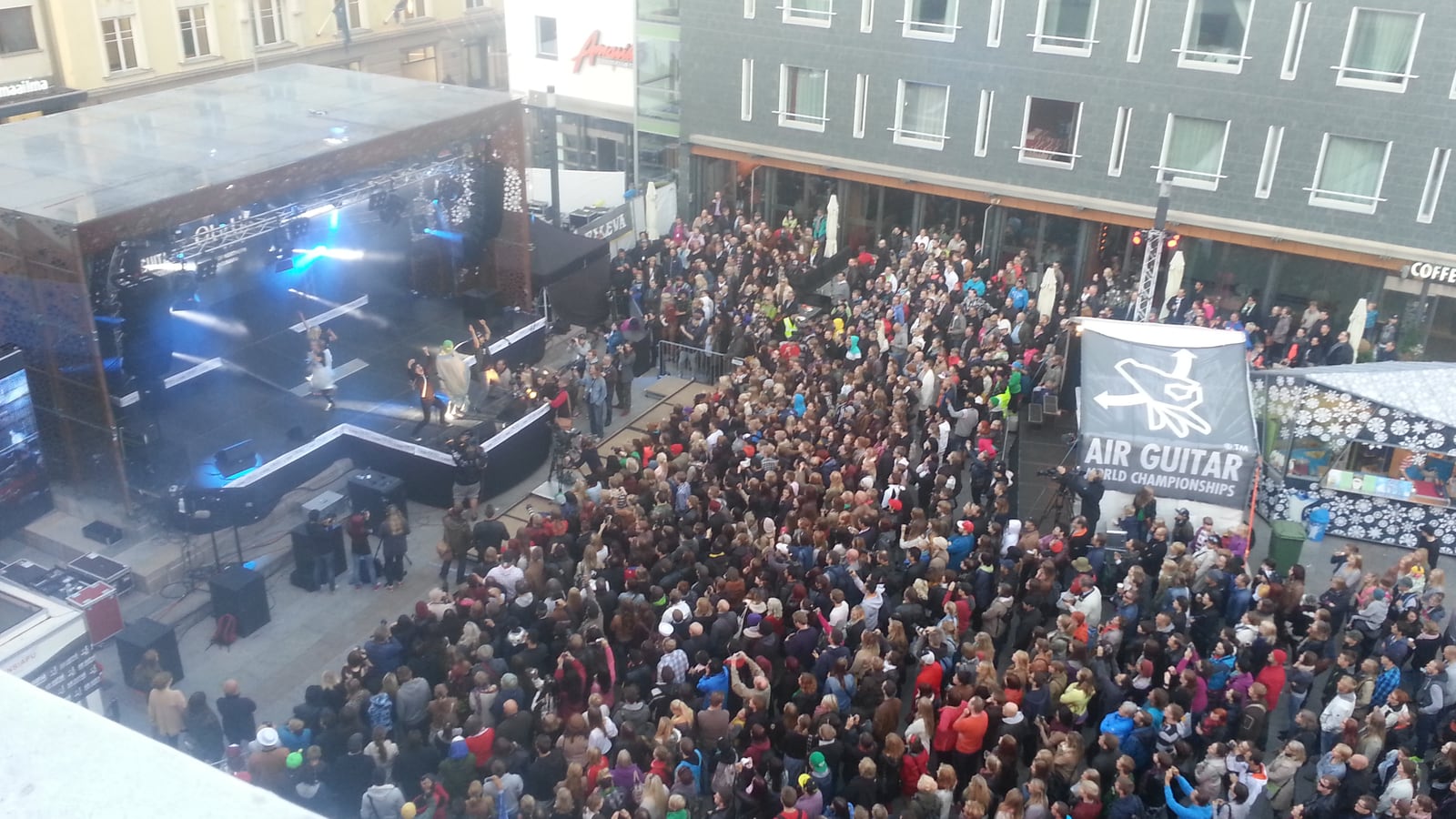
At 8:45 p.m. on August 28 and 29, Oulu will ask a crowd beside the river delta to take an invisible instrument completely seriously for one hour. That is the cleanest way into the 2026 Air Guitar World Championship final: not as a novelty to glance at, and not as a generic festival night, but as one concentrated outdoor performance at the exact place where the city is changing its usual stage.
The anchor is Delta Stage, built over Pokkisenväylä between Linnansaari and the Radisson Blu hotel. For Oulu's European Capital of Culture year, the final leaves its familiar Rotuaari-square setup and splits across two evenings on this temporary water stage. Round one starts Friday, August 28, at 20:45; round two starts Saturday, August 29, at the same time. Each championship block lasts about one hour, entry is free, and the organizer warns plainly that the venue is expected to be full [1].
That last detail should decide how you go. This is not a ticket hunt. It is a timing, sightline, clothing, and exit-route problem. Arrive early enough to let the delta become a room, learn what the judges are seeing, and stay through the handoff from tiny 60-second solos to a 45-minute large-scale show. The whole outing can cost nothing, but it rewards more planning than its imaginary guitars suggest.
Choose Friday for range, Saturday for the verdict
The first local move is to choose the night by competition structure, not by whichever date fits an open dinner slot. Friday is the broad read. Contestants perform their prepared songs in round one, and the eight highest-scoring players advance. Saturday is the pressure read. Those finalists meet a compulsory track selected by the organizer and heard just before they perform [3]. If you can attend only once, choose Friday to see more characters and Saturday to see adaptation, tension, and a champion emerge.
The distinction matters because every performance is exactly 60 seconds. Contestants may take up to 10 seconds to establish a character before the music begins. Judges score originality, surrender to the music, stage presence, technical merit, artistic impression, and the deliberately elusive quality called “Airness,” using marks from 4.0 to 6.0 [3]. Once you know that, the event stops looking like a sequence of people making the same joke. One performer may build an immaculate fictional instrument; another may use dance, facial control, timing, or a complete rock-star persona. Watch the first three acts without filming. By the fourth, you will have your own theory of Airness.
The second move is to keep 21:45 in view. The air-guitar block ends around then, but the evening does not. A pre-show bridges the changeover, and at 22:00 the Delta Life production begins on the same stage, running until 22:45. The multidisciplinary show repeats on all three event evenings, while the air-guitar programme changes from Thursday's qualifier to Friday's first final round and Saturday's second [2]. Leaving as soon as the scores finish means missing the reason the championship has moved onto water in 2026.
The delta is not just a bigger Rotuaari
Pokkisenväylä is an unusually Oulu place to make this change. The festival's own local history describes it as the city's birthplace and as a historical riverbed reshaped by land uplift. The banks between Tähtitorni Café and the Radisson form a natural amphitheater that organizers estimate can hold as many as 10,000 people [5]. The stage itself is more than 40 metres wide, rises to roughly 25 metres, and is expected to use as much as 8 kilometres of steel pipe [2]. Invisible instrument, very visible infrastructure.
That scale answers a real crowd problem. Local Oulu media reported roughly 3,500 people pressed into Rotuaari for the 2022 final and quoted the event's founder saying the square could not comfortably grow further [7]. A first-person Finland blog account likewise describes Rotuaari filling with fans and emphasizes the event's unusual mixture of lightness and genuine competitive seriousness [9]. The 2026 move is therefore not a decorative Capital-of-Culture flourish. It changes how the audience gathers: from a tight retail square with a familiar front-facing stage to a larger shoreline amphitheater with water, bridges, weather, and multiple approach lines.
It also changes what old advice is worth. The archival cover photograph is useful because it shows the championship's established atmosphere—jackets, a standing crowd, stage light, and a large event banner—but it does not show the 2026 venue [10]. Do not navigate to Rotuaari because an older article, community post, or photo puts the final there [7][9][10]. Use “Pokkinen park” or Pokkisenväylä as the destination, then confirm the audience entrances on the organizer's latest page before setting out [1][2].
The event is not merely an oddity imported for visitors. In 2025, Oulu native Aapo “The Angus” Rautio won after first entering the championship at age 10, returning seven times, and reaching five finals. In Yle's account, he emphasized the community around the contest more than the title itself [6]. That is the city-specific texture to hold onto: Oulu has hosted this improbable form since 1996, long enough for a child spectator-competitor to grow into the local world champion and for “Make Air, Not War” to become a civic ritual rather than a one-night slogan [4][6].
Eight moves that make the night work
Third move: walk the final approach. From Oulu railway station, open the current Maps search surface for the championship, set Pokkisenväylä as the destination, and generate a walking route toward the Radisson side of the delta rather than asking a taxi to solve the last central blocks [8]. Allow roughly 15–20 minutes for an ordinary station-to-waterfront walk and more if event controls divert the obvious line. The useful recognition cue is the channel between Linnansaari and the hotel, not Rotuaari's old championship stage [2].
Fourth move: aim to reach Pokkinen park between 19:15 and 19:30. That gives you 75–90 minutes before the first finalist, enough to identify the stage, toilets and a viable way out without spending the opening act moving sideways through a standing crowd. Free entry does not mean infinite prime frontage. A past 3,500-person audience already felt tight in the smaller square; a free headline event in a 10,000-person amphitheater can fill by layers rather than by a formal queue [5][7]. If organizers later publish controlled gate times, follow that access plan while preserving the same early buffer.
Fifth move: choose a sightline, not the water's edge—if the final access plan permits that choice. The stage's height and width are designed to work at scale [2]. A position slightly back or to one side should be better than forcing the central front if it lets you see the full body of each performer, hear the mix, and retain an exit line. Air guitar is read through silhouette, timing, knees, face, and imaginary fretwork. Because this temporary audience layout has not yet been published, treat exact standing and exit advice as provisional; signed controls and steward instructions take priority.
Sixth move: dress for two stationary hours beside water, not for the temperature at lunch. Bring one warm layer and a compact waterproof shell; skip the large umbrella in a dense sightline unless weather or event staff make it necessary. The published sequence runs from 20:45 to 22:45, and standing still through the pre-show feels different from walking Oulu's center [2]. Keep your bag small enough to remain inside your footprint.
Seventh move: make the scorecard part of the fun. The rulebook tells you exactly what the judges can reward and why a technically precise mime can lose to a performer with stronger artistic control [3]. Compare one score aloud with your companion, then let the next act reset the argument. Do not turn the whole hour into a phone screen. Sixty seconds is too short to watch twice at once.
Eighth move: if you bring a younger child, do not read “no age limit” as “no crowd plan.” The organizer specifically hopes younger children will attend with an adult and warns that the venue will be packed [1]. Use ear protection, choose the rear or side rather than the compression zone, and agree on one fixed meeting landmark before the audience thickens.
Ninth move: stay for the collective release. The championship's official story says the audience is invited to play air guitar together at the end in service of its extravagantly hopeful peace ritual [4]. Join it if it happens in the live sequence; then give the 15-minute transition its space and watch the Delta Stage change jobs. The same structure that held individual imaginary solos becomes the platform for musicians, dancers, circus artists, light, and the water itself [2].
Tenth move: leave on a chosen vector. If you need the railway station, retrace east only after the first post-show surge begins to loosen. If you are staying in the center, step away from the immediate bank before deciding on anything else. Do not stand at the outlet searching for an after-party whose venue has not yet been confirmed. As of publication, the organizers still describe some pre- and after-party details as forthcoming, so recheck the official programme within 48 hours of the event [2].
The Trapline
Mistake one: going to Rotuaari out of habit. That is where local coverage, firsthand accounts, and most archival images place earlier finals [7][9][10]. In 2026, the final is at Delta Stage in Pokkinen park, over Pokkisenväylä [1][2]. Save the correct destination before leaving Wi-Fi.
Mistake two: arriving at 20:45 because admission is free. The start time is not an arrival window. Both local reporting and a firsthand spectator account describe the old square filling densely; the new organizer warns that the 2026 venue will be full [1][7][9]. Use 19:15–19:30 to solve your sightline and exit while the audience is still forming.
Mistake three: assuming every Air Guitar evening offers the same competition phase. A firsthand account of the older event already distinguishes qualifying from the final, and 2026 adds a new split inside the final itself [9]. Friday is round one; Saturday is the compulsory-song second round. The Delta Life production repeats, but the championship story advances [1][2][3].
Mistake four: dismissing the contest as one repeated joke. Firsthand and local accounts describe both the relaxed welcome and the serious craft/community beneath it [6][9]. Learn the judging grammar, watch bodies rather than only imaginary hands, and let a few 60-second acts reset your first impression [3].
Concrete Go Details
- Best window: Friday, August 28, or Saturday, August 29, 2026; reach Pokkinen park at 19:15–19:30 for the 20:45 final. Choose Friday for breadth and Saturday for the title [1][3].
- Expected spend: admission itself is €0 [1][2]. A personal €0–€20 buffer for an optional drink or snack is an editorial budget, not a published concession price; vendor details are not yet confirmed.
- Queue/reservation reality: no spectator ticket or reservation is currently published for the free final, but the organizer expects a full venue. Recheck the access plan close to the date; crowd position replaces the booking problem unless organizers announce controls [1].
- Where to stand: begin slightly back or lateral in the natural amphitheater, preserving a clear view of the full stage and a route away from the bank. Do not assume the front rail is the only useful view [2][5].
- Navigation cue:
Oulu railway station -> city center westbound -> Pokkisenväylä / Pokkinen park -> audience area between Linnansaari and the Radisson Blu. Generate a current walking route from the live Maps search surface and follow the event's final access notice rather than an old Rotuaari pin [2][8]. - What to carry: warm layer, compact rain shell, small bag, hearing protection if needed, and a charged phone with one agreed meeting landmark saved.
- The numbers to remember: 19:15–19:30 arrival, 20:45 air guitar, 21:45 transition, 22:00 Delta Life, 22:45 finish, 60-second acts, eight advancing finalists, €0 entry [1][2][3].
Oulu's best trick here is not that it treats air guitar as serious. It is that the city knows exactly how serious to be. The rules are precise, the acts are brief, the peace claim is cheerfully impossible, and the 2026 stage is a huge piece of engineering laid across a historical riverbed. Go for the invisible instruments. Stay long enough to see the delta become the real one.
Sources
- Air Guitar World Championships, “World Final” — current official page for the August 28–29, 2026 dates, 8:45 p.m. start, Pokkinen park location, free entry, two-round split, approximate duration, crowd warning, and guidance for younger children.
- Air Guitar World Championships, “Air Guitar on the Delta Life stage” (February 9, 2026) — official schedule for all three evenings and specifications for the over-water stage between Linnansaari and the Radisson hotel.
- Air Guitar World Championships, “Rules of the Air Guitar World Championships” — official source for 60-second songs, two-round structure, eight finalists, scoring criteria and range, entrance timing, and tie-break procedure.
- Air Guitar World Championships, “Story” — official history of the Oulu event since 1996 and its “Make Air, Not War” collective-air-guitar ritual.
- Oulu August Festivals, “591 days to Oulu August Festivals’ grand finale in 2026” — local organizer's account of Pokkisenväylä as Oulu's birthplace, its land-uplift history, natural amphitheater, and estimated 10,000-person capacity.
- Yle News, “Finland recaptures Air Guitar World title after 25-year hiatus” (August 25, 2025) — recent Finnish reporting on Oulu native Aapo Rautio's long participation and the event's community character.
- Mun Oulu, “My Oulu: The Air Guitar World Championships remains Oulu's most visible event abroad” (September 7, 2022) — local community reporting on the roughly 3,500-person Rotuaari crowd and why the old square had reached its practical growth limit.
- Google Maps, “Air Guitar World Championships Oulu Finland” — current map, community-photo/review, and navigation search surface used to avoid carrying an obsolete Rotuaari route into the 2026 venue change.
- Tarja's Blog, “Wer wird Weltmeister an der Luftgitarre?” — German-language firsthand Finland-blog account of attending in Oulu, used for the packed Rotuaari setting, qualifying-to-final distinction, and the event's relaxed but serious performance atmosphere.
- Wikimedia Commons, “File:Air Guitar World Championships 20130823.jpg” — Antti Kultanen's real archival photograph of the 2013 championship crowd and stage in Oulu, used as the article image.