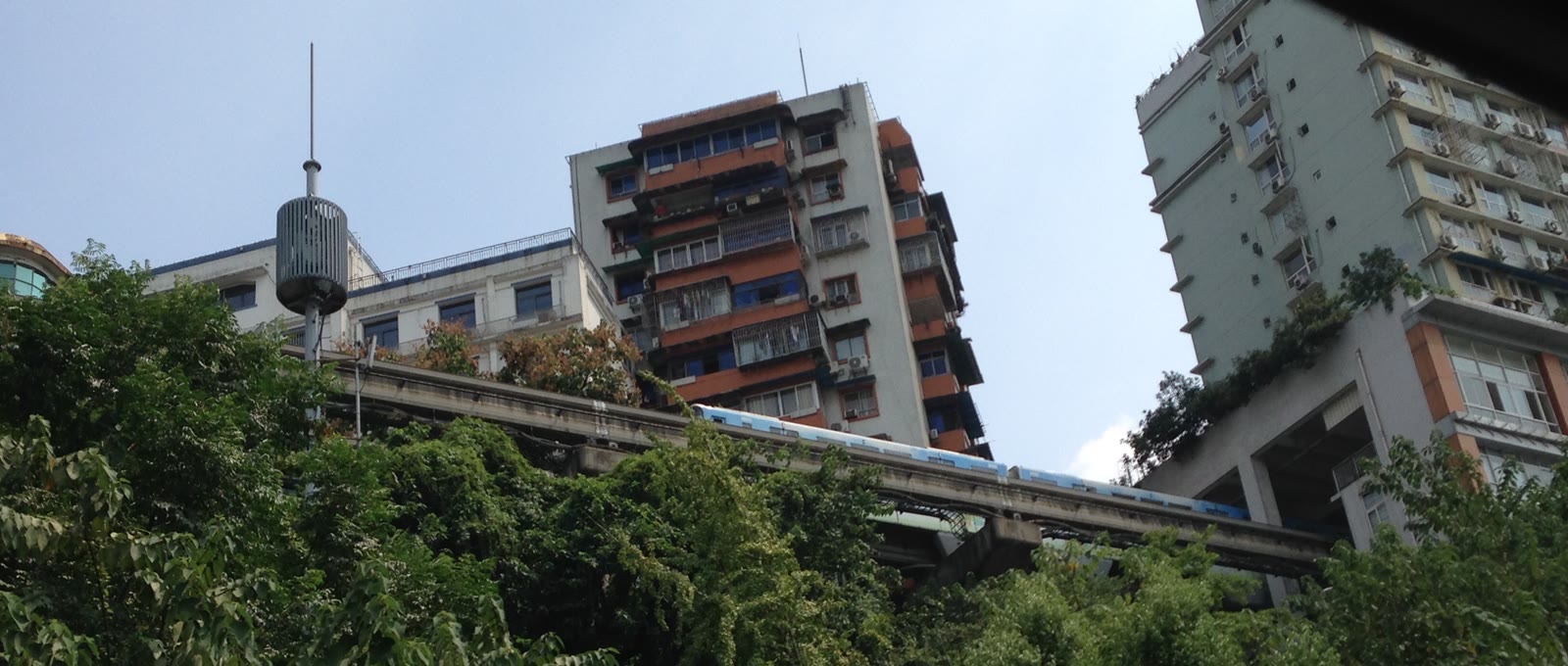
At Liziba, a blue monorail train slips into an occupied high-rise as if the building has inhaled it. That is the image everybody comes for. The more revealing Chongqing experience begins on the other side of the lens: inside the train, inside the station, and then down through a stack of levels until the same piece of infrastructure becomes a spectacle across the road.
Keep the outing to two coupled anchors: Liziba Station on Line 2 and the official viewing platform below it. Ride in, descend, cross only where staff and barriers currently direct you, watch two or three trains, and ride out. Allow 45–60 minutes. A useful non-holiday window is 09:30–10:45 on a Tuesday, Wednesday, or Thursday—an editorial comfort window after the sharpest commuter push and before the midday sightseeing build, not an official quiet-hours guarantee.
The timing matters more than usual in 2026. As of July 20, Liziba is open, but rail-station platforms, halls, and exits are being rebuilt in phases. Part of the boarding platform is scheduled to remain under work through November 30, and the full project is expected to finish on December 30. During the present phase, Hall B and Exit 3 are closed, while parts of Exits 1 and 2 are also affected. The station's live arrows, barriers, and staff therefore outrank any saved route screenshot.[1]
Image context: the cover is a real 2016 photograph of Line 2 entering the Liziba building. It gives the essential recognition cue—the blue train, elevated guideway, lived-in facade, and steep green grade—without pretending to show the station's changing 2026 construction paths.[9]
The building was not pierced after the fact
Liziba is often described as a train that somehow crashed through an existing apartment block. The actual origin is more Chongqing and less miraculous. Local practical reporting says the rail station and building were planned together after the Line 2 alignment and residential project converged in 1998. The station was completed in March 2004 as part of a structure designed to let housing and transit occupy the same steep urban section.[3][5]
The viewing platform came later. Once short-video fame turned an ordinary station into a place where crowds stopped in the roadway for the same few seconds of footage, the city created a safer dedicated viewing space across Liziba Zheng Street. The present platform opened in 2018. In other words, the building and railway belong to the original transport problem; the platform belongs to the later crowd problem.[4][5]
That sequence changes what is worth noticing. The train-through-building shot is not the whole object. Liziba is a vertical street made from a station, stairs, lifts, commercial passages, a steep road, a controlled crossing, and a viewing area that must absorb people who are no longer behaving like passengers. Chongqing's local counterpoint is wonderfully deflating: many residents remember this first as a normal rail stop and remain bemused that visitors cross the country to watch a few seconds of routine service.[4]
Eight moves through one vertical block
First, ride Line 2 before you photograph it. Enter at a convenient station on the central section and stay aboard to Liziba. The system's current distance bands are ¥2 for up to 4 kilometres and ¥3 for more than 4 and up to 8 kilometres, so a short central Line 2 approach normally sits in that narrow range; check the fare from your actual origin rather than treating ¥3 as a network-wide cap.[8] The viewing platform itself is free.[3] This order matters: you feel the curve, grade, and station arrival before flattening all three into a facade.
Second, choose an ordinary operating hour, not a holiday performance. The suggested 09:30–10:45 weekday window is intentionally modest. Local guidance warns that the photo space can become too crowded for a clean angle, while a May Day field report documented special circulation controls for peak holiday flow.[4][5] If you can only visit on a public holiday, accept that the managed route—not the shortest line on your map—is the attraction's real shape that day.
Third, leave the carriage like a passenger. Do not stop at the train door or at the first window to begin filming. Step clear, let boarding and alighting finish, and then take ten seconds to notice what level the station calls street. Liziba's published operating table places first trains at about 06:32 and the last departures between roughly 23:13 and 23:49, depending on direction; this is a working service day, not a timed attraction session.[3] Your photograph is optional. Someone else's transfer is not.
Fourth, make live wayfinding your only authoritative exit plan. A January 2026 community review still directs visitors through Exit 1 and straight down to the road.[7] That advice predates the June construction phase. The official schedule now shows partial work at Exit 1 through September 25, partial work at Exit 2 through September 20, and a full Hall B and Exit 3 closure through August 31; Hall A is then scheduled for a separate closure from September 1 to October 31.[1] Follow the open path shown on the day, even if it looks longer than the route in a review.
Fifth, count the descent instead of trusting compass language. The May Day field report describes visitors moving from the station's fifth-floor exit level to the first floor before reaching the road opposite the platform.[5] That is the local lesson. “Down,” “across,” and “next door” can describe a meaningful vertical journey in Chongqing. Recent lift and escalator work is designed to connect Liziba Zheng Street, Guihuayuan Road, and the viewing platform in under five minutes, replacing a detour that could take more than ten.[2] Treat those figures as the design promise; construction and crowd control still determine your actual time.
Sixth, cross where the day tells you to cross. On normal days, barriers may present a direct route. On the May 1–5 holiday plan observed by The Paper, the closest crossing was closed: visitors walked about 120 metres toward Fotuguan before crossing, then left the platform by continuing roughly 150 metres toward Niujiaotuo to cross back. The return pavement narrowed to about three people abreast.[5] Do not climb a barrier because an older map shows a shorter line. The detour is not bad navigation; it is crowd separation.
Seventh, use the viewing platform as a relay, not a set. The central building-facing angle is where movement stalls. In the field report, most visitors waited for two or three trains; with trains appearing at roughly three-minute intervals, the typical photo pause was six to ten minutes.[5] Begin off-centre, set your frame before stepping into the popular line, take one train cleanly, and decide whether a second genuinely adds anything. Then release the position. An empty-background portrait is the wrong success metric for a public platform built to handle shared demand.
Eighth, leave by rail and keep the road clear. Signs along the adjoining road impose six- or eight-minute passage limits and prohibit passenger pickup or drop-off in controlled stretches. The viewing area is also a no-drone zone; a drone collision stopped a train on this section in 2021.[5] Use the station again rather than summoning a car to the curb. For the final navigation check, compare the official construction notice with the live Liziba listing on Gaode, then defer to the on-site route if the two disagree.[1][6]
The rebuild is the landmark now
The 2026 work is easy to dismiss as housekeeping around a famous photo. Its scale says otherwise. Chongqing reports 14 new lifts or escalators and 10 refurbished ones in the Liziba vertical connection. The city says the changes raise theoretical station throughput from 16,600 to 40,200 people per hour, against a recorded peak day of 136,000 visits.[2] Those are operator figures, not a promise that every visitor will experience a five-minute transfer. They do identify the actual design problem: a neighborhood station inherited attraction-scale demand without ceasing to be a station.
The strongest detail is not the capacity multiplier. It is the direction of the investment. The railway already performs its famous trick every few minutes. What needed work was the handoff between levels: getting a resident from the road to the platform, getting a visitor from the train to the viewing area, and keeping both from colliding with a tour bus, a taxi, or a person planted in the middle of the best camera angle.
This is why Liziba works as a street microcosm rather than a novelty stop. The building holds daily life. The guideway carries daily service. The road still has through traffic. The platform converts a once-dangerous roadside habit into a managed public room. The construction signs show that the room is still being revised. No single postcard can contain all of those users, but one careful vertical trip can.
The visitor trapline
Mistake one: taking a taxi directly to the viewing platform. It produces the image while erasing the transit logic, and curb controls make stopping part of the congestion problem.[5] Better: arrive and leave on Line 2, paying the ordinary rail fare for an ordinary rail movement.[3][8]
Mistake two: treating a saved Exit 1 screenshot as permanent truth. Community directions published before June 2026 can be accurate for their day and wrong for yours.[1][7] Better: check the dated construction phase before departure, then use live station signs without improvising around barriers.
Mistake three: waiting for the platform to become empty. Local guidance and current field reporting both describe crowd friction around the photo angle.[4][5] Better: frame from the side, use a two-train maximum unless conditions are genuinely quiet, and keep the central sightline moving.
Mistake four: inventing a more dramatic camera position. The roadway, track edge, residential building, and airspace are not extensions of the viewing deck. Better: stay inside the marked platform, use the designated crossing, keep out of doorways and traffic, and leave the drone packed.[5]
A compact go plan
- Best window: 09:30–10:45 Tuesday–Thursday, avoiding public holidays when possible. This is a comfort recommendation, not a published low-crowd guarantee.[4][5]
- Time on site: 45–60 minutes from train arrival to departure, including the current signed descent, crossing, a six-to-ten-minute photo pause, and the return.[1][5]
- Expected spend: ¥4–¥6 for a same-origin round trip from the short central Line 2 corridor—¥2–¥3 each way, depending on distance—plus ¥0 admission to the viewing platform. A different or more distant departure point changes the outbound fare under the official distance table.[3][8]
- Queue and reservation reality: no platform reservation or attraction ticket. On busy holidays, expect controlled one-way walking rather than a conventional queue; allow the extra 120-metre in / 150-metre out routing if it is activated.[3][5]
- Where to stand: begin off-centre on the building-facing side of the official platform, prepare the frame outside the main sightline, then take a short turn at the central angle only when flow allows.[5]
- Navigation cue:
Line 2 -> Liziba Station -> live construction arrows -> open descent to street level -> staffed or marked crossing -> viewing platform -> signed return -> Line 2.[1][3][6] - Same-day check: current hall and exit phase, rain, holiday circulation, rail service, and whether staff have replaced the usual crossing with a one-way loop.[1][5]
Liziba's train still delivers the satisfying moment: blue carriages, concrete beam, open air, then a building swallowing the line. Give that moment ten minutes. Give the vertical transfer the rest of the hour. The photograph proves that Chongqing can put rail and housing in one frame; the route proves that the city keeps redesigning how everybody reaches it.
Sources
- Chongqing Municipal Government, “Liziba Station will begin its next renovation phase in mid-June” (June 13, 2026) — official platform, hall, and exit closure dates; detour instructions; and December 30 completion target.
- Chongqing Municipal Government, “Line 2 elevator renewal offers a Chongqing solution” (May 28, 2026) — official Liziba lift and escalator counts, vertical-link timing, throughput figures, peak-day demand, and resident access context.
- Chongqing Bendibao, “How to visit Liziba light-rail station” — local practical guide to the Line 2 approach, first and last trains, platform address, free admission, station/building co-design, and visitor facilities.
- Chongqing Bendibao, “Liziba travel guide: avoiding the traps” — local counterpoint on the station's ordinary transit role, photo-only expectations, crowd pressure, and the viewing platform's later arrival.
- Wang Xin, “How does Liziba viewing platform handle holiday crowds?” The Paper (May 1, 2026) — on-site reporting on floor changes, one-way circulation, walking detours, train waits, curb controls, drone restrictions, and narrow return paths.
- Gaode Maps, “Liziba monorail-through-building viewing platform” — current Chinese local-map listing used for place confirmation and same-day route planning.
- Ctrip community, “Liziba viewing platform” — January 4, 2026 visitor directions preserved as a useful example of pre-construction Exit 1 advice that the official June works have superseded.
- Chongqing Development and Reform Commission, “Notice on improving the city's urban-rail fare mechanism” (effective July 30, 2025) — official current distance bands and Line 2 coverage.
- Wikimedia Commons, “Train going through resident building in Liziba Station, Aug 14 2016” — A Chinese ID's real photograph of Line 2, the station building, guideway, and hillside, used as the cover image.