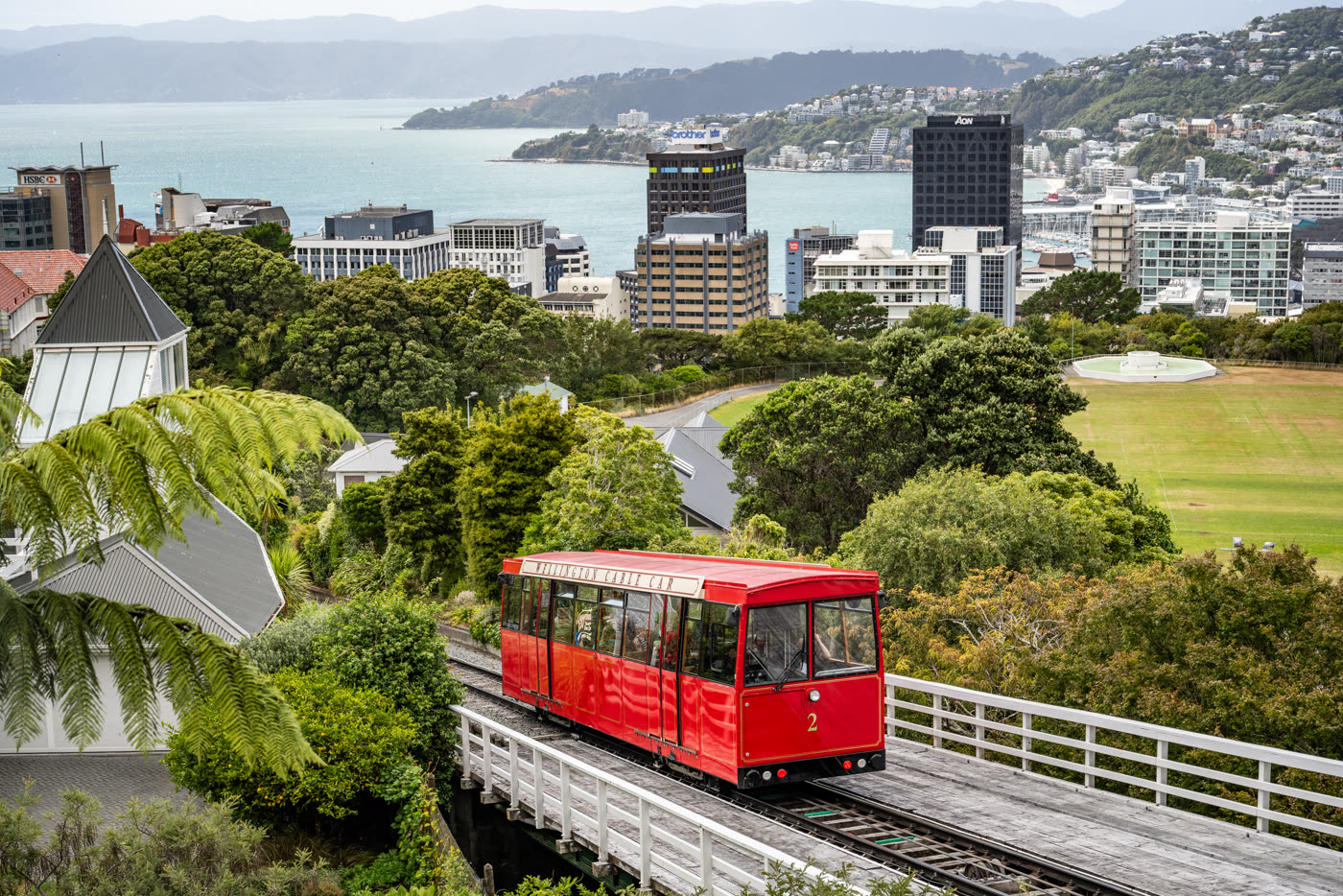
Wellington is easy to misread if you treat it as a flat waterfront city with some hills attached at the edges. The local correction is short, ordinary, and much better than a grand scenic itinerary. Ride the Cable Car up from Lambton Quay, take the lookout while the city is still in front of you, then walk down through the Botanic Garden instead of reversing the ride immediately.[1][2][3][4]
That ritual works because the Cable Car is not a novelty bolted onto the city after the fact. WellingtonNZ's current overview says the line has been moving for over 120 years, running 612 metres up the Kelburn hillside, through three tunnels and over three bridges, climbing 120 metres above sea level in roughly 5 minutes.[2] The Wellington Cable Car timetable page adds the practical rhythm: cars leave every 10 minutes, adult fares are NZD 6.50 one way or NZD 12 return, and online purchase lets you bypass the Lambton Quay ticket-office line altogether.[1] In Wellington terms, that is not a tourist flourish. It is a compact urban move that commuters, students, and visitors all share.[2]
The city-specific texture begins at the top. Wellington Gardens describes the Cable Car Lookout as a 180-degree orientation point over the city and harbour.[3] WellingtonNZ's botanic-garden pages fill in the rest: the garden covers more than 25 hectares, the trails reach a 126-metre high point, and the downhill path begins directly from the Cable Car entrance.[4][5] What matters is not merely that there is a view waiting at the summit. It is that Wellington's slopes, weather, and harbour stop feeling abstract once you have seen the CBD from above and then threaded back into it on foot.
Image context: the cover uses a real documentary photograph of the Wellington Cable Car on the Kelburn slope with the harbour behind it. That visual is the whole argument in one frame: the car is not a detached attraction, but a moving hinge between downtown compression and hillside release.[11]
Why the up-then-down sequence is the local version that lands
Most first-time visitors either underuse this line or use it backward. They ride up and down as if the point were only the carriage, or they walk uphill through the garden and spend the better part of the outing earning a transport shortcut that already exists. The stronger local version is asymmetrical: let the machine do the vertical work, then let the city reassemble itself on the way down.
Source [7] states the visitor logic plainly: buy a one-way ticket, go up to Kelburn, and take the approximately 40-minute walk down through the Botanic Gardens.[7] Source [6] gives the more granular local-operational version: from Kelburn Station to Parliament, the main downhill route through the Botanic Garden is about 35 minutes, marked by a mosaic tile most of the way, with another 5 to 10 minutes to return along Lambton Quay to the terminal if you want a closed loop.[6] Those two timings explain why the outing works so well in Wellington. It is long enough to become a city-reading exercise, short enough to fit into a weather gap, a late afternoon, or the edge of an arrival day.
The garden itself keeps the descent from turning into dead transit. WellingtonNZ's trail page describes 4.8 kilometres of paths with an easy walking grade, while the official garden page layers in the rose garden, protected native forest, views, and the old Bolton Street Cemetery sitting just below the main descent line.[4][5] Local advice on Reddit sharpens the route into something more usable than a brochure description: one Wellington commenter recommends taking the Cable Car up, then staying on the paved route past the Rose Garden, around the sports field, through the cemetery, and back toward the city overbridge instead of improvising blindly at each fork.[8]
Why later afternoon is the cleanest time to do it
Wellington rewards timing more than heroic effort. The ritual works best when the city is still bright enough to read from the lookout but late enough that you are not boarding at peak sightseeing clutter.
The official timetable is the first reason. The Cable Car runs 7:30 a.m. to 8:00 p.m. Monday to Thursday, 7:30 a.m. to 9:00 p.m. Friday, 8:30 a.m. to 9:00 p.m. Saturday, and 8:30 a.m. to 7:00 p.m. Sunday, always at 10-minute intervals.[1] The Botanic Garden grounds, by contrast, are open only dawn to dusk.[3] That means the sweet spot is not the last possible ride but the later-afternoon shoulder, when the harbour is still legible, the downhill path remains comfortably visible, and the city has softened out of office hardness without dropping into darkness.
The second reason is crowd shape. Wellington Cable Car's own cruise-passenger page tells visitors to consider the 40-minute downhill garden walk after riding up.[7] A March 2025 r/Wellington thread gives the more realistic local version: cruise passengers often surge uphill early, then disperse to other stops, and on ship days the queue at Lambton Quay can stretch well out toward the street if you arrive at the wrong moment.[8] The practical implication is simple. If a cruise ship is in town, do not treat late morning as neutral. Buy online, wait for the first wave to pass, and board in the later-afternoon window when the line is usually thinner and the city reads better from above.[1][8]
There is also a specifically Wellington pleasure in taking this route during unsettled weather. The line is short enough to exploit a clear break, and the top gives you multiple ways to absorb a sudden shower without wasting the outing: the free Cable Car Museum sits in the old winding house, and the garden paths begin only once the sky behaves.[3][10] In a city where sunshine and gusts keep renegotiating the terms of an afternoon, that flexibility matters.
8 local moves that make this route work properly
- Buy a one-way ticket uphill, not a return by reflex. The official route logic assumes you may ride up and walk down, and online purchase lets you skip the ticket-office queue.[1][7]
- Use the lookout immediately after you arrive. The view is an orientation tool before it is a photo stop; read the harbour, the CBD, and the ridges first, then begin the descent.[3]
- Favor the later-afternoon shoulder over the middle of the day. The Cable Car still has ample operating time, the garden remains open, and cruise-driven queue pressure is more likely to have thinned.[1][3][8]
- Stay on the main paved downhill line unless you deliberately want detours. The local Reddit route past the Rose Garden, sports field, cemetery, and overbridge is the cleanest city-return sequence.[9]
- Treat the Rose Garden as the long pause, not the top station. The top is for orientation; the garden descent is where the outing loosens and becomes less transactional.[4][9][10]
- Keep the free museum in reserve for wind or showers. It occupies the original winding house and holds the machinery used from 1902 to 1978, which gives the route a civic-memory layer rather than a generic scenic one.[3]
- Use Lambton Quay as the true start and Parliament/Bolton Street as the lower spatial cue. The official FAQ times the Kelburn-to-Parliament descent at about 35 minutes, which is a more useful mental unit than wandering toward "somewhere downtown."[6]
- If you want the route to feel local rather than purely touristic, do it as a city crossing, not as an attraction round-trip. Wellington locals repeatedly recommend the ride-up, walk-down combination because it turns transport, slope, and garden into one continuous move.[8][9][10]
Non-local trapline: 4 common mistakes and the better alternative
Mistake 1: buying a return ticket automatically and ending up with a thin out-and-back
Better move: buy the NZD 6.50 uphill one-way, take the view, and use the garden for the return to ground level.[1][7]
Mistake 2: arriving at the Lambton Quay terminal exactly when everyone else does
Better move: purchase online and, on cruise days, wait out the first uphill rush instead of joining it.[1][8]
Mistake 3: improvising every fork in the garden and drifting into a slower, hillier wander than intended
Better move: commit to the paved downhill line via the Rose Garden and cemetery unless you explicitly want a longer botanical detour.[6][9]
Mistake 4: treating the lookout as the finish rather than the hinge
Better move: pause at the lookout briefly, then walk the city back into scale. The point of this ritual is not only the summit view but the controlled descent that follows.[3][4][6]
Concrete go details
- Best window: on a clear or clearing day, board at about 3:30 to 5:30 p.m.; this keeps the lookout bright, the garden walk within dusk, and the cruise-day queue more manageable.[1][3][8]
- Expected spend: NZD 6.50 one way or NZD 12 return for an adult; the garden and Cable Car Museum are free.[1][3]
- Queue / reservation reality: no general booking is required, but online purchase is the cleanest way to bypass the Lambton Quay ticket-office queue.[1][5]
- Where to stand: take the lookout first, then make your real pause lower down near the Lady Norwood Rose Garden before continuing through the cemetery line.[4][9][10]
- Navigation cue:
Lambton Quay terminal -> Kelburn top station -> Cable Car Lookout -> main paved downhill path -> Rose Garden -> Bolton Street Cemetery edge -> city return.[4][6][9] - Numeric anchors worth keeping: 5 minutes, 612 metres, 3 tunnels, 3 bridges, 120 metres climbed, 180-degree view, 25+ hectares, 4.8 km of trails, 126 m high point, 35 minutes to Parliament, 40 minutes for the broader downhill walk, 10-minute service frequency, NZD 6.50 / NZD 12.[1][2][3][4][5][7]
Wellington does not need a huge itinerary to explain itself. One short red car, one lookout, one downhill line through trees and civic leftovers: that is enough to turn the city from windy impression into legible structure.
Sources
- Wellington Cable Car, "Timetable & Fares English Page" (current official timetable and fare page covering adult fares of NZD 6.50 one way / NZD 12 return, 10-minute service frequency, operating hours by day, and the advice to buy online to avoid the ticket-office queue).
- WellingtonNZ, "Wellington Cable Car" (official city guide page covering the line's 120+ year history, 5-minute ride time, 612-metre length, three tunnels, three bridges, and 120-metre vertical rise).
- Wellington Gardens, "Wellington Botanic Garden ki Paekākā" (official garden page covering dawn-to-dusk grounds access, the Cable Car Lookout's 180-degree harbour view, and the Cable Car Museum in the original winding house with machinery used from 1902 to 1978).
- WellingtonNZ, "Wellington Botanic Garden ki Paekākā" (official city guide page covering the garden's 25+ hectares, 150+ year history, rose garden, protected native forest, and the Bolton Street Cemetery connection).
- WellingtonNZ, "Wellington Botanic Garden trails" (official trail page covering the 4.8-kilometre easy walking network, 126-metre high point, downhill path from the top of the Cable Car, and practical access notes).
- Wellington Cable Car, "Things to know before travel" (official visitor guidance covering the approximately 35-minute Kelburn-to-Parliament walk, the mosaic-marked main path, and practical return details).
- Wellington Cable Car, "Cruise Passenger Guide" (official visitor guidance recommending the approximately 40-minute downhill Botanic Gardens walk from Kelburn for cruise passengers and other short-stay visitors).
- Reddit / r/Wellington, "Join the /r/Wellington daily chat topic - Monday, March 10 2025" (local/community discussion covering cruise-ship queue patterns at the Cable Car and the idea that the first uphill rush often clears later in the afternoon).
- Reddit / r/Wellington, "My mums visiting any advice?" (local/community discussion with a concrete route recommendation to ride up, stay on the paved paths, pass the Rose Garden and sports field, and descend through the cemetery line back toward the city).
- My Guide Wellington, "Wellington Cable Car" (local guide updated 4 August 2024, reinforcing the ride-up / walk-down pattern, the free museum, and the route's connection to the Botanic Garden and city return).
- Wikimedia Commons, "File:Wellington Cable Car (20240206a) (53532605708).jpg" (documentary cover photograph source).
Editor’s Pick Review
This piece earns the add-on Editor’s Pick slot because it is the cleanest travel article in the 24-hour pool: narrow, local, executable, and atmospheric without becoming fluffy. The route is built from one commuter shortcut and one downhill garden return, then supported with official timetable, fare, garden, trail, cruise-passenger, and local-community sources. That gives readers concrete decisions—when to go, which ticket to buy, where to pause, how to avoid the tourist trapline—while still preserving the sensory logic of Wellington as a city of slope, harbour, wind, and short weather windows. It also passes the updated image standard especially well: the cover is immersive real photography of the red Cable Car against the city and harbour, not an analytical support graphic. The Chinese version is fluent and place-aware, keeping English place names legible while building a natural rhythm around the route’s physical sequence, so the bilingual package feels polished rather than mechanically translated.