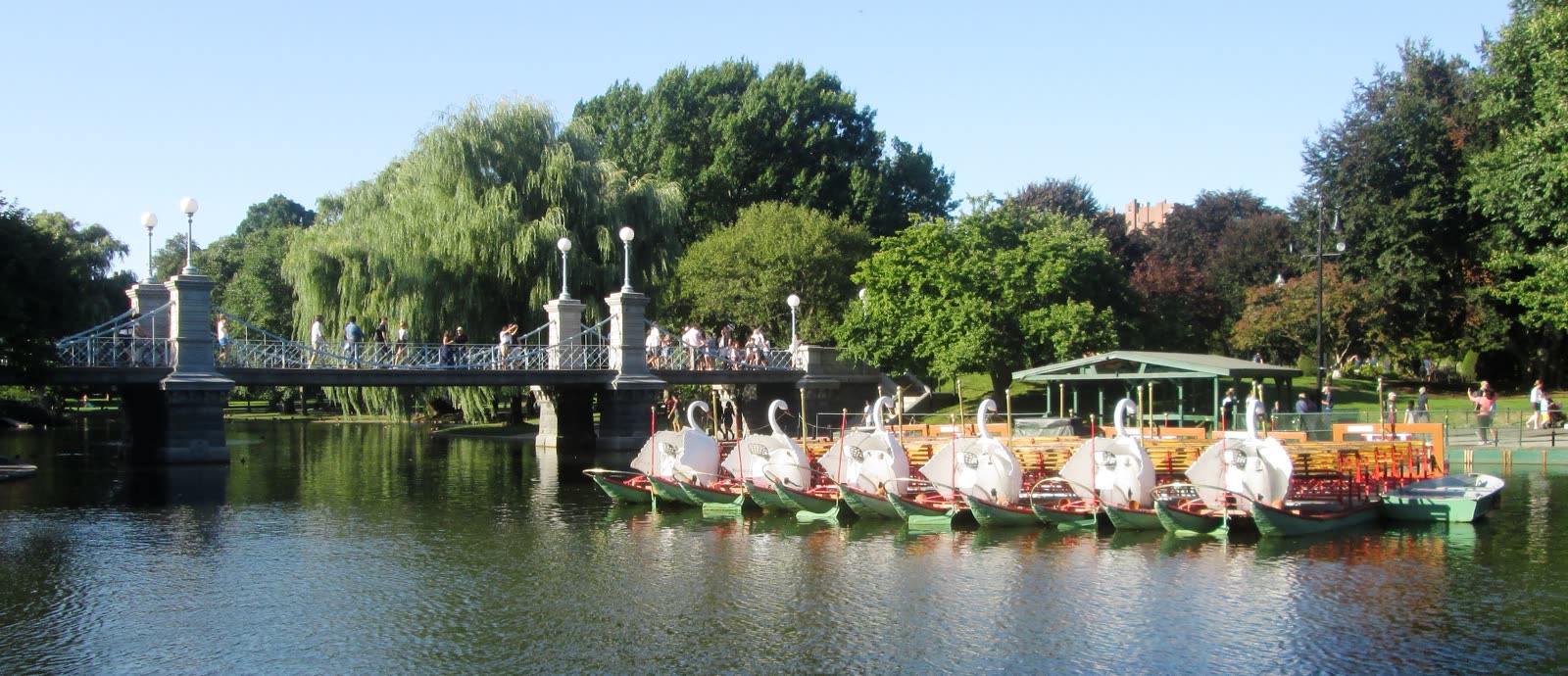
Boston has plenty of spring markers, but one of them changes behavior more than the rest. When the Swan Boats come back to the Public Garden, the city stops treating spring as a forecast and starts treating it as a room you can step into. The useful version is small and timed: enter from Arlington, walk the four minutes to the dock, take the short loop on a weekday or early shoulder, then use the footbridge and duckling-side paths after the ride instead of burning the whole visit in line.[1][2]
That advice works because the Swan Boats are not a generic paddle attraction dropped into a pretty park. The Public Garden was established in 1837 as the first public botanical garden in America, built for strolling rather than crosstown efficiency.[2] The boats have been family-owned and operated since 1877, and the current 2026 operating page still keeps the ritual modest: opening day was Saturday, April 18, 2026; spring hours run 10:00 a.m. to 4:00 p.m. through June 20; tickets are bought at the dock; and the ride lasts 10 to 15 minutes.[1][6]
That is why this is a true seasonal moment rather than a generic sightseeing stop. The Garden itself is a 24-acre Victorian landscape with a pond, curved paths, and the suspension footbridge already in place by 1880.[5] The Swan Boat season is short, weather-sensitive, and easy to miss if you assume Boston spring is equally usable at every hour and on every day.[1][4] What returns in April is not just a boat ride but a particular Boston mix of flower beds, family ritual, school-break traffic, and the slow public theater of people waiting their turn by the lagoon.[2][4]
The city-specific texture sits just outside the dock. Friends of the Public Garden's 2026 Duckling Day page notes that the annual Mother's Day parade retraces Mrs. Mallard's route to the Make Way for Ducklings sculpture in the Garden.[3] That matters because the strongest version of this outing is not only nautical or botanical. It is literary and civic too: a short ride on the lagoon, a pass under the bridge, then a loop that keeps the ducklings, benches, and Charles Street edge in the same small circuit.[2][3][8]
Image context: the cover uses a real documentary photograph from Wikimedia Commons showing a Swan Boat on the Public Garden lagoon with the footbridge behind it. That image fits the argument exactly because this seasonal moment depends on seeing transport, bridge, and spring foliage collapse into one recognizably Boston frame.[9]
Why this spring window is better than a random midday stop
The biggest visitor error is treating the Public Garden as if all spring visits were interchangeable. They are not. Officially, the boats operate only on a weather-permitting basis and do not run in rain, high winds, or extreme heat.[1] They also require 10 to 12 passengers to sit low enough in the water for the paddlewheel to work properly.[1] That means the best visit is one that accepts a little elasticity instead of trying to pin the dock to an inflexible minute.
The local crowd signal is even more important. In an October 2025 r/boston itinerary thread, a highly upvoted local warned that on a major Saturday the Common-side core becomes "wall to wall people" and specifically said visitors should avoid hitting the Swan Boats, Newbury Street, or the library in that crowd band.[7] That advice translates cleanly to spring. Saturdays, holiday weekends, and event weekends push the Garden toward performance. Weekdays and early shoulders keep it closer to what locals actually like about it: a short, photogenic civic pause in the middle of downtown.[1][7]
The geometry helps too. The Swan Boats site says Arlington Station on the Green Line is the closest stop, with a four-minute walk from Arlington and Boylston to the dock.[1] That makes the Arlington-side entrance the cleanest way in. You are not spending half the outing marching through the Common first, and you land directly in the decorative part of the landscape the Garden was designed to offer.[2][5]
8 local moves that make this moment work
- Use Arlington Station as the default approach. The official route from Arlington and Boylston to the dock is about four minutes, which is the cleanest way to arrive without wasting the best part of the Garden on access walking.[1]
- Treat late April through early June as the sweet spot, not the whole warm season equally. Through June 20, the boats still run on the tighter 10:00 a.m. to 4:00 p.m. spring schedule, and the seasonal mood is strongest while the beds, families, and school-break energy are still in spring mode.[1][4]
- Go on a weekday if you can. The Garden remains lively, but the local warning about Saturday crowd density is real enough that weekday mornings and the 3:00 to 4:00 p.m. shoulder are materially better.[1][7]
- Do not look for advance booking. Tickets are bought at the dock, no reservation is needed, and payment can be made by cash or card.[1]
- If the dock looks thin right at opening, give it a moment. The boat needs 10 to 12 passengers for safe operation, so the first departure is about people gathering, not about theatrical punctuality.[1]
- Cross the footbridge after the ride, not before. Reviews and local chatter both keep circling back to the bridge because it is the cleanest recognition point in the Garden and the best second-angle view once you have already seen the lagoon from water level.[6][8]
- Fold the ducklings into the same loop. The Mother's Day Duckling Day parade still ends at the sculpture in the Public Garden, which tells you the statue is not trivia appended to the park; it is part of the city's spring script.[3]
- If weather turns, downgrade gracefully instead of forcing the ride. The boats do not run in rain, high wind, or extreme heat, but the Garden still works as a walk, and Boston Common restrooms are nearby if you need a practical reset.[1][2]
Non-local trapline: 4 common mistakes and the better alternative
Mistake 1: planning Swan Boats for a Saturday as if the time slot were neutral
Better move: use a weekday or at least the first or last workable hour of the spring schedule. Local advice is explicit that big Saturdays near the Common can turn this area into a crush.[1][7]
Mistake 2: assuming there is an online reservation trick
Better move: walk straight to the dock and buy there. The operation is intentionally low-friction and low-tech; planning energy is better spent on timing the crowd band than on hunting for a booking link that does not exist.[1]
Mistake 3: taking the bridge first, then leaving after a few photos
Better move: ride first, bridge second. The lagoon reads better once you have already passed under the footbridge and come back onto land with the route in your body.[5][8]
Mistake 4: treating the Public Garden and Boston Common as the same park
Better move: keep the Garden as the decorative half of the visit and use the Common only for practical overflow, restrooms, or the next leg of your walk. The Public Garden is the botanical, lagoon-centered piece; that distinction shapes the outing.[1][2]
Concrete go details
- Best window: on ordinary spring weekdays, aim for 10:00 to 11:30 a.m. or 3:00 to 4:00 p.m. while the current spring hours still hold through June 20, 2026.[1]
- Expected spend: $4.75 per adult, $4.25 for seniors, $3.25 for children 2-15, and free for children under 2; a walk-only version costs nothing.[1]
- Queue / reservation reality: no advance reservation, ticket purchase at the dock only, 10-15 minute ride length, and Saturday/event-day crowding is the main variable rather than ticket scarcity.[1][7]
- Where to stand: board first, then take your longer pause on or just after the footbridge, where the lagoon, boats, and spring beds sit in one field of view.[5][8]
- Navigation cue:
Arlington Station -> Arlington/Boylston entrance -> 4-minute walk to Swan Boat dock -> ride loop -> footbridge -> ducklings side of the Garden -> Charles Street edge.[1][3] - Numeric anchors worth keeping: 1837, 1877, 1880, 24 acres, April 18, June 20, September 7, 10:00 a.m.-4:00 p.m., 10-15 minutes, 10-12 passengers, 4-minute walk, $4.75 / $4.25 / $3.25.[1][2][5][6]
Boston has grander spring outings and longer ones. This one wins because it is so concentrated. A lagoon, a boat, a bridge, a duckling detour, and a schedule narrow enough to make the whole city feel briefly more precise.
Sources
- Swan Boats, "Plan Your Visit" (official 2026 operating page covering opening day on April 18, 2026, spring hours through June 20, ticket prices, dock-only purchase, weather limits, 10-15 minute ride time, 10-12 passenger minimum, and the four-minute walk from Arlington Station).
- Boston.gov, "Public Garden" (official city page covering the Public Garden's 1837 founding as America's first public botanical garden, its strolling design, and the Swan Boats as a longstanding family-run feature).
- Friends of the Public Garden, "Duckling Day" (official 2026 event page noting the annual Mother's Day parade from Boston Common to the Make Way for Ducklings sculpture in the Public Garden).
- Boston.com, "Where do the Swan Boats go in the winter?" (January 28, 2026 local feature covering the spring assembly cycle and confirming the 2026 return date).
- U.S. National Park Service, "Boston Public Garden" (official historical overview covering the 24-acre garden, the 1880 footbridge-and-pond layout, and the larger Victorian landscape design).
- WBUR, "Nearly 150 years later, the Public Garden swan boats are still a family business" (April 25, 2025 local reporting on the Paget family's operation, 1877 origin, and current spring schedule and fares).
- Reddit / r/boston, "Surprise trip recommendations" (October 2025 local/community thread with explicit advice to avoid Swan Boats and the Public Garden core on a major Saturday because the area becomes wall-to-wall crowded).
- Yelp, "Boston Public Garden" (recent review/community page surfacing recurring visitor patterns around the footbridge as the main photo stop, the ducklings as part of the Garden loop, and the park's spring crowding and bench-heavy strolling rhythm).
- Wikimedia Commons, "File:2017 Boston Public Garden Lagoon Bridge and Swan Boats.jpg" (documentary cover photograph source).