Bologna is easy to flatten into lunch, towers, and a few well-behaved porticoes between them. The city gets sharper once you give one outing to the covered climb that locals still actually use. The strongest version is not the full symbolic march from Piazza Maggiore and not the lazy tourist-train substitution either. Start at the Arco del Meloncello, take the hilly half of the portico on foot, and let San Luca arrive gradually instead of all at once.[1][2][3]
That starting point matters because Meloncello is the hinge where the route changes character. Bologna Welcome's current San Luca guide says the classic route from the centre runs under a 3.5-kilometre portico marked by 666 arches, and that at a certain point the portico crosses the road in the large Arco del Meloncello.[1] Its UNESCO-section article makes the geometry even clearer: Meloncello is the exact mid-point where the portico stops behaving like the long plain of Via Saragozza and begins its slow hill climb toward the sanctuary on Colle della Guardia.[2] If you begin here, you keep the sequence that matters most and cut the low-yield city preamble.
The city-specific texture sits inside the porticoes themselves. Italia.it notes that Bologna has 62 kilometres of porticoes overall, 42 kilometres of them in the historic centre, because medieval expansion turned covered edges into the city's basic social architecture.[4] San Luca is the grandest version of that logic. It is a devotional path, a weather system, a training route, a family walk, and a public room stretched uphill for nearly 4 kilometres.[2][4]
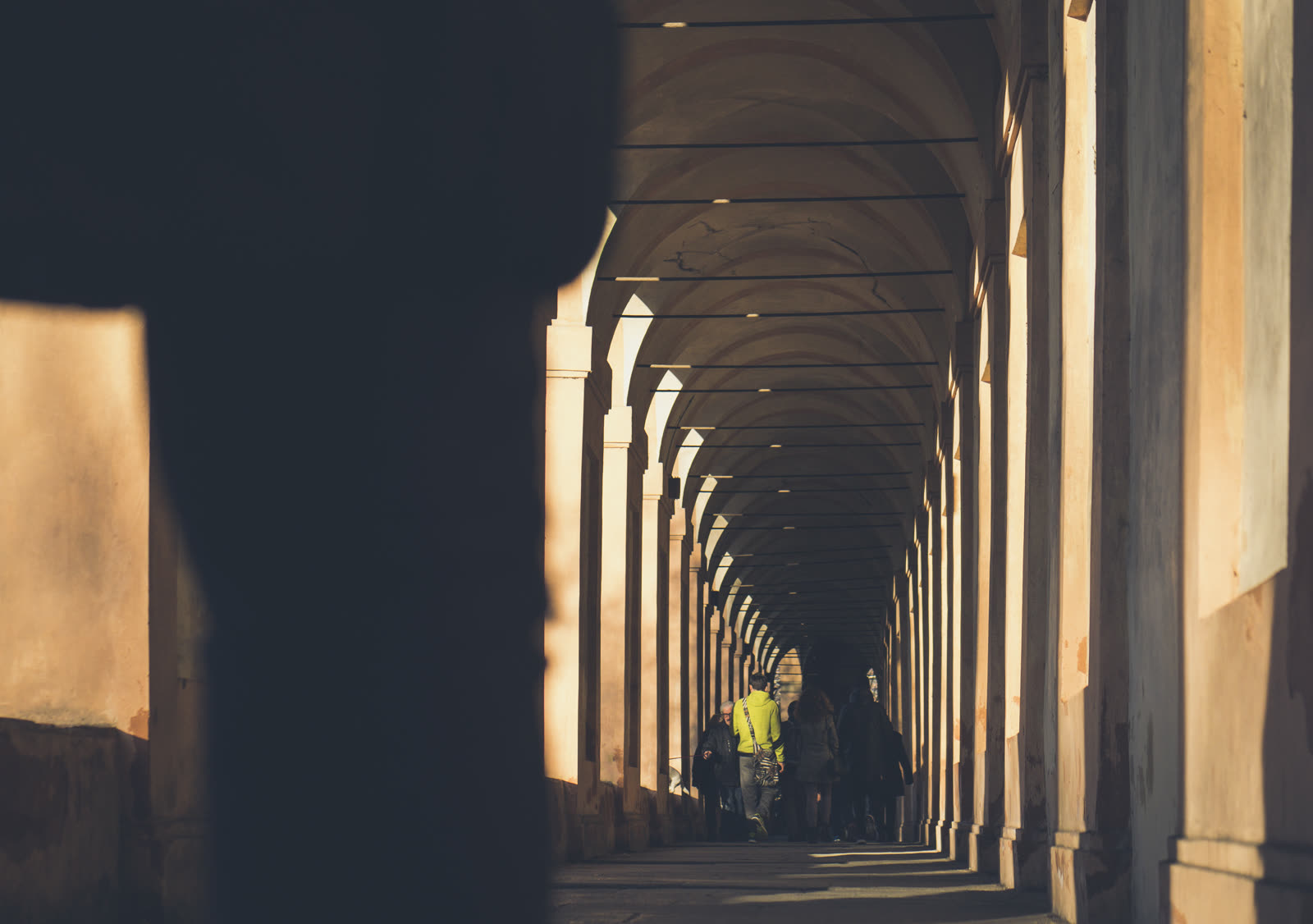
Image context: the cover uses a real documentary photograph of the Arco del Meloncello carrying the portico over the road. That is the right visual cue for this article because the whole argument depends on one exact shift in terrain: flat city arcades below, hill ascent above, and the bend where Bologna turns from stroll to climb.[8]
Why the Meloncello start is the useful correction
Most first-timers either underdo San Luca or overdo it. They either look at the sanctuary from afar and keep eating in the centre, or they march the entire route from deep in town at the wrong hour and spend the whole climb budgeting their legs. The cleaner correction is to treat Meloncello as the real threshold.
Source [1] gives the official version: from Porta Saragozza you follow the portico until the great arch crosses the road, and from there begins the uphill stretch toward the sanctuary, punctuated by 15 chapels of the Rosary.[1] Source [5] gives the local walking version: from Meloncello to the sanctuary, the hill segment is about 2.276 kilometres, made up of 350 arches, and community replies describe it as roughly 30 to 45 minutes at an ordinary pace, with about 200 metres of elevation gain if you are counting the effort honestly.[5] That is the exact scale this route wants. It is long enough to feel earned, short enough to remain an urban outing rather than a small expedition.
Meloncello also sharpens the visual logic. Bologna Welcome dates the arch to the early eighteenth century and describes it as the point where the portico leaves the plain and starts winding through the hills.[2] You feel that transition immediately. The road noise is still there, but the cadence changes. The arches tighten the frame. The city begins to fall behind you in measured increments instead of disappearing in one heroic reveal.
Why late afternoon works better than a noon slog
San Luca is a route with two clocks: the bodily clock of the climb and the institutional clock of the sanctuary. Bologna Welcome's sanctuary page says the church runs 7:00 a.m. to 7:00 p.m. every day, closing 30 minutes later from March to October, while the panoramic terrace stays available only until 15 minutes before closing.[3] That schedule is the practical reason to do this in the late-afternoon shoulder. You want enough time to climb without haste, enough light to read the ochre rhythm of the arches, and enough daylight left for the terrace to feel like a culmination instead of a rushed ticket check.
The local-use pattern supports the same timing. Bologna Welcome's UNESCO piece says walkers, runners, and cyclists use the route every day, while weekends fill with families and mixed-age groups heading for the sanctuary or the hills beyond.[2] The March 2025 Reddit thread is even more concrete: one local comment says Sunday can be crowded enough to irritate people who want quiet, while another suggests the climb from Meloncello is entirely manageable if you keep a human pace.[5] This is why weekday late afternoon is the sweet spot. The route still feels lived in, but it is less likely to turn into a social bottleneck.
At the top, the sanctuary page gives the reward its proper dimensions. The terrace opened in 2017, stands 42 metres above the hill at 300 metres above sea level, and offers a 180-degree view from the hills back across Bologna toward Casalecchio di Reno.[3] You do not need to rush that payoff. In fact, the whole point of starting at Meloncello is to delay it until the portico has already done its work on your sense of scale.
8 local moves that make this Bologna route land properly
- Start at Arco del Meloncello, not at Piazza Maggiore. The symbolic full-city version is fine for pilgrims and completionists; the better everyday version keeps the part of the route where the climb actually begins.[1][2][5]
- Treat the arches as the outing, not as covered transfer space. Bologna's porticoes are the city's social infrastructure, and San Luca is the largest expression of that habit.[2][4]
- Use weekday late afternoon if you can. Weekends remain social and lively, but local comments point to noticeably heavier Sunday foot traffic.[2][5]
- Budget about 30 to 45 minutes from Meloncello to the top. That is enough for a steady pace without turning the climb into a race.[5]
- Keep enough margin for the terrace cutoff. Access ends 15 minutes before sanctuary closing, and from March to October the church closes 30 minutes later than the base daily schedule.[3]
- Carry water and wear shoes you actually want on steps. The local guide at Bologna da Vedere notes roughly 489 steps on the route and treats comfortable shoes as basic equipment rather than optional wisdom.[6]
- If weather or energy collapses, remember the bus fallback. Bologna Welcome says bus 20 gets you to Villa Spada and bus 58 continues up to the sanctuary, with the same validated ticket covering the whole connection.[1]
- Go a little beyond the sanctuary after you arrive. One local Reddit reply recommends passing the gates and continuing to the road/parking side so you can look back and take in the whole sanctuary on the hill, not only the terrace view outward.[5]
Non-local trapline: 4 common mistakes and the cleaner alternative
Mistake 1: beginning too deep in the centre and spending your energy before the route becomes distinctive
Cleaner alternative: enter at Meloncello. You still get the hill sequence, the chapels, the sanctuary, and the view, but you remove the flatter prelude that adds symbolism more than insight.[1][2][5]
Mistake 2: riding the tourist train up and then wondering why San Luca felt thin
Cleaner alternative: walk at least the Meloncello-to-sanctuary segment. Even locals on Reddit describe the route as unusually meaningful for Bologna, not just as a sightseeing task.[5][7]
Mistake 3: choosing Sunday midday and expecting solitude
Cleaner alternative: lean toward weekday late afternoon, when the portico still feels socially alive but less compressed by weekend family traffic and fitness use.[2][5]
Mistake 4: reaching the top just as the terrace window closes
Cleaner alternative: reverse-plan from the sanctuary clock. The terrace stops admitting visitors 15 minutes before closing, and the church keeps a distinct seasonal extension from March to October.[3]
Concrete go details
- Best window: on a weekday, reach Meloncello around 4:45-5:15 p.m. in warmer months, climb in the late-afternoon shoulder, and leave enough time for terrace entry before the 15-minute cutoff.[3][5]
- Expected spend: EUR0 if you do the route on foot and skip the paid Sky Experience; the sanctuary itself is free, and the bus fallback only matters if you decide to use 20 and 58.[1][3]
- Queue / reservation reality: no reservation for the walk or the sanctuary; the variable is crowd density, especially on weekends, not ticket scarcity.[2][3][5]
- Where to stand: take only a brief pause at Meloncello, save the long stop for the terrace, then walk slightly beyond the sanctuary for the backward look at the whole complex on its hill.[3][5]
- Navigation cue:
Porta Saragozza -> Arco del Meloncello -> uphill portico -> Sanctuary of San Luca -> terrace -> short continuation beyond the gates for the backward facade view.[1][2][5] - Numeric anchors worth keeping: 62 km, 42 km, 3.5 km, almost 4 km, 666 arches, 15 chapels, 300 m asl, 42 m, 180°, 2.276 km, 350 arches, 30-45 minutes, 200 m, 489 steps, 15 minutes.[1][2][3][4][5][6]
Bologna has grander symbols than this and easier pleasures than this. It has fewer routes that explain the city so compactly. One arch over the road, one long ochre climb, one terrace earned at the end: that is enough.
Sources
- Bologna Welcome, "The paths to San Luca" (updated 1 October 2025; official route guide covering the 3.5-kilometre/666-arch classic walk, the Meloncello crossing, and the 20-to-58 public-transport fallback with the same validated ticket).
- Bologna Welcome, "In the shade of the porticoes - 6th section: San Luca" (updated 16 January 2025; official local piece on the portico's daily life, 4-kilometre length, 300-metre hill setting, and Meloncello as the route's turning point).
- Bologna Welcome, "Sanctuary of San Luca" (official sanctuary page with 2017 terrace opening, 42-metre terrace height, 180-degree view, 7:00 a.m.-7:00 p.m. timetable, the March-October half-hour extension, and the 15-minute terrace cutoff).
- Italia.it, "The Porticoes of Bologna: a stroll through history" (official national-tourism page covering the city's 62 kilometres of porticoes, 42 kilometres in the historic centre, and the 3,796-metre San Luca portico within the broader urban system).
- Reddit / r/bologna, "Salita per San Luca" (March 31, 2025 local/community thread covering the Meloncello-to-sanctuary distance, 350 arches, 30-45 minute timing, about 200 metres of elevation gain, Sunday crowding, and the suggestion to continue beyond the sanctuary for the backward view).
- Bologna da vedere, "The Walk to the Sanctuary of San Luca, Bologna" (recent local guide covering the route's near-4-kilometre scale, 489 steps, free access, and the practical need for water and proper shoes).
- Reddit / r/bologna, "3 nights in Bologna - my experience" (July 30, 2025 community thread where a local notes that the San Luca walk is not merely a standard tourist move, even for people from Bologna).
- Wikimedia Commons, "File:Arco Del Meloncello, Bologna, Italy (Unsplash).jpg" (documentary cover photograph source).