At Warsaw’s Old Powązki cemetery, early November brings two small objects into the same landscape: the grave lantern and the collection tin. The first lights a place of remembrance. The second helps repair it. The annual kwesta, a public appeal for the cemetery’s historic monuments, has brought volunteers among the graves since 1975.[1]
That gives a visit a purpose beyond waiting for the candles to glow. Come while you can still read the stone, leave time for the changing light, and bring a little cash if you would like to help preserve what you see. This year, All Saints’ Day falls on Sunday, 1 November 2026, followed by All Souls’ Day on Monday. A parish announcement published on 25 October confirms the launch of this year’s collection.[2][3]
Begin at the gate that remembers a person
Put Stare Powązki, Powązkowska 14 into your journey planner. The Military Cemetery, also called Powązki, is a separate destination at 43/45 on the same street. WarsawInfo24’s local holiday guide explicitly warns against confusing them. For this walk, choose the old cemetery and Gate II, the Gate of Saint Honorata, as your meeting point.[3][4]
The gate is worth a pause before you enter. A local specialist guide identifies the large warrior on one side and the funerary wreath on the other; an inscription inside records Mieczysław Landsberg’s gift in memory of his wife Honorata in 1915.[4] A piece of private grief became an entrance used by strangers. It is a fitting introduction to a place where care repeatedly passes beyond the immediate family.
Use public transport and check the holiday service for your actual travel date. The local guide warns that routes and street access change around the cemeteries; an ordinary weekday itinerary is a poor basis for this Sunday.[3] Set your destination before leaving, then check the return journey too. The useful certainty is the gate you want, rather than a bus number copied from a previous November.
For an adult paying full fare, the city currently lists a 75-minute Zone 1 ticket at PLN4.40 and a 24-hour Zone 1 ticket at PLN15. Two separate 75-minute journeys cost PLN8.80 if each fits that allowance. Validate a paper ticket on boarding, or before entering the metro platform.[8] With free cemetery entry reported by visitors, budget PLN8.80–15 for transport, plus any voluntary donation; PLN10–20 in cash is a suggested personal allowance, not an admission charge or required contribution.[6]
Give the afternoon a small boundary
For this visit, I would aim for 15:00–16:30 on 1 November: a suggested 90-minute window that begins with readable inscriptions and carries into the early evening. Warsaw Insider’s account of the holiday describes families gathering at dusk with flowers and lanterns.[9] The attraction is that gradual change, so leave enough unhurried daylight at the beginning.
Keep the walk compact. Warsaw-born writer Jacek Wojciechowski recommends letting the monuments and names draw your attention rather than trying to exhaust a list of famous graves. His account makes a persuasive case for an incomplete visit: hurried recognition leaves little room to notice the carving.[5] From the Honorata gate, follow an open path into the older burial grounds and choose a few monuments that hold your attention. Step to the side when you stop so families can reach the graves they have come to tend.
If one particular grave matters to you, reverse that approach: use the cemetery’s official search before setting out and save the section, row and plot. The grounds cover 43 hectares.[7] A name alone can turn a reflective hour into a search, especially as the light fades.
Two visitor reports collected from Google on Wanderlog sharpen the practical boundaries. One describes spending more than two hours exploring; another reports being caught inside after closing and waiting for a caretaker to open Gate IV.[6] Allowing yourself a smaller circuit and confirming the exit time on arrival addresses both problems. An ordinary independent walk needs no tour booking; crowding on the paths and at stops is the uncertainty, and the sources provide no dependable holiday queue estimate.[3][7]
The operator publishes 07:00–18:00 in winter, compared with a later summer closure.[7] Use 18:00 as the planning limit unless staff or a current notice explicitly confirms otherwise. The 20:00 hours displayed by a review platform are not a reliable promise for this November visit.[6] Keep your entrance marked on your phone and begin returning while the route still looks familiar.
The tin beside the monument
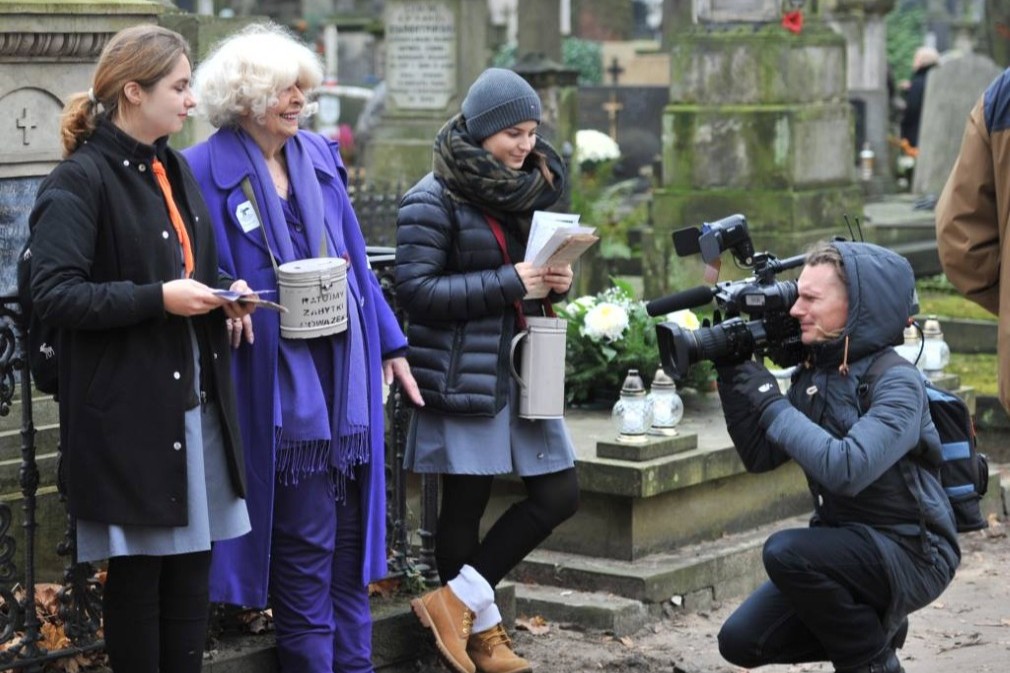
The collection has its own recognizable material culture. Poland’s National Institute of Cultural Heritage describes sealed tins, white volunteer armbands and banners bearing the appeal Ratujmy zabytki Powązek — “Let us save Powązki’s monuments.” The tins have traditionally been aluminium military mess tins, an idea credited to the campaign’s founder, music critic Jerzy Waldorff. The appeal supports conservation of historic tombs.[1]
Look for those marked collectors while you walk. If you donate, step out of the moving stream first. There is no need to turn the encounter into a photograph: the useful gesture takes only a moment. The institute describes a tradition sustained by repeat encounters between volunteers and visitors.[1]
Then look again at one monument. Follow a carved fold, an inscription or the edge of a stone wreath. Consider the work required to keep that detail legible through another winter. The gate’s dedication has already shown how remembrance can become something publicly useful; the collection offers a modest way for a visitor to join that work.
By the time you turn back, the lanterns may command more attention than the inscriptions. Leave with both in mind: the light someone has brought for today, and the stone that other people are helping to carry into next year.
Visitor information checked 27 October 2026. The published sources confirm the 2026 appeal but do not establish individual collectors’ shifts or holiday extensions to cemetery opening hours.
Sources
- National Institute of Cultural Heritage, “Niematerialny pomnik pamięci — Tradycja kwestowania na Cmentarzu Stare Powązki w Warszawie,” 31 October 2025 — collection history, volunteer practices and photograph credited to Tomasz Rogala.
- Parafia Wszystkich Świętych, “Koncert z okazji Kwesty na Starych Powązkach,” 25 October 2026 — current community announcement confirming the launch of the 2026 appeal.
- WarszawaInfo24, “Wszystkich Świętych 2026 w Warszawie. Cmentarze i dojazd,” 17 October 2026 — local holiday guide distinguishing the cemeteries and explaining date-specific travel planning.
- Zwiedzanie Powązek, “Brama św. Honoraty” — local specialist guide to Gate II, its sculpture and memorial inscription.
- Jacek Wojciechowski, “Spacer po Powązkach,” ZażyjKULTURY, 27 August 2019 — a Warsaw resident’s account of exploring slowly; historical opening hours are not used here.
- Wanderlog, “Powązki Cemetery” — Google visitor reviews reporting free entry, the scale of the grounds and a July 2025 experience of being caught after closure; individual experiences, not official hours.
- Stare Powązki, official cemetery website — self-guided visits, grave search, 43-hectare grounds and seasonal gate hours; checked 27 October 2026.
- City of Warsaw, Warszawa 19115, “Bilety krótkookresowe w komunikacji miejskiej” — official short-term fares and ticket-validation instructions; checked 27 October 2026.
- Warsaw Insider, “A Night of a Thousand Lights,” 31 October 2025 — local account of dusk visits and candlelight during All Saints’ and All Souls’ days.