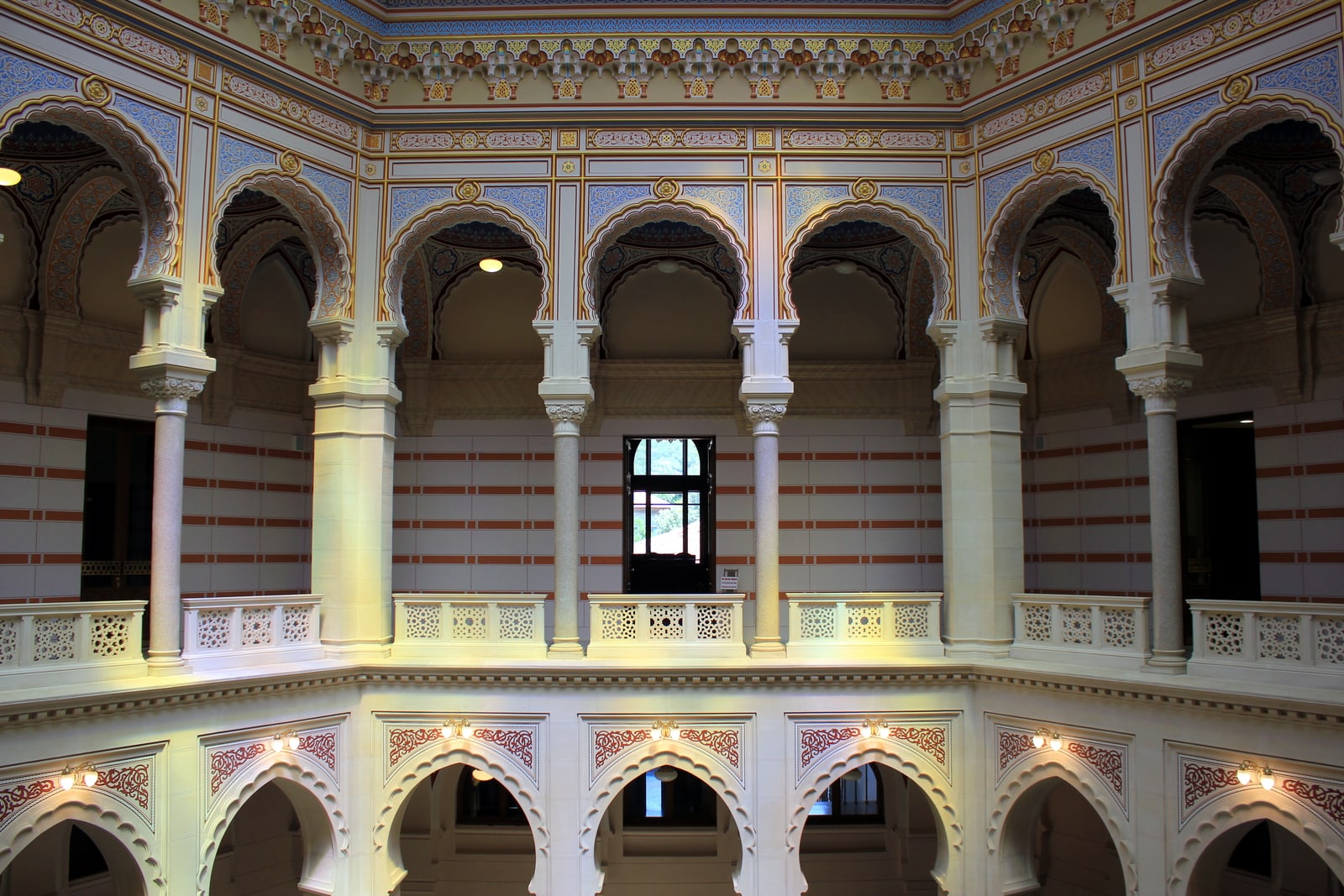
At Sarajevo’s Vijećnica, the eye has plenty of reasons to travel upwards. Arches frame more arches; bands of colour draw the gaze around the galleries. But save some attention for the objects near floor level. The building’s permanent display includes original architectural fragments recovered during reconstruction, arranged in six display cubes in the atrium.[1] They offer a useful place to begin: with a piece small enough to examine before taking in the room that surrounds it.
The City Hall opened in 1896, later housed the National and University Library, and was devastated by incendiary shelling on the night of 25–26 August 1992. Reconstruction extended from 1996 to its reopening on 9 May 2014.[2] The splendour visible today carries that interruption. An hour here becomes much more absorbing when you give both the rebuilt space and the surviving material time to speak.
Arrive with an hour to spare
The striped building stands beside the Miljacka at the eastern edge of the old town. Tours.ba’s local guide suggests the short riverside approach from Baščaršija, allowing roughly five minutes. Use Brodac 1 as the map destination: that is the operator’s published address.[4][5]
I would aim for 09:00–10:00 on a weekday, following the local guide’s preference for morning light and quieter halls. This is a suggested window, not a guarantee of solitude. Its 45–60-minute visit allowance is a sensible starting point.[4] Give yourself longer if you enjoy reading exhibition panels.
The operator currently lists 09:00–17:00 daily, with an explicit exception during events. Check that notice before setting out; if the interior is the purpose of your trip, call +387 33 292 800 to confirm access.[5] A published closing time alone does not establish which rooms will be available that afternoon. City Council sessions, ceremonies and cultural events remain part of the building’s use.[2]
Sarajevo Navigator’s current listing puts standard admission at KM10, with KM5 tickets for children, students, pensioners and visitors with disabilities.[6] That gives an admission budget of KM5–10 per person, depending on eligibility; transport and refreshments are separate. Buy at the desk for an ordinary visit.[4] The sources describe walk-in ticketing but provide no dependable queue-time estimate, so leave breathing room before another reservation.
One small economy comes from the city’s own community discussion. A contributor on r/sarajevo points first-time visitors towards the combined cable-car and City Hall ticket.[7] If a cable-car ride is already in your plans, check that option before buying separate admission here. The operator’s 3 September 2026 notice confirms a same-day combination, sold at the cable-car ticket offices, for KM35 for non-residents or KM12 for residents of Bosnia and Herzegovina, through 31 December 2026.[8] Buying at the wrong desk or assuming the ticket carries over to tomorrow defeats the convenience. Keep the hour at City Hall intact when arranging the two visits.
Let a fragment interrupt the view
If a group occupies the atrium, Tours.ba suggests beginning on an open upper gallery and returning downstairs afterwards. It also advises checking the posted photography rules, since exhibitions can differ.[4] Those two adjustments are more useful than waiting in the circulation route for an empty photograph.
Back at floor level, look for the cubes containing pieces of the original walls, columns and interior. The operator identifies them as material saved during the 1996–2014 reconstruction.[1] Choose one fragment and examine its edges. Then look towards the surrounding architecture. The change in scale gives the visit a rhythm: a whole room, a surviving piece, the room again.
Architect Lejla Odobašić Novo offers a valuable caution in her study of Vijećnica. She argues that reducing the building to a single emblem of resilience obscures its changing purposes and the political meanings imposed on it.[9] Consider that interpretation while standing here. The building has served administrators, readers and present-day civic gatherings. Each use asks something different of the same grand interior.
For a visitor, her argument suggests a question worth carrying between displays: which part of the building’s life does this room make easiest to imagine? The restored decoration draws attention immediately. The history of people using the space takes more deliberate looking.
Go downstairs before going back to the river
Ask staff for the basement history exhibition. Its eight thematic sections use local-language and English text. The operator describes a sequence covering the building’s history, destruction and reconstruction, including photographs by Milomir Kovačević Strašni. In the section about the fire, authentic burned books and debris appear within a deliberately constructed ruin setting.[1] That distinction matters: the objects and the exhibition scenery have different histories.
Read this part slowly. Restoring architectural form could not reverse the loss of the library collection.[2] Returning to the atrium afterwards allows its brightness to register differently. The pleasure of the room survives the encounter with its history, but it becomes less effortless.
For the exterior photograph, the local guide recommends the south bank, using a signalled crossing and keeping out of the roadway.[4] From there, you can take in the façade as a whole. You will also have a smaller image to carry away: a fragment encountered inside, with enough time to notice that its broken edge belongs to the building too.
Visitor information checked 25 October 2026. Event access and temporary exhibitions can change; the operator’s notice takes precedence.
Sources
- JP Sarajevo, “Stalna postavka” — official account of the original fragments and bilingual basement exhibition; checked 25 October 2026.
- City of Sarajevo, “Vijećnica”, 8 October 2019 — municipal history of the building, library, destruction, reconstruction and civic uses.
- Julian Nyča, “Sarajevo Vijećnica Interior 1.JPG”, 1 August 2015, Wikimedia Commons — original photograph and attribution.
- Tours.ba, “A visitor’s guide to Vijećnica (Sarajevo City Hall)” — local visitor guidance on approach, timing, ticket desk, galleries, photography and riverbank viewpoint; checked 25 October 2026.
- JP Sarajevo, Vijećnica official website — daily hours, event exception, Brodac address and contact telephone; checked 25 October 2026.
- Sarajevo Navigator, “Muzej Vijećnica” — local directory’s current admission categories and prices; checked 25 October 2026.
- r/sarajevo, “prvi put u sarajevu” — local community discussion recommending the combined ticket; individual advice, corroborated with the operator.
- JP Sarajevo, “Promotivna ponuda”, 3 September 2026 — official combination-ticket prices, purchase location, same-day validity and December end date.
- Lejla Odobašić Novo, “Architectural Irony and the Sarajevo City Hall”, AR, 2024 — architectural interpretation of the building’s changing uses, reconstruction and contested meanings.